Advance one bounded product, process, scale, campaign, lifecycle or change option only after quality, safety, equipment, resource, economic, environmental and evidence limits remain explicit.
Independent hypothetical company study · food and ingredients
CargillFive process decisions
Choose one use case. Add authorised plant data. Test capacity, cost and constraints.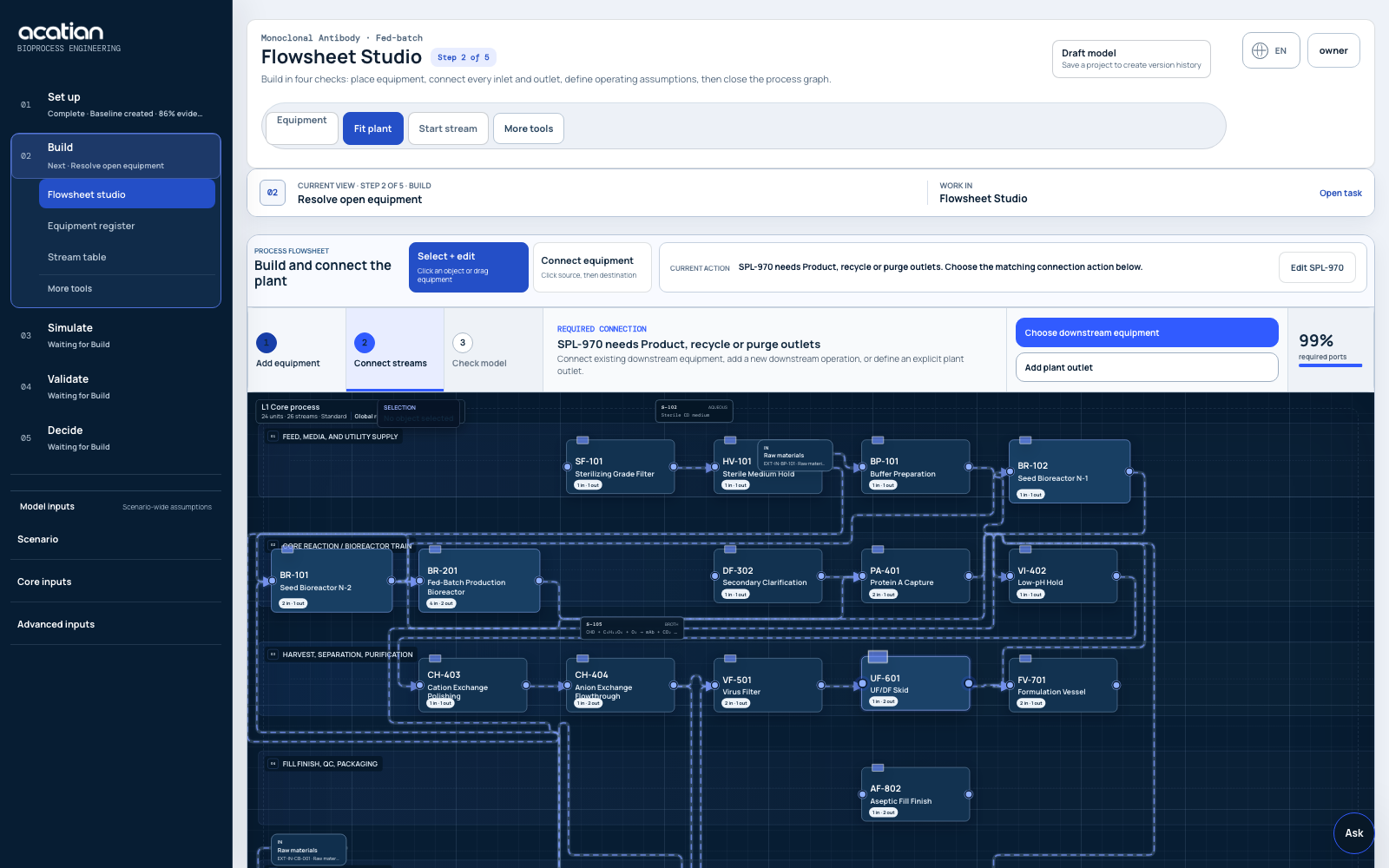
Decision brief
One question. One model.
One authorised food or ingredient product and one declared process or change boundary, including recipe inputs, unit operations, equipment, cleaning, utilities, packaging, quality holds, waste and relevant supply handoffs.
Five practical use cases
Five places to start.
Evaluation scopes for Cargill—not claims of current software use.Prioritise a product and process route
Compare authorised ingredient, formulation, dosing, mixing, homogenisation, thermal or shaping variants against the same product function, quality limits and uncertainty before selecting the next laboratory or pilot study.
Screen pilot-to-plant equipment fit
Translate approved pilot evidence into rheology, kinetics, transfer, residence-time, fouling and utility envelopes for a named target train while marking every open engineering, safety and scale-up test.
Schedule a multiproduct process line
Sequence authorised product families across preparation, processing, buffers, packaging, cleaning, maintenance, laboratory and labor resources without representing any actual Cargill line, occupancy or commitment.
Compare process and supply TEA/LCA scenarios
Evaluate raw-material, process, site or logistics options under one functional unit and disclosed boundary, separating yields, utilities, waste, transport, capital, operating cost and data-quality uncertainty.
Govern product and process change evidence
Link intended use, requirements, recipe and process versions, supplier evidence, tests, specifications, risks and acceptance criteria while keeping food-safety, quality, regulatory and formal change approvals separate.
Action pack
Inputs in. Decisions out.
- Authorised recipe, ingredient, specification and quality basis
- Laboratory, pilot, process, equipment and analytical evidence
- Orders, routings, resources, cleaning, hold and release rules
- Materials, utilities, logistics, waste, cost and lifecycle factors
- Product and process-route comparison
- Pilot-to-plant and equipment-fit evidence map
- Finite campaign schedule and accepted-output range
- TEA/LCA screen and change-readiness register
- Select one authorised product, process or change decision.
- Declare the legal entity, intended use and system boundary.
- Import approved recipe, pilot, equipment and operating evidence.
Evidence and limits
Public evidence only.
- Cargill — Credit and financial informationOfficial current legal and ownership context for Cargill, Incorporated as a privately held company.
- Cargill — Cargill at a GlanceOfficial current enterprise, portfolio and global operating context used to bound the study.
- Cargill — 2026 letter to stakeholdersOfficial current context for the three-enterprise and 14-business-group reorganisation.
- Cargill — Minnesota Innovation and R&D hubOfficial context for Cargill's own food, ingredient, pilot, process-development, scale-up and analytical capabilities.
- Cargill — Factory and Operations of the FutureOfficial context for Cargill's own automation, robotics, AI and predictive-analytics operations initiatives.
- Cargill — Reporting HubOfficial source for current sustainability reports, methods, policies and assurance material.
- Cargill — Food safety and quality requirementsOfficial context for formal supplier, food-safety, quality and regulatory evidence requirements.
Guardrail: This is an independent hypothetical study based only on public sources. Cargill is not represented as an Acatian customer, user, partner or endorser. No Cargill recipe, supplier, line, plant, schedule, cost, bottleneck, environmental result, system connection, private data or performance is represented. Acatian would not replace Cargill's R&D, pilot, nutrition, market, operations, quality, food-safety, regulatory or enterprise systems, and only authorised Cargill reviewers could make product, safety, engineering, sustainability or release decisions.