Engineering resources
Build a process model that can survive technical review.
Practical templates and focused guides for process development, MSAT, plant engineering, scheduling, TEA, and LCA teams. No registration is required for the downloads.
Security and reliability
Review platform controls.
User documentation
Learn Acatian step by step.
Acatian Benutzerhandbuch
Vollständige Anleitung für Projekte, Fließbilder, Simulationen, CFD, Scheduling, TEA/LCA, Daten, Versionen und Exporte.
PDF öffnenAcatian User Manual
Complete guidance for projects, flowsheets, simulation, CFD, scheduling, TEA/LCA, data, versions, and engineering exports.
Open PDFAcatian Quickstart
Ein kompakter Einstieg vom Login über das erste Modell bis zur technischen Prüfung und zum Download der Ergebnisse.
PDF öffnenAcatian Quickstart
A concise path from sign-in and first model setup to technical review and downloadable engineering results.
Open PDFModule manuals
Open the guide for the task in front of you.
Ten focused manuals follow the same controlled path: required inputs, ordered actions, visible results, review criteria, troubleshooting, and handover.Projects and model brief
Define scope, intended use, data ownership, review roles, and a protected baseline.
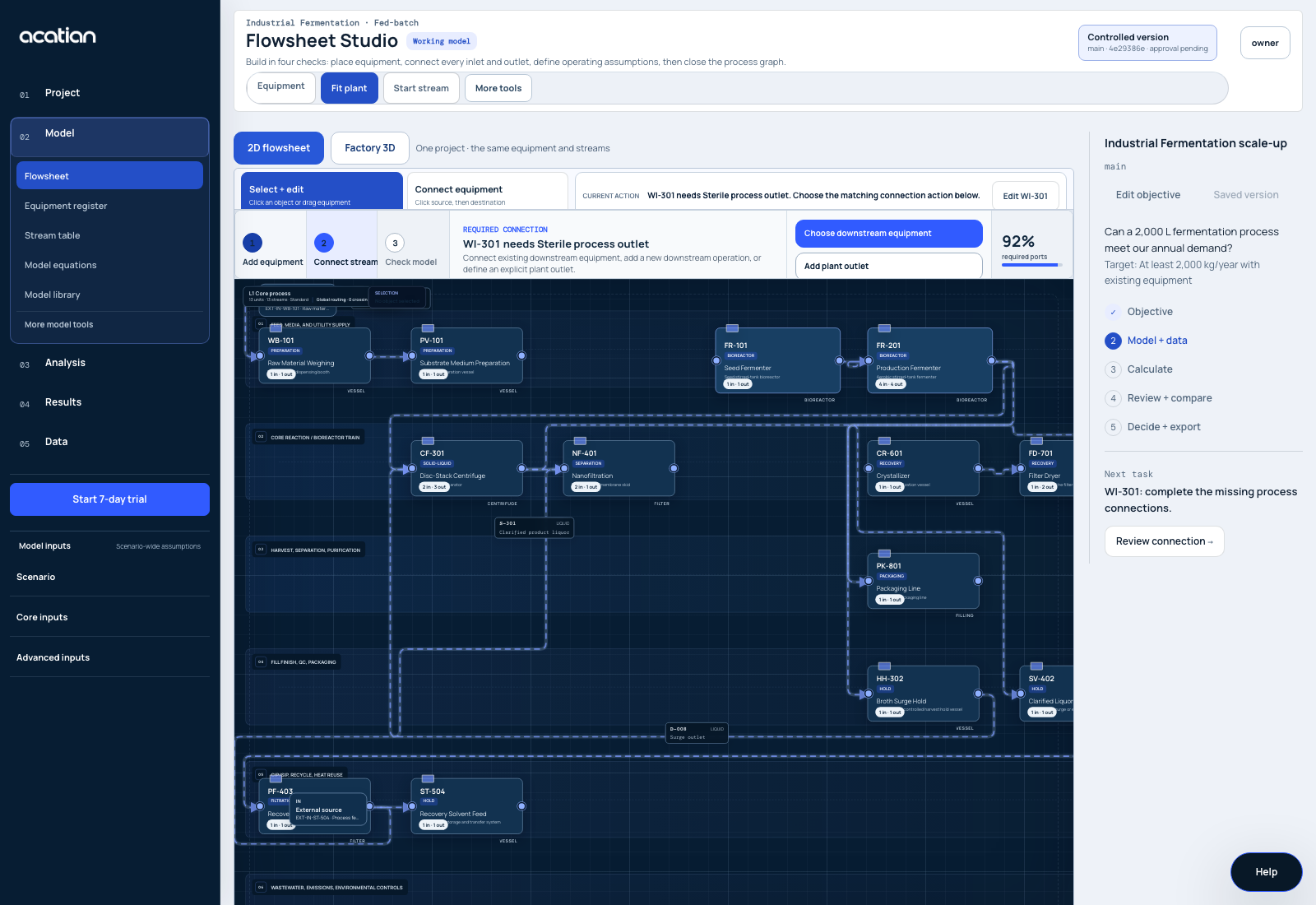
Flowsheet, equipment, streams, and equations
Create a complete process graph with explicit inlet, outlet, internal, utility, and waste streams.
Dynamic simulation and operating modes
Configure batch, fed-batch, perfusion, or continuous operation with ODE/PDE states and events.
Bioreactor CFD and transport analysis
Set geometry, physics, boundary conditions, field interpretation, and external validation boundaries.
Scheduling, resources, and factory twin
Plan batches, cleaning, equipment reuse, rooms, personnel, utilities, and finite-capacity campaigns.
Data ingestion and integrations
Register, map, review, apply, and roll back company data with provenance and permissions.
Boundaries, standards, and model validation
Test numerics, physics, comparison data, standards coverage, maturity, and approval readiness.
TEA, LCA, uncertainty, and sensitivity
Build a shared process basis for costs, environmental impact, intervals, and decision drivers.
Versions, branches, collaboration, and approval
Create alternatives, inspect before/after impact, request review, approve, and restore safely.
Reports, downloads, APIs, and handover
Generate complete, readable, reproducible engineering packages for every recipient.
Bioprocess model readiness checklist
Check the minimum evidence behind balances, kinetics, equipment sizing, cleaning, scheduling, utilities, TEA, LCA, controls, and model validation.
Download CSVProduction data request template
Structure historian tags, batch records, laboratory results, equipment data, material costs, utility meters, and source ownership before import.
Download CSVAcceptance criteria template
Define balance closure, schedule fidelity, equipment duty, sensitivity, economics, sustainability, traceability, and export requirements before a pilot starts.
Download CSVHigh-intent technical guides
Choose the engineering question you need to answer.
From flowsheet to dynamic operating envelope
Connect component balances, reactions, ODE/PDE kinetics, batch and perfusion modes, equipment duties, physical limits, and uncertainty in one reviewable model.
- Use for scale-up, route comparison, and process characterization.
- Validate against measured kinetics, mass closure, and an approved reference case.
Model the complete facility, not one isolated batch
Schedule shared reactors, chromatography skids, hold vessels, utilities, rooms, operators, CIP/SIP, maintenance, release, and campaign changeovers.
- Use for capacity planning, facility fit, and debottlenecking.
- Review occupancy, wait states, WIP, and achievable annual throughput.
Make the economic and environmental basis auditable
Trace media, buffers, consumables, labor, utilities, waste, equipment, facility, yield, titer, and utilization through intervals and sensitivity results.
- Use for investment, process selection, and sustainability review.
- Export long-form datasets for analysts instead of relying on dashboard totals.
Synchronize model state, plant data, and engineering evidence
Connect the process graph, dynamic states, batch and historian data, equipment states, schedules, uncertainty, versions, and model-readiness gates.
- Use for design, calibration, monitoring, and governed scenario review.
- Separate a design twin from an operational or closed-loop claim.
Turn reactor geometry and boundary conditions into a defensible case
Define multiphase physics, impeller and sparger zones, oxygen and nutrient transport, cell uptake, numerical evidence, and experimental validation.
- Use screening to expose scale-up risks and missing inputs.
- Use a qualified external solver for validated three-dimensional CFD.
Connect cell growth, media demand, factory capacity, and COGS
Compare fed-batch, perfusion, seed expansion, cell retention, harvest, scale-up, parallel trains, utilities, TEA, and LCA.
- Use for process architecture, scale strategy, and cost reduction.
- Validate kinetics, transfer limits, retention, quality, and supplier assumptions.
Technical library
Work from engineering fundamentals.
Each guide defines the calculation basis, evidence requirements, acceptance checks, and limits needed for a reviewable model.
Use-case library
Start from a real production decision.
Acatian Engineering Brief