Advance one formulation or process option only after functional requirements, manufacturability, scale risk, finite capacity, cost, lifecycle inventory and missing evidence remain explicit on the same scenario basis.
Independent company use-case study · ingredients and nutrition
dsm-firmenichFive process decisions
Choose one use case. Add authorised plant data. Test capacity, cost and constraints.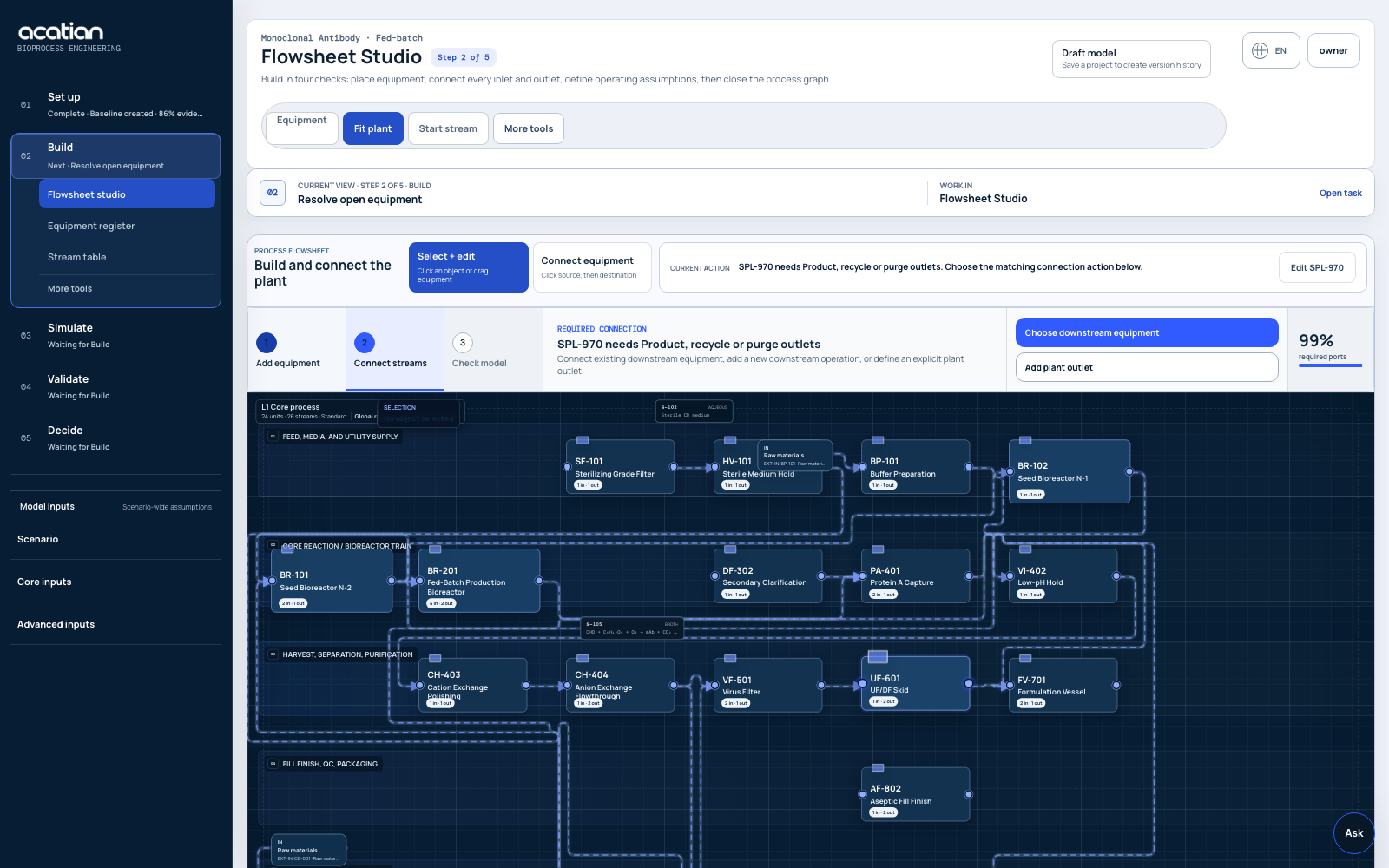
Decision brief
One question. One model.
Authorised ingredients through mixing, reaction or fermentation, separation, concentration, encapsulation or drying, packaging, cleaning, utilities, quality holds, waste and released product for one declared application.
Five practical use cases
Five places to start.
Evaluation scopes for dsm-firmenich—not claims of current software use.Compare formulations on a manufacturing basis
Carry an authorised food, nutrition or fragrance formulation beyond ingredient selection into mass yield, process time, equipment duty, accepted output, cost and declared quality constraints.
Build a pilot-to-production evidence path
Translate fermentation or encapsulation trials into explicit mixing, heat, mass-transfer, separation and drying limits, then identify the experiment needed before the next scale gate.
Schedule multi-product ingredient campaigns
Sequence eligible mixers, fermenters, separators, dryers, packaging lines, cleaning, laboratories and release holds for an authorised portfolio without representing a real dsm-firmenich plan.
Evaluate process options with TEA and LCA
Compare functionally equivalent alternatives across materials, yield, energy, water, packaging, waste, cost and lifecycle inventory while keeping the functional unit and system boundary visible.
Govern evidence for a regulated change
Link requirements, sources, assumptions, model versions, experiments, specifications, deviations and acceptance criteria while keeping Acatian checks separate from formal quality or regulatory approval.
Action pack
Inputs in. Decisions out.
- Formulation, functional target, specification and stability basis
- Kinetic, rheological, mixing, transfer and recovery evidence
- Equipment eligibility, cycle time, cleaning and release rules
- Material, utility, packaging, cost and lifecycle factors
- Formulation-to-process option comparison
- Scale-up and equipment-fit evidence map
- Finite campaign schedule and accepted-output range
- Cost, lifecycle inventory and change-evidence register
- Select one authorised formulation or process decision.
- Declare the functional, product and manufacturing boundary.
- Import formulation, experiment and equipment evidence.
Evidence and limits
Public evidence only.
- dsm-firmenich — Business unitsOfficial context for the three continuing business units and their portfolios.
- dsm-firmenich — Taste, Texture & HealthOfficial context for food and beverage ingredients, cultures, enzymes, texture, taste and nutrition solutions.
- dsm-firmenich — Perfumery & BeautyOfficial context for synthetic, natural and biotechnology-derived ingredients and portfolio lifecycle assessment.
- dsm-firmenich — Health, Nutrition & CareOfficial context for nutrition, pharmaceutical, medical-nutrition and biomedical-material applications plus development support.
Guardrail: No dsm-firmenich recipe, product claim, customer, plant, system, schedule, cost, environmental result or performance value is represented. Safety, sensory, efficacy, quality, regulatory, investment and release decisions remain within approved dsm-firmenich processes.