Select one laboratory workflow, upstream process concept, experiment plan or scale path only after sample integrity, biological response, equipment fit, finite resources, economics, environmental inventory and transfer evidence remain consistent.
Independent company use-case study · laboratory and bioprocess equipment
EppendorfFive process decisions
Choose one use case. Add authorised plant data. Test capacity, cost and constraints.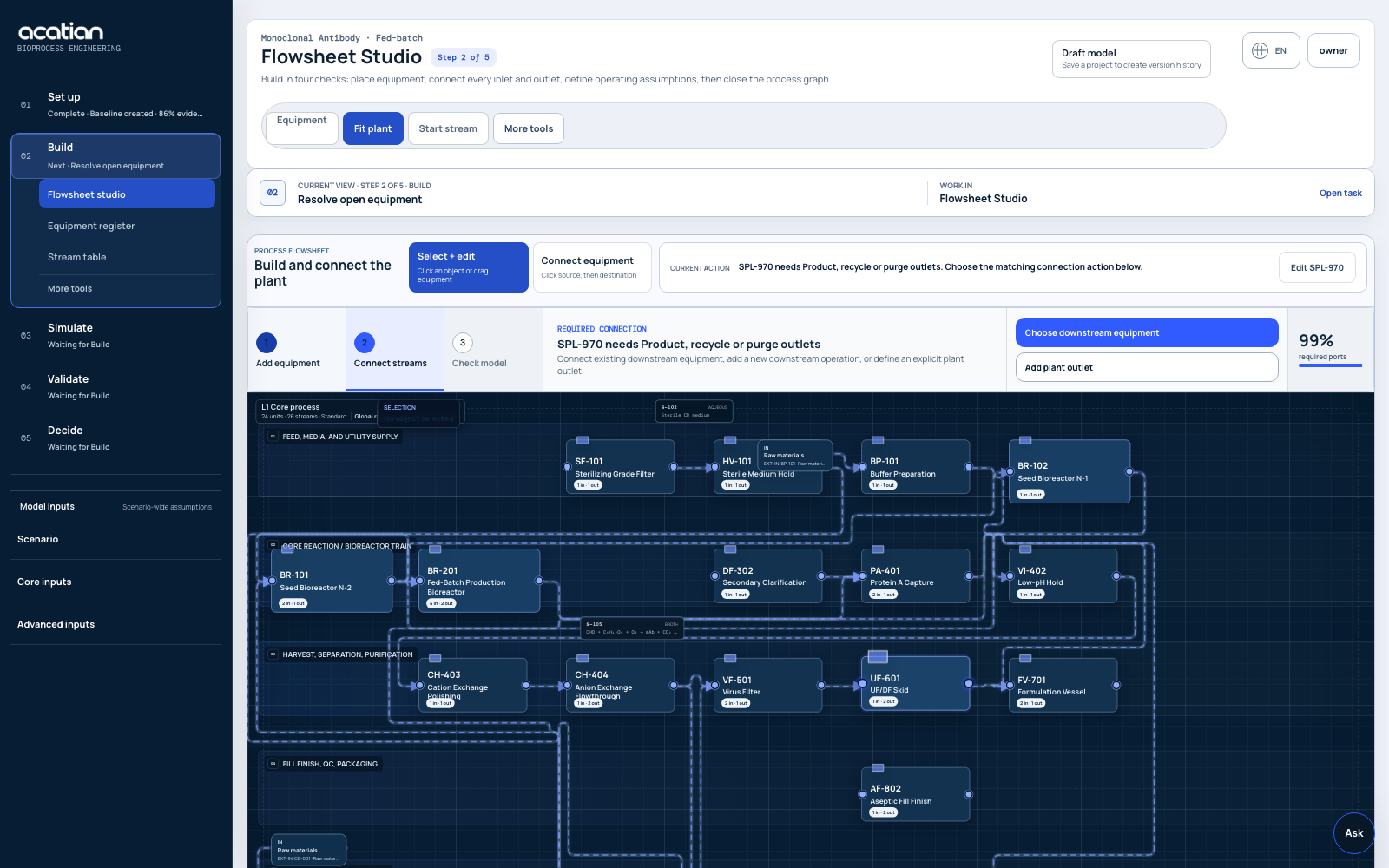
Decision brief
One question. One model.
One authorised liquid- or sample-handling workflow or one upstream process from inoculum or feed through the declared harvest handoff, including transfers, devices, media, gases, sampling, sensors, consumables, utilities, cleaning and holds.
Five practical use cases
Five places to start.
Evaluation scopes for Eppendorf—not claims of current software use.Compare liquid and sample-handling workflows
Connect pipetting or dispensing, mixing, incubation, centrifugation, detection and storage on one sample-integrity, transfer, time, device and uncertainty basis before selecting a methods study.
Screen bioreactor scale-up and equipment fit
Translate authorised small-scale evidence into mixing, gas-transfer, heat-removal, shear and feed envelopes, then test requirements against approved vessel, controller and facility limits.
Schedule parallel experiments and pilot campaigns
Sequence eligible bioreactors, analyzers, autosamplers, media preparation, cleaning, labor and review gates without representing any real customer laboratory, Eppendorf deployment or capacity constraint.
Compare platform economics and lifecycle inventory
Evaluate reusable and single-use configurations across successful experiments, consumables, cleaning, energy, water, waste, labor and equipment cost under one declared functional unit and boundary.
Govern process-development and transfer evidence
Link experimental designs, process versions, equipment configurations, raw data, scale assumptions, risks and acceptance criteria while keeping model review separate from formal qualification or validation.
Action pack
Inputs in. Decisions out.
- Sample or cell basis, workflow, quality and experimental objective
- Transfer, growth, titer, gas-transfer and heat-removal evidence
- Device, vessel, controller, sensor, analyzer and facility limits
- Materials, consumables, utilities, time, cost and lifecycle factors
- Laboratory workflow and experiment-plan comparison
- Scale-up and equipment-fit evidence map
- Finite experiment or pilot schedule
- TEA/LCA screen and transfer-readiness register
- Select one authorised workflow or upstream-development decision.
- Declare sample, process, equipment and evidence boundaries.
- Import experimental, vessel and analyzer evidence.
Evidence and limits
Public evidence only.
- Eppendorf — ImprintOfficial legal context for Eppendorf SE, its Hamburg registered office and website responsibility.
- Eppendorf — 2025 Annual ReportOfficial current legal and group context, corporate strategy, liquid and sample handling focus, product priorities and sustainability activity.
- Eppendorf — Bioprocess softwareOfficial context for Eppendorf's own DASware monitoring, control, data-logging, analyzer-integration and scale-up software capabilities.
- Eppendorf — Bioprocess solutionOfficial context for parallel process development and Scale Up Assist calculations from bench toward pilot and production scales.
Guardrail: No Eppendorf customer, culture, process, experiment, product configuration, laboratory, schedule, capacity, yield, cost, environmental result, deployment or software integration is represented. Equipment selection, biosafety, process control, qualification, validation, GxP and release decisions remain under approved Eppendorf and customer systems.