Select one food-process architecture, scale, equipment train, line schedule or lifecycle option only after product quality, food safety, equipment fit, finite resources, economics, environmental inventory and validation evidence remain consistent.
Independent company use-case study · food processing and packaging
Tetra PakFive process decisions
Choose one use case. Add authorised plant data. Test capacity, cost and constraints.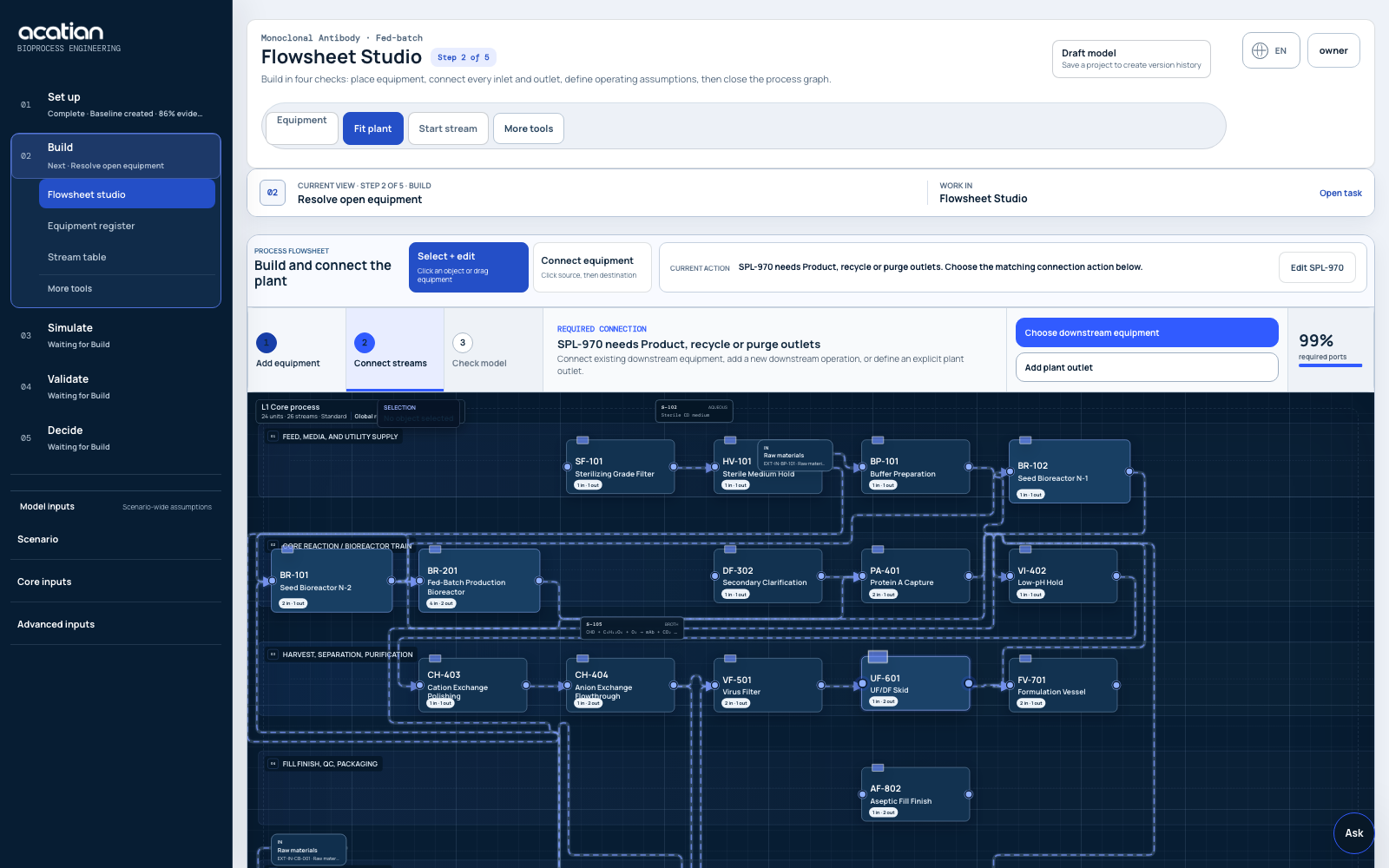
Decision brief
One question. One model.
One authorised customer food or beverage process from recipe and ingredient basis through mixing, thermal treatment, fermentation or separation to filling and packaging handoff, including cleaning, utilities, consumables, waste and holds.
Five practical use cases
Five places to start.
Evaluation scopes for Tetra Pak—not claims of current software use.Compare complete food-process concepts
Connect recipe preparation, mixing, heat treatment, fermentation or separation, storage, filling and packaging on one material, quality, equipment, time and uncertainty basis.
Screen scale-up and equipment-train fit
Translate authorised Product Development Centre or customer pilot evidence into rheology, heat-transfer, residence-time, separation and line-rate envelopes, then test approved equipment and utilities.
Schedule hygienic multiproduct lines
Sequence eligible process equipment, tanks, fillers, package formats, changeovers, cleaning, laboratories and labor without representing any actual customer line, Tetra Pak installation or performance.
Compare factory economics and lifecycle inventory
Evaluate processing, heat-recovery, cleaning, water and packaging options across accepted product, energy, waste, capital and operating cost under one functional unit and boundary.
Govern commissioning and validation evidence
Link recipe and process versions, equipment requirements, trial results, utilities, food-safety risks, acceptance criteria and test status without performing supplier acceptance or formal validation.
Action pack
Inputs in. Decisions out.
- Recipe, ingredients, product quality and demand basis
- Rheology, heat treatment, residence time and pilot evidence
- Equipment eligibility, line rates, cleaning and facility limits
- Materials, packaging, utilities, waste, cost and lifecycle factors
- Food-process and equipment-train comparison
- Scale-up and facility-fit evidence map
- Finite line schedule and accepted-output range
- TEA/LCA screen and validation-readiness register
- Select one customer-authorised food-process or line decision.
- Declare product, safety, equipment and facility boundaries.
- Import recipe, pilot, equipment and utility evidence.
Evidence and limits
Public evidence only.
- Tetra Pak — Legal informationOfficial legal context for the Tetra Pak group, its Swiss headquarters and Tetra Pak International S.A.'s website role.
- Tetra Laval — Group in briefOfficial group boundary distinguishing the Tetra Pak, Sidel and DeLaval industry groups.
- Tetra Pak — Processing and packaging solutionsOfficial current context for integrated food-processing equipment, packaging, services, product innovation and supported categories.
- Tetra Pak — Product Development CentresOfficial context for Tetra Pak's own trials, food technologists, process engineers, pilot equipment and scale-up support.
- Tetra Pak — Factory OSOfficial context for Tetra Pak's own Factory OS automation, data, production, asset, quality and material-management capabilities.
- Tetra Pak — Life Cycle AssessmentOfficial context for Tetra Pak's own reviewed lifecycle studies, verified product-CO2 model and ProductXplorer.
- Tetra Pak — Bioreactors.net acquisitionOfficial current ownership and brand boundary for the bioreactor portfolio acquired in December 2025.
- Tetra Pak — Russia exitOfficial boundary for the transferred, independent and non-affiliated former Russia business.
Guardrail: No Tetra Pak or Tetra Laval customer, recipe, line, equipment configuration, factory, schedule, capacity, performance, cost, environmental result, deployment or digital integration is represented. Sidel and DeLaval are separate Tetra Laval industry groups and are outside this study; the transferred Russia business is independent and not represented. Food safety, product selection, detailed design, commissioning, qualification, validation, regulatory and procurement decisions remain under approved supplier and customer systems.