Advance one bioprocess architecture, scale, facility or campaign option only after product quality, equipment fit, finite resources, supply assumptions, economics, environmental inventory and technology-transfer evidence remain consistent.
Independent company use-case study · bioprocess and CDMO
Thermo Fisher ScientificFive process decisions
Choose one use case. Add authorised plant data. Test capacity, cost and constraints.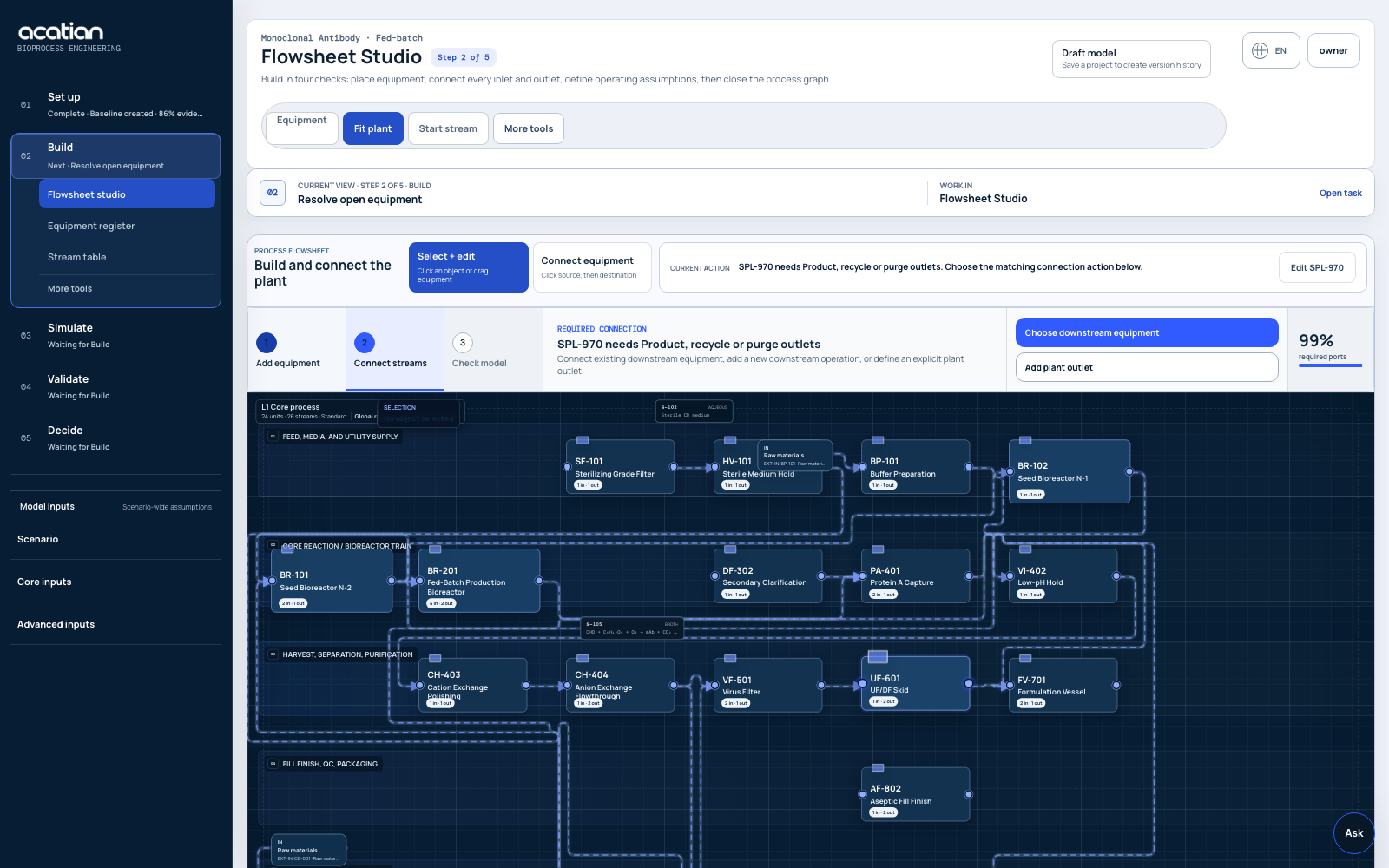
Decision brief
One question. One model.
Authorised cell-culture or other process basis through media preparation, cultivation or fermentation, harvest, filtration, chromatography, concentration, formulation and relevant fill-finish, including single-use assemblies, utilities, holds, waste and accepted product.
Five practical use cases
Five places to start.
Evaluation scopes for Thermo Fisher Scientific—not claims of current software use.Compare complete bioprocess architectures
Connect media, cell culture, harvest, filtration, chromatography, concentration and formulation on one material, quality, equipment, consumables and uncertainty basis.
Screen scale-up and facility fit
Translate authorised development evidence into mixing, gas-transfer, heat-removal, harvest and downstream-load envelopes, then test requirements against approved equipment and utility limits.
Test finite CDMO campaigns offline
Schedule eligible upstream, downstream, buffer, fill-finish, cleaning, laboratory, consumable and release resources without representing Patheon customers, real capacity, occupancy or delivery commitments.
Compare platform economics and lifecycle inventory
Evaluate conventional, intensified, single-use and hybrid options across yield, materials, consumables, energy, water, waste, capital and operating cost under the same functional unit.
Govern technology-transfer and validation evidence
Link process versions, scale assumptions, component configurations, analytical methods, risks, studies, deviations and acceptance criteria while keeping model review separate from formal validation.
Action pack
Inputs in. Decisions out.
- Molecule, modality, quality, demand and development-stage basis
- Growth, titer, recovery, flux, capacity and hold-time evidence
- Bioreactor, fluid-management, harvest, purification and facility limits
- Consumables, utilities, supply, waste, cost and lifecycle factors
- End-to-end bioprocess architecture comparison
- Scale-up, equipment and facility-fit evidence map
- Finite campaign and consumables schedule
- TEA/LCA screen and transfer-readiness register
- Select one customer-authorised process or scale decision.
- Declare modality, quality, process and facility boundaries.
- Import development, equipment and supply evidence.
Evidence and limits
Public evidence only.
- Thermo Fisher Scientific — 2025 Annual ReportOfficial legal, listed-parent and current four-segment reporting context for Thermo Fisher Scientific Inc.
- Thermo Fisher Scientific — About usOfficial context for the company's public brand portfolio, including Thermo Scientific, Gibco, Patheon and PPD.
- Thermo Fisher Scientific — Patheon pharma servicesOfficial context for current end-to-end CDMO capabilities across development, manufacturing, advanced therapies, clinical supply and commercial services.
- Thermo Fisher Scientific — Single-use bioprocessingOfficial context for research- and production-scale single-use equipment, automation, process optimisation and scale-up.
- Thermo Fisher Scientific — Bioprocessing solutionsOfficial context for upstream, downstream, single-use, cell-culture, chemical and technical-service capabilities.
Guardrail: No Thermo Fisher Scientific or Patheon customer, molecule, process, product configuration, facility, campaign, capacity, yield, cost, environmental result, deployment or integration is represented. Product selection, technology transfer, validation, GxP, batch release, regulatory and commercial decisions remain under approved company and customer systems.