Choose the next scale-up intervention across biology, oxygen/heat transfer, primary recovery, membrane area and dryer capacity.
Independent model study · 100 L to 20,000 L
Scale secreted dairy protein without moving the bottleneck downstream
Test whether higher titer creates more accepted powder or only overloads biomass removal, UF/DF, evaporation and drying.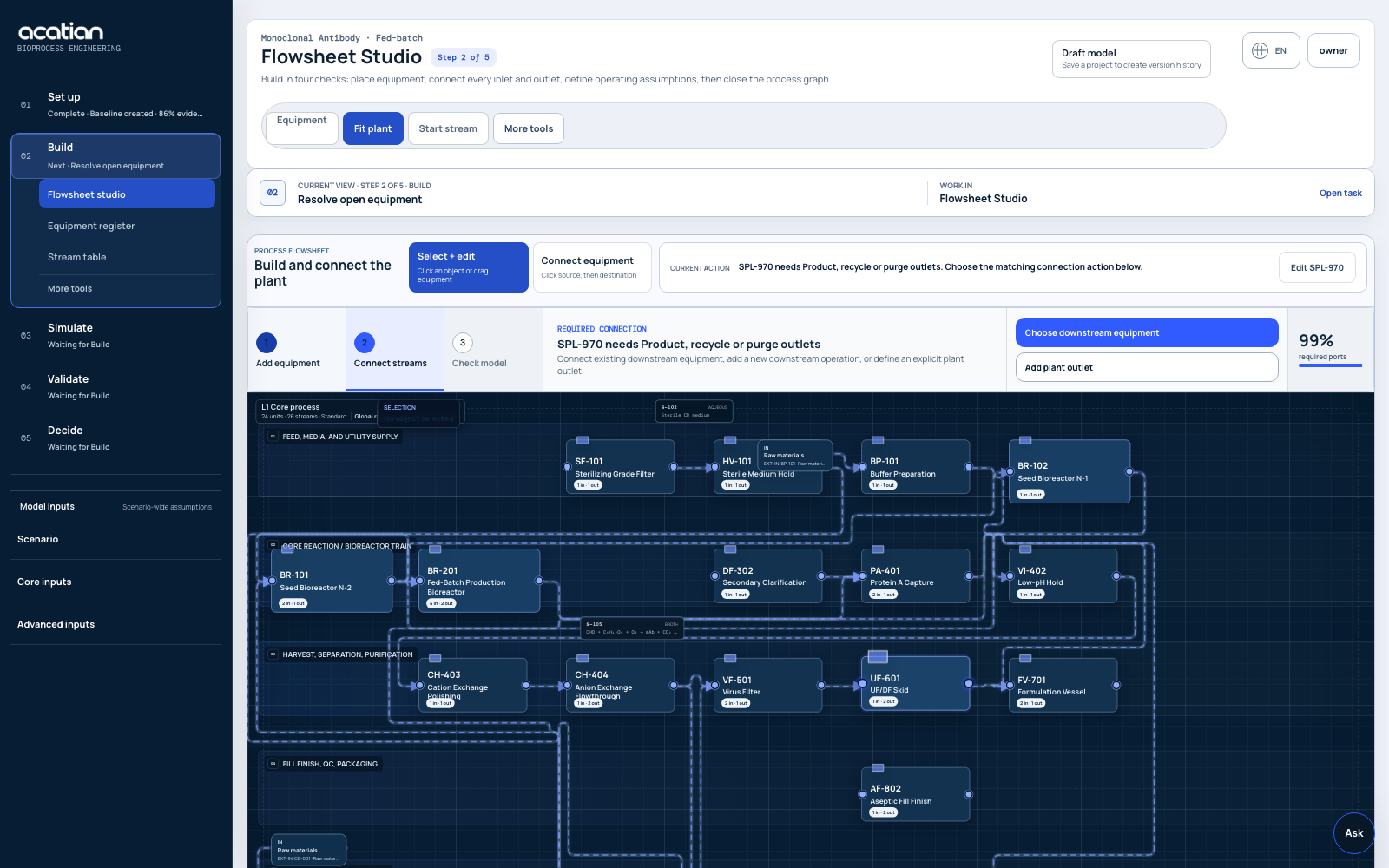
MediaK. phaffiiBiomass removalPolish filterUF/DFConcentrateDry
Decision model
A bounded question with a complete plant consequence.
Media and seed through fed-batch fermentation, biomass removal, polishing, UF concentration, diafiltration, optional evaporation, drying, packaging, CIP and wastewater.
Equations and accounting rules
Dynamic biomass, substrate, secreted-product and volume balancesOUR ≤ kLa(C* − CL)V and generated heat ≤ removed heatUF concentration factor = feed volume / retentate volumeDryer duty closes inlet/outlet water and exhaust humidityBase, alternative and stress cases
- 100 L reference to illustrative 20,000 L
- Constant kLa versus constant P/V
- +30% titer and 25% UF flux decay
- Extra membrane or dryer capacity
Engineering brief
Model the complete decision, not an isolated unit operation.
The FDA public record for Remilk states that β-lactoglobulin is secreted into the fermentation medium, biomass is removed, the product is concentrated with UF/DF, then dried and packaged.
The 100 L and 20,000 L cases are illustrative Acatian scales, not disclosed Remilk vessel sizes. Titer, flux, recovery, geometry and dryer design remain labelled assumptions.
01 · Model basis
What the Acatian model needs to resolve
Inputs, mechanisms, limits and outputs remain reviewable on one declared basis.Inputs
Growth, secretion, feed and OUR parameters
Vessel geometry, kLa, P/V and cooling
Filter/UF flux, rejection and fouling
Pre-dryer solids, powder recovery and moisture
Mechanisms
Dynamic biomass, substrate, secreted-product and volume balances
OUR ≤ kLa(C* − CL)V and generated heat ≤ removed heat
UF concentration factor = feed volume / retentate volume
Dryer duty closes inlet/outlet water and exhaust humidity
Constraints
OTR, cooling, mixing and working volume
Solids loading and filter area
UF flux decay and diafiltration volume
Evaporation and dryer water-removal rate
Outputs
Accepted protein kg/year
OTR/heat and scale-up margin
Membrane area/hours and water removed
Bottleneck transition, COGS and utility demand
02 · Acatian workflow
Build it in six controlled steps
Each step creates a reviewable object, not a hidden spreadsheet assumption.- 01
Declare scale geometry and data provenance.
- 02
Fit transparent fermentation dynamics.
- 03
Test oxygen, heat and mixing criteria.
- 04
Pass harvest state into filtration and UF/DF.
- 05
Schedule concentration, drying and CIP.
- 06
Compare accepted powder and bottleneck movement.
03 · Decisions
Questions the model should answer
Does a titer gain survive downstream?
Which scale criterion is binding?
How much membrane and dryer capacity is needed?
What measurement removes the largest uncertainty?
04 · Evidence boundary
Validate before the result carries weight
Validation
Require C/N/water closure, timestep independence, representative filtration/UF data, final composition and independent scale confirmation.
Limitations
This is precision-fermentation dairy protein, not cultivated meat. It does not disclose a Remilk recipe, actual scale, plant result or regulatory conclusion outside the cited record.
Public evidence
What the company context supports—and what it does not.
Sources establish the public process architecture. They do not reveal private operating parameters, site performance or an Acatian relationship.Frequently asked questions
Practical modelling questions
Is this the named organisation's real plant model?
No. It is an independent hypothetical Acatian study based only on the cited public process architecture. It claims no affiliation, endorsement, deployment, confidential data or actual plant performance.
Where do the numerical inputs come from?
Every input must be marked as a public fact, literature estimate, transparent engineering assumption or authorised customer input. The public article does not invent private operating values.
Can the model be calibrated to a real facility?
Yes, when the operator supplies authorised process, equipment, schedule and utility evidence and agrees the intended use, acceptance criteria and validation plan.