Growth, maintenance, uptake, yield and productivity parameters
Precision fermentation · scale-up
How to model a precision fermentation process
Connect expression biology, feed control and transfer limits to recovery yield, factory capacity and product cost.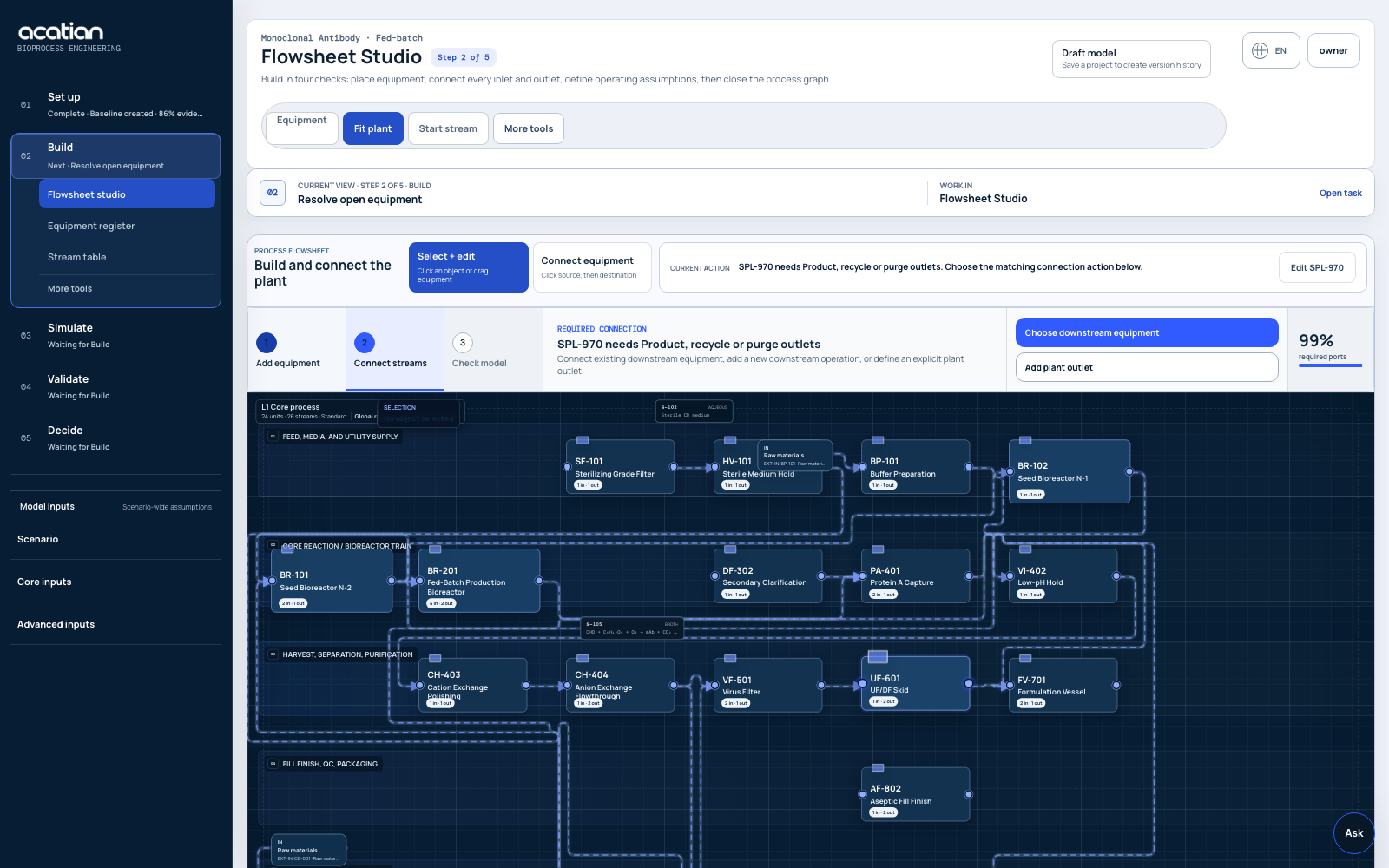
MediaSeed trainFed-batchHarvestRecoveryPurificationFinish
Engineering brief
Model the complete decision, not an isolated unit operation.
Precision fermentation scale-up is a coupled problem: the feed trajectory changes biomass, product formation, oxygen demand, heat release and broth properties, which then change recovery and facility load. Acatian keeps those dependencies explicit.
A useful model separates measured parameters from targets and assumptions. It can compare organisms, expression strategies, vessel scales and recovery routes without presenting screening output as validated manufacturing performance.
01 · Model basis
What the Acatian model needs to resolve
Inputs, mechanisms, limits and outputs remain reviewable on one declared basis.Inputs
Feed assay, induction logic and dynamic recipe
Vessel geometry, agitation, aeration, pressure and cooling
Product location, broth properties and recovery performance
Mechanisms
Dynamic biomass, substrate, product and by-product balances
OUR/OTR, kLa and dissolved-oxygen constraints
Heat generation and removal over the batch
Harvest timing, step yields and finite-capacity scheduling
Constraints
Oxygen and carbon-transfer limits
Cooling, mixing, foam and exhaust capacity
Expression burden and product degradation
Recovery capacity and hold-time windows
Outputs
Titer, yield, productivity and trajectory confidence
OTR and heat margin by time interval
Recovery yield, annual output and COGS
Critical experiments and scale-dependent risks
02 · Acatian workflow
Build it in six controlled steps
Each step creates a reviewable object, not a hidden spreadsheet assumption.- 01
Define product, host, mode and context of use.
- 02
Fit a transparent dynamic fermentation model.
- 03
Map geometry and transfer evidence by scale.
- 04
Connect broth state to recovery operations.
- 05
Schedule seed, production and downstream assets.
- 06
Run uncertainty and agree validation criteria.
03 · Decisions
Questions the model should answer
Which feed or induction policy is robust?
What limits scale before working volume?
Which recovery step captures most value loss?
What experiment reduces uncertainty fastest?
04 · Evidence boundary
Validate before the result carries weight
Validation
Use independent batches across the intended operating envelope to test state trajectories, gas data, heat duty, harvest composition, recovery yield and elapsed time.
Limitations
Acatian is an engineering workspace, not a substitute for strain characterization, biosafety, GMP validation or detailed facility design.
Frequently asked questions
Practical modelling questions
Can Acatian model fed-batch precision fermentation?
Yes. Time-dependent feeds, induction, gas transfer, heat and state balances can be linked to the recovery train.
Can intracellular and secreted products be represented?
Yes. Product location changes harvest, disruption, clarification and purification assumptions.
Can scenarios compare different hosts?
Yes, when kinetic evidence, media, containment and downstream consequences are explicitly separated.