Faster technical intake
Use one governed request for components, recipe, yields, batch timing, equipment requirements, quality holds, materials, assays and uncertainty instead of repeated email exchanges.
CDMO process development software
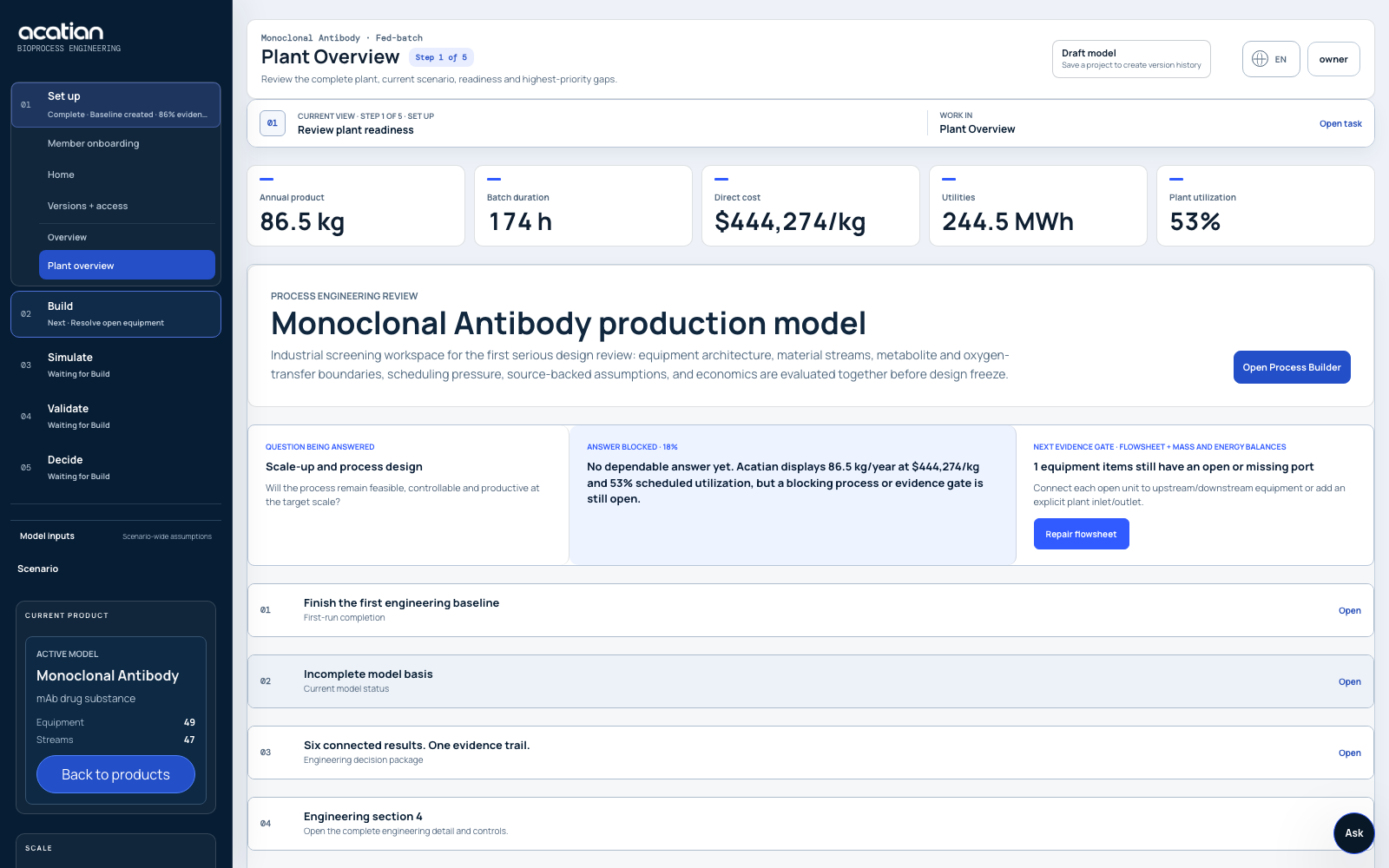
Use one governed request for components, recipe, yields, batch timing, equipment requirements, quality holds, materials, assays and uncertainty instead of repeated email exchanges.
Compare vessel and skid capacity, Protein A column size and chromatography cycles, buffer and hold vessels, transfers, rooms, utilities, labor, CIP/SIP, maintenance and parallel capacity.
Connect materials, consumables, labor, utilities, occupancy, yield, utilization, waste, changeover and risk allowances to a transparent low/base/high scenario.
Reusable delivery system
Create a baseline, proposal alternatives and transfer-ready branch with controlled collaborators and immutable versions. Compare equipment, streams, parameters, schedule, costs and outputs before merging a change. Record who changed the model, why, what recalculated and which evidence became stale.
Schedule multiple customers and batches across reactors, clarification, chromatography, UF/DF, filling, rooms, labor, utilities, QC, storage, cleaning, maintenance and changeover. Report occupancy, queues, lateness, campaign gaps, utilization and the bottleneck that constrains the promised delivery date.
Carry the accepted process basis, cost assumptions, exclusions, data gaps and risks into process development and MSAT. Replace screening values with authorized experimental or site data through review rather than overwriting their provenance. Export a complete engineering record for customer review.