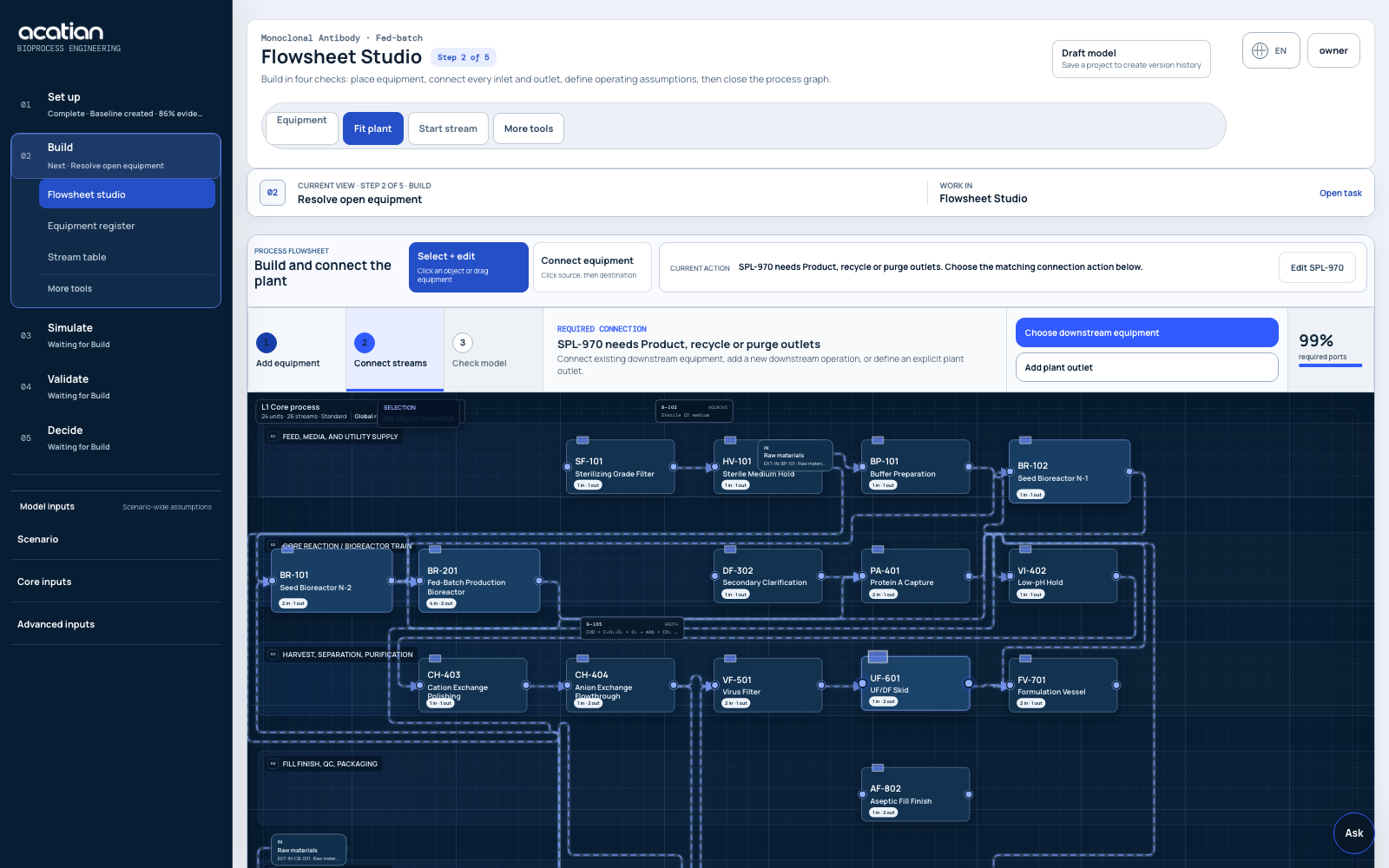
Dynamic reactor states must resolve into material demand, equipment duty and downstream load.
Calculation basis
A feed profile is only useful when its states, events and physical boundaries are explicit.
Freeze the organism or cell line, medium and feed composition, inoculum, initial and maximum working volume, temperature, pressure, pH strategy, gas train, agitation policy, batch events, harvest criterion and intended decision before fitting parameters.
Biological states
Represent biomass or viable and total cells, limiting substrates, nitrogen source, product, metabolites, dissolved oxygen and carbon dioxide, volume and relevant quality proxies. Separate growth, maintenance, production, death, degradation and transfer terms so the model cannot hide two effects inside one fitted yield.
Operating policy
Define each bolus and continuous feed by composition, flow, start condition and actuator limit. Include base, acid, antifoam, sampling, evaporation, gas composition, backpressure, agitation, cooling and induction or temperature-shift events. Event logic must use the same timestamps as the imported batch data.
Whole-process consequences
Translate the simulated harvest volume, titer, biomass, impurities and timing into centrifuge or filter load, chromatography cycles, buffer and consumable demand, hold times, schedule occupancy, utility peaks, waste, COGS and LCA inventory. This is where a reactor optimization becomes a factory decision.
Fed-batch state balanced(VCi)/dt = FinCin,i − FoutCi + Vri
Use the corresponding volume balance dV/dt = Fin − Fout − Fevap. Concentration equations must retain dilution, reaction, gas transfer, sampling and bleed terms. Numerical integration should report solver settings, event handling, residuals and failed physical checks.
ConstraintCalculate over timeRequired evidence
Oxygen and gasOUR, OTR, kLa margin, gas rate, enrichment and exhaust loadOUR or off-gas data, kLa method, vessel and gas-train limits
Mixing and feed zoneBlend time, local substrate exposure, osmolality and pH riskTracer data, feed-port location, scale-down or qualified CFD
Heat and volumeMetabolic heat, cooling duty, working-volume and foam marginCalorimetry or heat reconciliation, UA, coolant and operating records
Downstream interfaceHarvest mass, solids, impurity burden, cycles and hold-time riskAssays, recovery data, equipment limits and schedule rules
Independent validationReserved batches or conditions · predefined trajectory and endpoint tolerances · mass closure · event timing · equipment duty · documented deviations
Decision outputLow/base/high scenarios · limiting interval · active constraint · sensitivity ranking · data gaps · screening, calibrated, validated or not decision-ready status