Select feed ratio and production plan under furnace, separation, steam, product-storage and downstream-demand constraints.
Independent model study · integrated chemicals
Optimise cracker feed only after the full co-product network closes
Choose the naphtha/butane ratio against ethylene, propylene, C4, pygas and fuel-gas demand while steam, storage and downstream outages remain visible.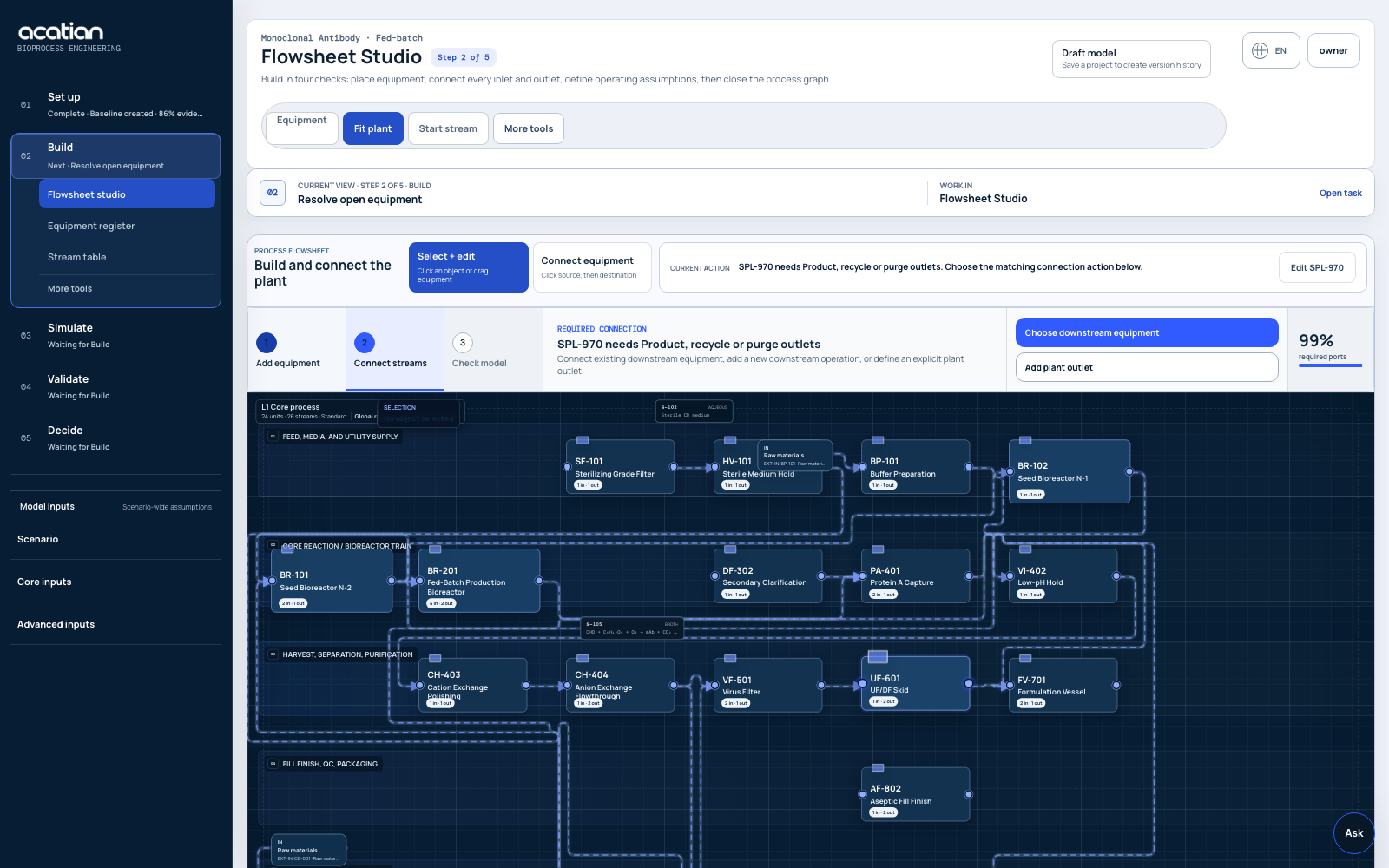
BlendCrackQuenchCompressSeparateStoreVerbund sinks
Decision model
A bounded question with a complete plant consequence.
Naphtha/butane receipt through cracking abstraction, quench, compression, separation, product tanks, fuel/steam network and downstream demand sinks.
Equations and accounting rules
Elemental and total mass balanceFeed-dependent product yield matrixFurnace duty and steam generation/consumptionTime-indexed product inventory and downstream demandBase, alternative and stress cases
- Naphtha-heavy versus butane-heavy
- Propylene-demand spike
- Downstream outage and constrained steam
- Co-product price collapse
Engineering brief
Model the complete decision, not an isolated unit operation.
BASF publicly describes a flex-feed cracker able to use naphtha and butane and the Verbund principle of integrated by-product and energy flows.
The public evidence supports the architecture, not proprietary yields, furnace settings, economics or downstream nominations. The model is not a Zhanjiang digital twin.
01 · Model basis
What the Acatian model needs to resolve
Inputs, mechanisms, limits and outputs remain reviewable on one declared basis.Inputs
Feed assays, prices and availability
Public/literature yield matrix by feed and severity
Furnace, compressor and separation capacities
Product demand, storage, steam and maintenance calendars
Mechanisms
Elemental and total mass balance
Feed-dependent product yield matrix
Furnace duty and steam generation/consumption
Time-indexed product inventory and downstream demand
Constraints
Furnace and compression capacity
Steam headers and energy integration
Product storage and minimum rates
Downstream outages and co-product demand
Outputs
Ethylene, propylene and co-product tonnes
Feed and energy intensity
Steam balance and inventory peaks
Margin, carbon proxy and binding capacity
02 · Acatian workflow
Build it in six controlled steps
Each step creates a reviewable object, not a hidden spreadsheet assumption.- 01
Declare feed and demand basis.
- 02
Close elemental and yield-matrix balances.
- 03
Add furnace, compression and separation duties.
- 04
Connect steam, fuel and product inventories.
- 05
Schedule demand, outages and minimum rates.
- 06
Compare margin, energy and carbon outcomes.
03 · Decisions
Questions the model should answer
Which feed ratio fits the demand slate?
Where does a co-product accumulate?
Does steam or separation bind?
How does an outage change the optimum?
04 · Evidence boundary
Validate before the result carries weight
Validation
Verify yield-matrix provenance, C/H closure, energy balance, inventory and demand reconciliation against authorised plant or licensor data.
Limitations
No BASF cracker yield, severity, margin or plant configuration is disclosed. Detailed furnace, metallurgy, safety and licensor design are outside scope.
Public evidence
What the company context supports—and what it does not.
Sources establish the public process architecture. They do not reveal private operating parameters, site performance or an Acatian relationship.Frequently asked questions
Practical modelling questions
Is this the named organisation's real plant model?
No. It is an independent hypothetical Acatian study based only on the cited public process architecture. It claims no affiliation, endorsement, deployment, confidential data or actual plant performance.
Where do the numerical inputs come from?
Every input must be marked as a public fact, literature estimate, transparent engineering assumption or authorised customer input. The public article does not invent private operating values.
Can the model be calibrated to a real facility?
Yes, when the operator supplies authorised process, equipment, schedule and utility evidence and agrees the intended use, acceptance criteria and validation plan.