Choose a process-line concept and equipment configuration only after biological or product performance, unit-operation capacity, utility peaks, cleanability, schedule and lifecycle value remain feasible together.
Independent company use-case study · process engineering
Five ways GEA could use Acatian
Connect customer product requirements, process calculations and equipment choices in one reviewable model from early concept through scale-up and operating scenarios.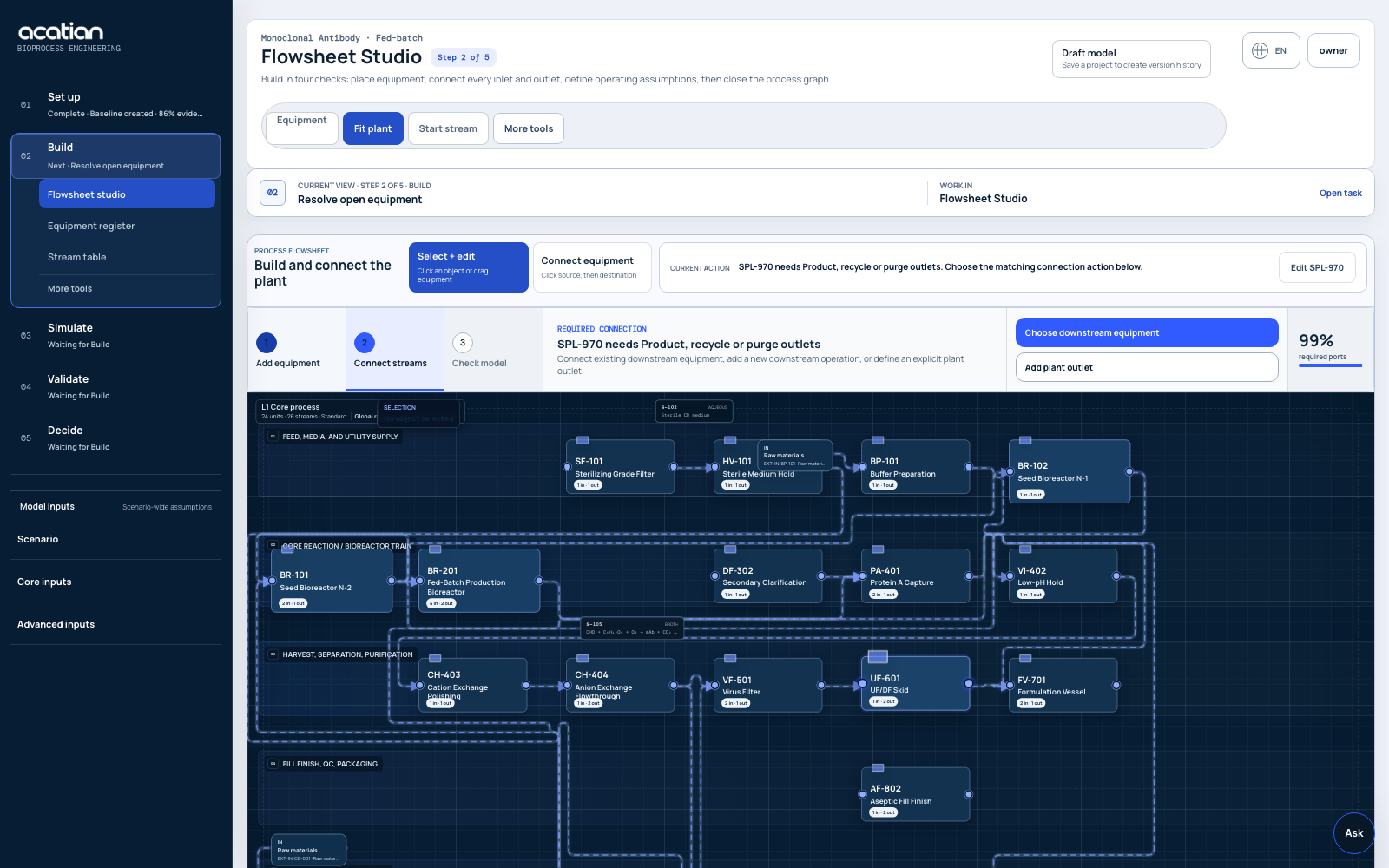
ProductProcessScale-upEquipmentUtilitiesCommissionOperate
Decision model
A bounded question with a complete plant consequence.
Customer product and feed basis through the proposed GEA process line, utilities, cleaning, controls handoff, commissioning scenarios, accepted product, waste and lifecycle performance.
Equations and accounting rules
Unit duty follows component balance, phase state, residence time and target specificationRequired equipment count = ceiling(peak process duty / derated unit capacity)OUR ≤ kLa(C* − CL)V and generated heat ≤ verified removal capacityLifecycle value = accepted throughput margin − capital − utilities − downtime − wasteBase, alternative and stress cases
- Alternative process routes and equipment trains
- Batch, fed-batch, perfusion or continuous operation
- Base, turndown, fouling and equipment-outage cases
- Heat recovery, water reuse and future-capacity expansion
Five practical use cases
Where Acatian could support GEA
Each use case is a proposed evaluation scope, not a claim about current software use.Turn customer requirements into a complete process concept
Translate product, feed, quality and demand targets into a connected flowsheet before individual machines are selected, preserving every assumption and interface.
Link bioreactor scale-up to the downstream train
Connect kinetic and CFD-derived operating envelopes to harvest, separation, concentration, drying and packaging so upstream gains are tested against whole-line capacity.
Size and compare equipment configurations
Use verified vendor curves and derating rules to compare unit counts, parallel trains, buffer volumes, turndown and installed margin without converting catalogue values into guarantees.
Rehearse commissioning and resource peaks
Sequence batches, CIP/SIP, heat-up, cooling, holds and shared utilities to find conflicts before site commissioning and to define evidence needed by controls and validation teams.
Quantify lifecycle value for the customer
Tie accepted output to capital, utilities, water, waste, downtime and expansion scenarios so efficiency and sustainability options remain comparable on one process basis.
Engineering brief
Model the complete decision, not an isolated unit operation.
GEA publicly presents integrated processing equipment and complete plants across food, beverage, new food, pharmaceutical and chemical production. It also describes CFD-based virtual bioreactor testing, technology centres for pilot-to-industrial scale-up and digital tools intended to improve resource use and production performance.
Acatian could complement those public capabilities as a customer-facing process-system model that keeps process assumptions, equipment duties, schedules, utilities, economics and evidence connected. It would not replace GEA's proprietary design methods, CFD, controls, product selectors, equipment guarantees or commissioning procedures.
01 · Model basis
What the Acatian model needs to resolve
Inputs, mechanisms, limits and outputs remain reviewable on one declared basis.Inputs
Customer product, feed, quality and annual-demand basis
Pilot kinetics, rheology, transfer and separation evidence
Equipment curves, turndown, materials and cleanability
Batch events, utilities, availability and commercial assumptions
Mechanisms
Unit duty follows component balance, phase state, residence time and target specification
Required equipment count = ceiling(peak process duty / derated unit capacity)
OUR ≤ kLa(C* − CL)V and generated heat ≤ verified removal capacity
Lifecycle value = accepted throughput margin − capital − utilities − downtime − waste
Constraints
Cell, product or material operating envelope
Equipment capacity, turndown and transfer interfaces
CIP/SIP, hygiene, holds and sequence dependencies
Steam, cooling, power, water and site-space limits
Outputs
Process concept and equipment-duty register
Scale-up envelope and CFD/model handoff
Capacity, utility and commissioning schedule
Customer TEA, resource and validation package
02 · Acatian workflow
Build it in six controlled steps
Each step creates a reviewable object, not a hidden spreadsheet assumption.- 01
Freeze the customer requirement and product specification.
- 02
Build the end-to-end component and equipment flowsheet.
- 03
Import authorised pilot, CFD and equipment evidence.
- 04
Schedule operation, cleaning, holds and utility demand.
- 05
Compare configurations, lifecycle value and stress cases.
- 06
Export the decision basis and unresolved qualification evidence.
03 · Decisions
Questions the model should answer
Which process-line concept best fits the product and demand?
Where does scale-up change the downstream duty?
Which equipment combination gives useful rather than unused margin?
Can the site supply the concurrent cleaning and production utilities?
Which missing test or vendor datum can reverse selection?
04 · Evidence boundary
Validate before the result carries weight
Validation
Reconcile the Acatian model with authorised pilot runs, CFD boundaries, supplier curves, functional descriptions and commissioning tests. Treat catalogue and public values as context only; procurement must use project-specific, approved vendor data.
Limitations
No GEA customer project, proprietary sizing method, equipment guarantee, control design or plant performance is represented. Mechanical design, hygienic qualification, safety, automation and contractual acceptance remain within GEA and customer procedures.
Public evidence
What the company context supports—and what it does not.
Sources establish the public process architecture. They do not reveal private operating parameters, site performance or an Acatian relationship.- GEA — Digital twin for bioreactor developmentOfficial context for CFD-based virtual bioreactor testing, scale-up and mechanical-configuration decisions.
- GEA — New foodOfficial context for process design, technology-centre testing, complete lines, scale-up and energy- and resource-efficient processing.
Frequently asked questions
Practical modelling questions
Is GEA an Acatian customer?
Not to Acatian's knowledge. This independent article describes five hypothetical uses based only on cited public information. It claims no affiliation, endorsement, deployment, confidential data or actual plant performance.
Does the article reproduce a real company model?
No. Unreported recipes, equipment, schedules, costs and performance values must remain explicit assumptions until the company supplies authorised evidence for a bounded project.
How would a real evaluation start?
Select one company-owned process decision, agree the system boundary and acceptance criteria, import only authorised evidence, and compare Acatian results with an approved reference before expanding the scope.