Industrialise or expand a medical-device or primary-packaging process only after moulding, refinement, assembly, inspection, cleanroom, quality and supply-chain capacity remain feasible on the same demand basis.
Independent company use-case study · pharma devices
Five ways Gerresheimer could use Acatian
Connect pilot and product evidence to cleanroom equipment, production schedules, quality gates, cost and site decisions without claiming access to Gerresheimer operations.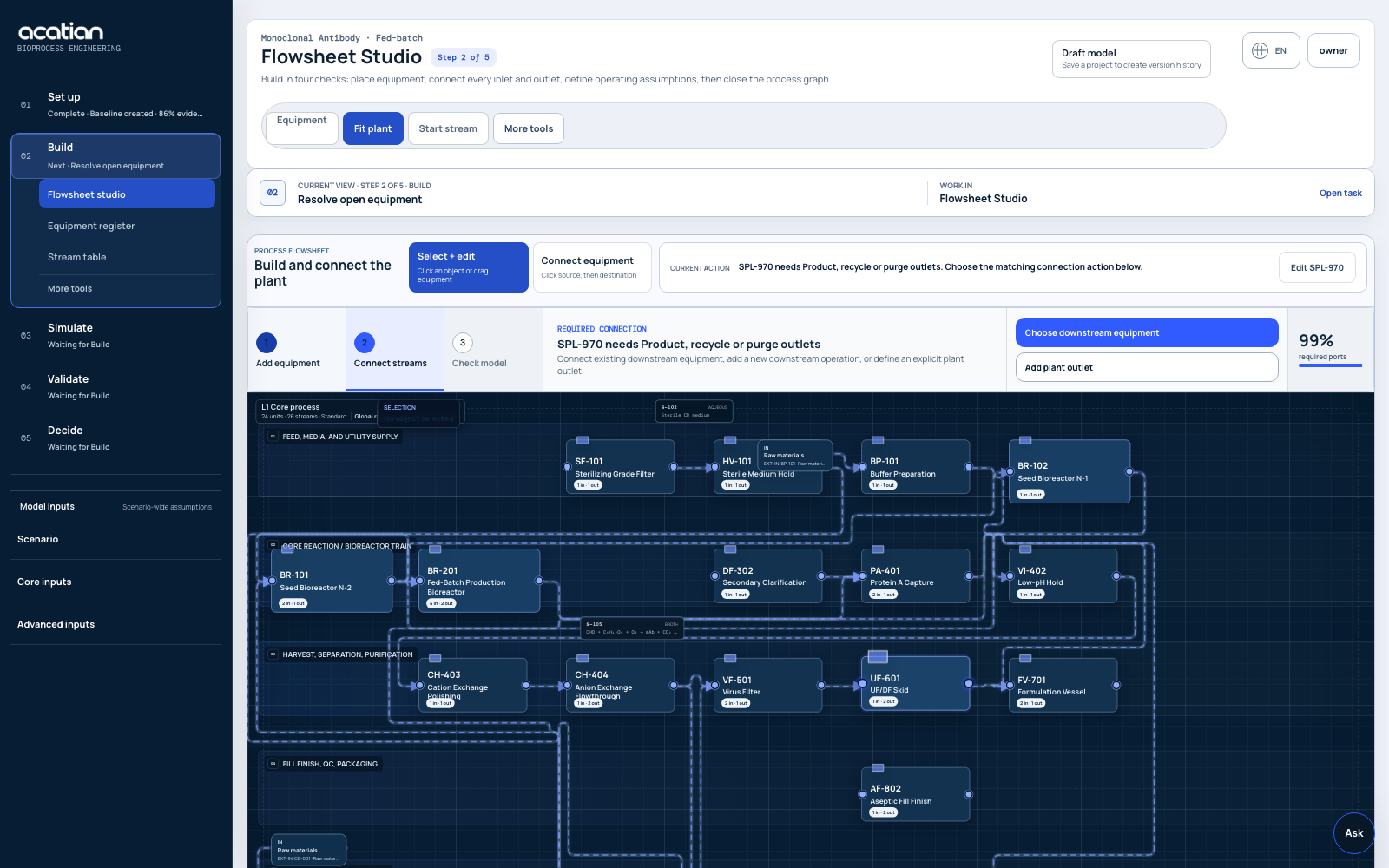
ConceptPilotMouldProduceAssembleInspectRelease
Decision model
A bounded question with a complete plant consequence.
Approved resin, glass, metal and electronics receipt through moulding or forming, refinement, assembly, inspection, filling where applicable, sterile or protective packaging, quality holds and released shipment.
Equations and accounting rules
Good units = starts × mould yield × assembly yield × inspection acceptanceCavity output = cavities × qualified cycles/hour × scheduled hours × availabilityFinite resources prohibit overlap across tool, press, cleanroom, line, inspector and packerUnit cost = annual material + conversion + quality + facility + loss cost / released unitsBase, alternative and stress cases
- Pilot, low-volume and high-volume production routes
- Alternative cavity count, press or assembly automation
- Tool maintenance, line outage and demand-upside stress
- Site allocation, second-source and material-reduction case
Five practical use cases
Where Acatian could support Gerresheimer
Each use case is a proposed evaluation scope, not a claim about current software use.Plan the move from pilot to commercial series
Translate development and stability batches into explicit scale gates for tools, automation, cleanroom qualification, inspection and released-volume demand.
Model the complete device-production route
Connect moulding or glass forming, refinement, assembly, electronics, testing and packaging so local cycle improvements are checked against the full value chain.
Schedule cleanrooms, tools and quality resources
Resolve finite presses, moulds, assembly lines, rooms, inspectors, maintenance and release holds across small and large series without double-booking shared capacity.
Link MES evidence to engineering decisions
Use authorised aggregated process and quality records to calibrate yields, cycle times and downtime while keeping provenance, versions and acceptance criteria attached to each scenario.
Compare network, cost and sustainability options
Test product allocation, duplicate tooling, local supply, material reduction, energy, cleanroom load, scrap and expansion scenarios on a released-unit basis.
Engineering brief
Model the complete decision, not an isolated unit operation.
Gerresheimer publicly describes development samples and pilot series, precision injection moulding, cleanroom production, automated and manual assembly, in-line quality testing, packaging and a company-wide manufacturing execution system. That value chain supports a hypothetical process-systems model from industrialisation to released device.
Acatian could provide an engineering and scenario layer around authorised product, equipment, schedule, utility, cost and evidence data. It would not replace Gerresheimer's MES, product-lifecycle, mould-design, automation, quality-management, GxP or regulatory systems.
01 · Model basis
What the Acatian model needs to resolve
Inputs, mechanisms, limits and outputs remain reviewable on one declared basis.Inputs
Product specification, bill of material and demand profile
Tool cavities, cycle times, yields and maintenance evidence
Assembly, inspection, packaging and quality-release rules
Cleanroom, labor, utilities, material cost and waste factors
Mechanisms
Good units = starts × mould yield × assembly yield × inspection acceptance
Cavity output = cavities × qualified cycles/hour × scheduled hours × availability
Finite resources prohibit overlap across tool, press, cleanroom, line, inspector and packer
Unit cost = annual material + conversion + quality + facility + loss cost / released units
Constraints
Tolerance, material, particulate and cleanliness requirements
Qualified tool, press and automation eligibility
Inspection, traceability, packaging and release capacity
Cleanroom space, HVAC, labor and maintenance windows
Outputs
Pilot-to-series capacity and scale gates
Feasible line, tool and cleanroom schedule
Yield, inspection, waste and unit-cost sensitivity
Qualification and change-impact evidence register
02 · Acatian workflow
Build it in six controlled steps
Each step creates a reviewable object, not a hidden spreadsheet assumption.- 01
Select one product family and industrialisation decision.
- 02
Map the material, equipment, quality and cleanroom route.
- 03
Import authorised pilot, tool, line and inspection evidence.
- 04
Build finite-capacity schedules and quality holds.
- 05
Stress demand, yield, downtime, material and site allocation.
- 06
Review qualification gaps before approving the next scale gate.
03 · Decisions
Questions the model should answer
Can the pilot route meet commercial demand after all quality gates?
Which tool, line or cleanroom resource limits released output?
Does more automation improve capacity after inspection and packaging?
When does duplicate tooling or a second site reduce risk enough?
Which change requires requalification or additional evidence?
04 · Evidence boundary
Validate before the result carries weight
Validation
Reconcile unit genealogy, material consumption, qualified cycle time, yield, equipment occupancy, inspection results and release timing against authorised MES and quality records. Preserve the intended use and validation status of every result.
Limitations
No Gerresheimer customer, product design, tool, plant, yield, cost, defect rate or MES dataset is represented. Medical-device, primary-packaging, GxP, regulatory and quality decisions remain under approved Gerresheimer and customer systems.
Public evidence
What the company context supports—and what it does not.
Sources establish the public process architecture. They do not reveal private operating parameters, site performance or an Acatian relationship.- Gerresheimer — Injection moulding for drug-delivery systemsOfficial context for precision moulding, cleanroom production, assembly, in-line testing, worldwide capacity and MES traceability.
- Gerresheimer — Small series and pilot seriesOfficial context for development, clinical and stability samples, pilot production, verification and transition toward product validation.
Frequently asked questions
Practical modelling questions
Is Gerresheimer an Acatian customer?
Not to Acatian's knowledge. This independent article describes five hypothetical uses based only on cited public information. It claims no affiliation, endorsement, deployment, confidential data or actual plant performance.
Does the article reproduce a real company model?
No. Unreported recipes, equipment, schedules, costs and performance values must remain explicit assumptions until the company supplies authorised evidence for a bounded project.
How would a real evaluation start?
Select one company-owned process decision, agree the system boundary and acceptance criteria, import only authorised evidence, and compare Acatian results with an approved reference before expanding the scope.