Select MABR, MBBR, co-digestion or another intervention based on effluent risk, aeration, footprint, solids and net energy.
Independent model study · water and resource recovery
Intensify wastewater treatment without moving the burden to sludge handling
Choose the lowest whole-plant energy and footprint configuration that meets effluent limits and maintains stable digester loading.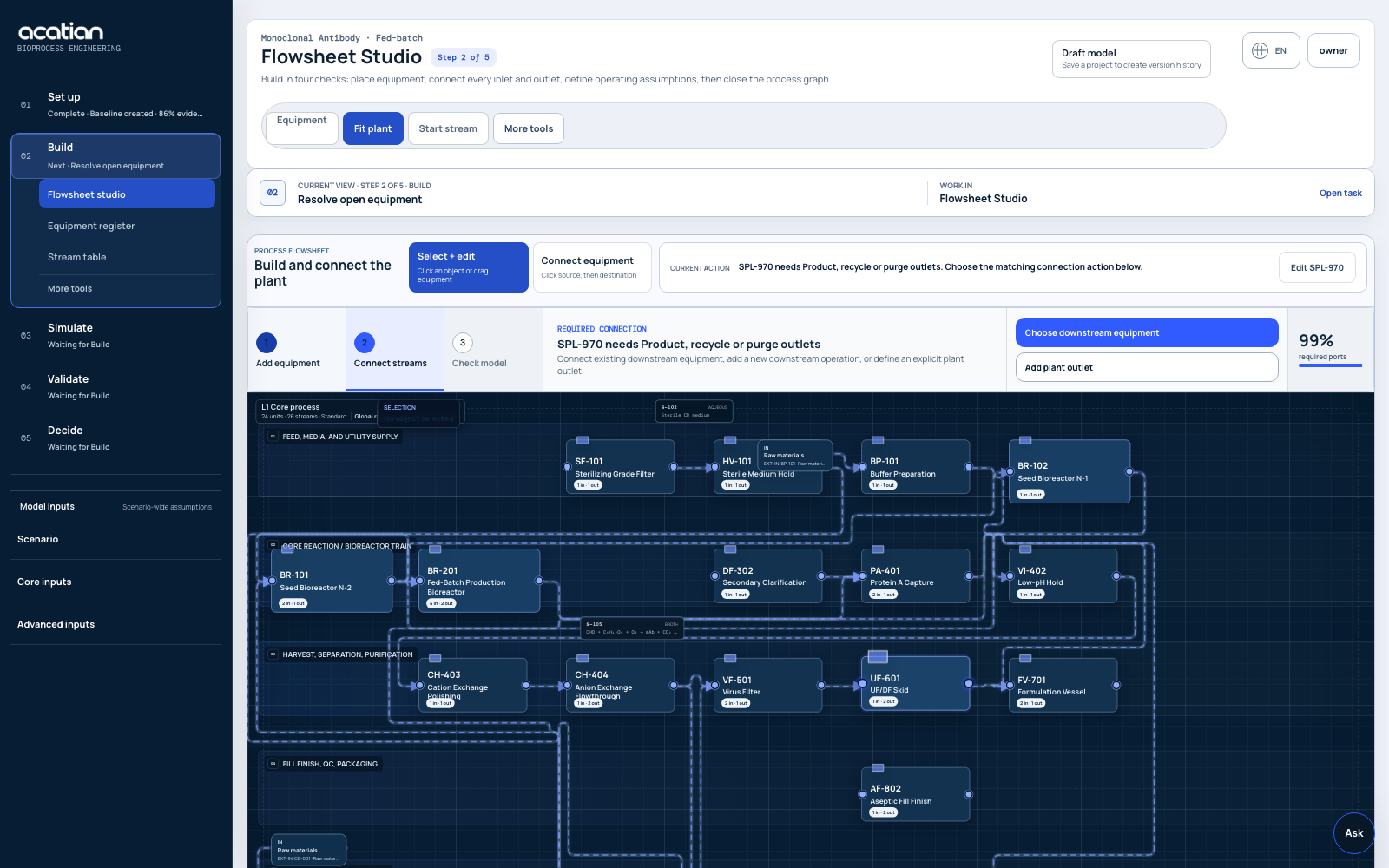
InfluentPrimaryMABR / MBBRClarifyPolishDigestCHP
Decision model
A bounded question with a complete plant consequence.
Screening and primary treatment through biological stages, secondary/tertiary treatment, sludge thickening, digestion, dewatering and CHP, including recycles.
Equations and accounting rules
COD, nitrogen, phosphorus, alkalinity and solids balancesMonod rates with HRT and SRTOxygen demand and blower powerMethane = BMP × volatile solids × destructionBase, alternative and stress cases
- Dry weather, storm and cold season
- High-ammonia industrial load
- MABR versus MBBR retrofit
- Co-digestion, CHP outage and sidestream treatment
Engineering brief
Model the complete decision, not an isolated unit operation.
Veolia publicly discusses MABR, MBBR, membranes, energy savings, biogas from sewage-sludge digestion and resource recovery in its wastewater portfolio.
The study compares technology options, not a named plant. Kinetics, oxygen-transfer performance, effluent limits and energy factors require jurisdiction- and facility-specific evidence.
01 · Model basis
What the Acatian model needs to resolve
Inputs, mechanisms, limits and outputs remain reviewable on one declared basis.Inputs
Hourly flow, COD fractions, N, P, alkalinity and temperature
Reactor volume, media area and oxygen transfer
Solids yields, BMP and digester capacity
Effluent limits, CHP efficiency and chemicals
Mechanisms
COD, nitrogen, phosphorus, alkalinity and solids balances
Monod rates with HRT and SRT
Oxygen demand and blower power
Methane = BMP × volatile solids × destruction
Constraints
Effluent COD and nutrient limits
Media loading, oxygen and clarification
Digester organic loading and sidestream return
CHP, chemical and dewatering capacity
Outputs
Effluent quality and risk frequency
Aeration kWh/m³ and footprint
Sludge, methane and CHP output
Net energy, chemicals and utilisation
02 · Acatian workflow
Build it in six controlled steps
Each step creates a reviewable object, not a hidden spreadsheet assumption.- 01
Characterise hourly influent and limits.
- 02
Close COD/N/P/solids balances.
- 03
Fit biological and oxygen demand states.
- 04
Add clarification and sludge production.
- 05
Connect digestion, CHP and sidestreams.
- 06
Compare compliance, energy and footprint.
03 · Decisions
Questions the model should answer
Is aeration or reactor volume limiting?
Which retrofit meets the effluent envelope?
Can biogas offset treatment energy?
What peak load drives the investment?
04 · Evidence boundary
Validate before the result carries weight
Validation
Calibrate kinetics, oxygen, solids and methane against independent seasonal periods; report average and peak residuals and compliance frequency.
Limitations
No Veolia plant or vendor guarantee is represented. The model does not replace permitting, process safety, biological commissioning or professional design.
Public evidence
What the company context supports—and what it does not.
Sources establish the public process architecture. They do not reveal private operating parameters, site performance or an Acatian relationship.Frequently asked questions
Practical modelling questions
Is this the named organisation's real plant model?
No. It is an independent hypothetical Acatian study based only on the cited public process architecture. It claims no affiliation, endorsement, deployment, confidential data or actual plant performance.
Where do the numerical inputs come from?
Every input must be marked as a public fact, literature estimate, transparent engineering assumption or authorised customer input. The public article does not invent private operating values.
Can the model be calibrated to a real facility?
Yes, when the operator supplies authorised process, equipment, schedule and utility evidence and agrees the intended use, acceptance criteria and validation plan.