Recommend one intensified process architecture and equipment train only after upstream biology, downstream recovery, scale-up criteria, connected-operation timing, utilities, lifecycle value and validation evidence remain feasible together.
Independent company use-case study · bioprocess technology
Five ways Sartorius could use Acatian
Connect a customer's molecule and process requirements to scalable equipment, end-to-end capacity, utilities and evidence without claiming access to a Sartorius project or proprietary model.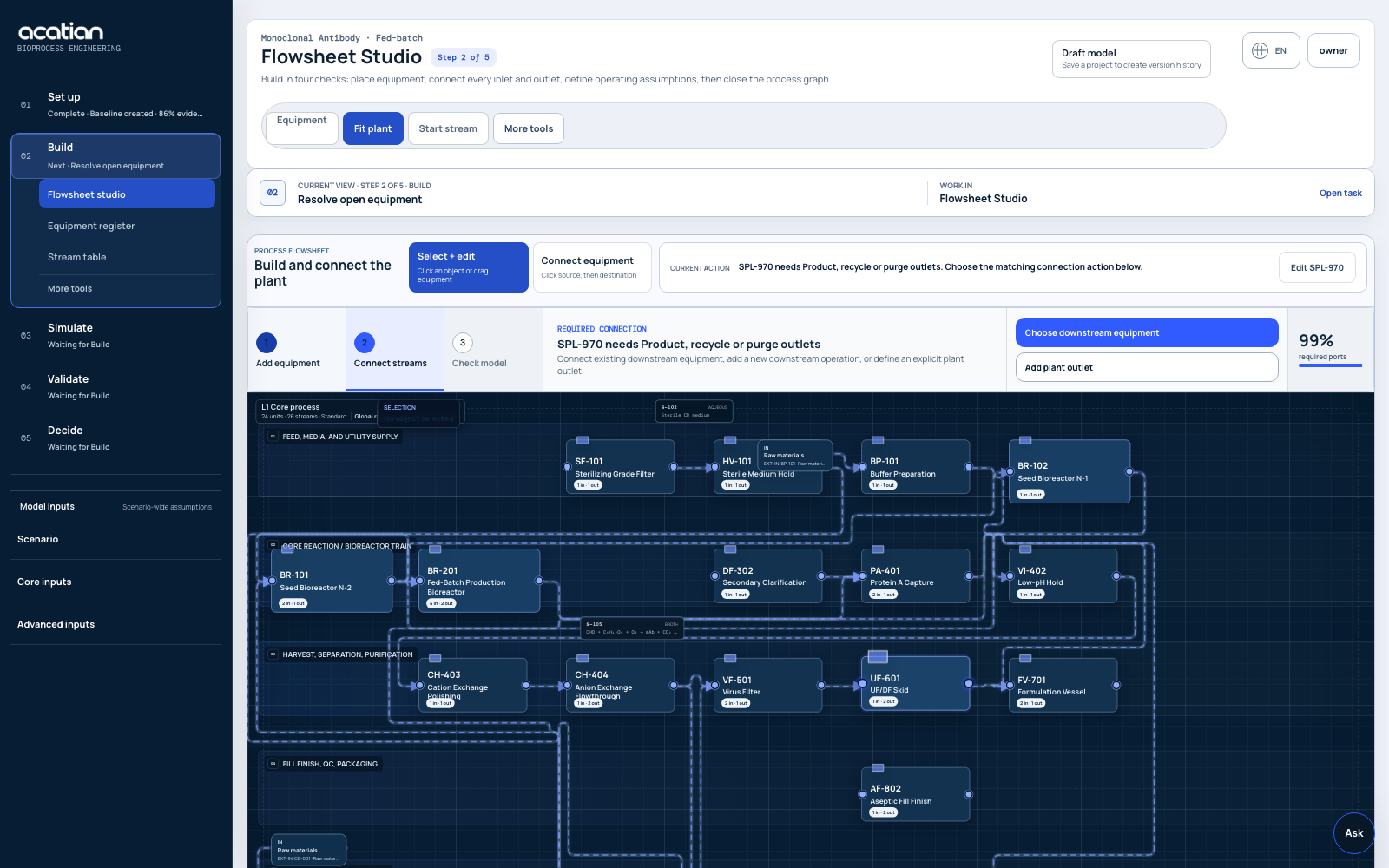
CloneDevelopScaleIntensifyConnectTransferManufacture
Decision model
A bounded question with a complete plant consequence.
Authorised cell-line and product basis through seed, production bioreactor, harvest, capture, polishing, virus safety, UF/DF, formulation, connected buffers and utilities to released bulk product.
Equations and accounting rules
Accepted mass = bioreactor harvest × step recoveries × release fractionOUR ≤ verified OTR and generated heat ≤ qualified heat-removal dutyConnected flow requires upstream output, buffer inventory and downstream capacity to remain synchronizedLifecycle value = accepted output value − capital − consumables − utilities − labor − lossBase, alternative and stress cases
- Conventional fed-batch versus intensified or perfusion upstream
- Batch versus connected or continuous downstream configuration
- Base, turndown, fouling, deviation and equipment-outage cases
- Clinical-to-commercial scale and future-demand expansion
Five practical use cases
Where Acatian could support Sartorius
Each use case is a proposed evaluation scope, not a claim about current software use.Frame an end-to-end intensification decision
Translate customer product, quality and demand targets into a whole-process comparison so an upstream productivity gain is tested against capture, polishing, buffers, holds and release capacity.
Link small-scale evidence to commercial scale
Carry Ambr, DoE, PAT and authorised analytics into oxygen transfer, mixing, heat, vessel geometry and downstream load envelopes while preserving the limits of each scale-down model.
Configure equipment and consumable trains
Compare bioreactor, filtration, membrane chromatography, conventional chromatography and UF/DF configurations using approved capacities, turndown, cycle, consumable and validation evidence.
Synchronise connected processing and shared resources
Schedule production, transfers, buffers, cleaning, sampling, holds and utilities so a connected or continuous architecture is checked for inventory starvation, overflow and peak-demand conflicts.
Build a transparent customer lifecycle case
Tie accepted output to footprint, capital, consumables, water, energy, waste, labor, downtime and expansion scenarios without turning public portfolio claims into a project guarantee.
Engineering brief
Model the complete decision, not an isolated unit operation.
Sartorius publicly describes process-intensification workflows spanning cell-line and process development, Ambr and Biostat bioreactors, downstream technologies, PAT, automation, multivariate analytics, mechanistic modelling and digital twins. It also offers engineering support from early development through scale-up, technology transfer and commercial manufacturing.
Acatian could complement those capabilities as an independent process-system and decision model connecting declared customer inputs to mass balances, equipment duties, finite-capacity schedules, utilities, economics and evidence. It would not replace Sartorius equipment sizing, Umetrics, Biobrain, BioPAT, validation services, controls or contractual performance guarantees.
01 · Model basis
What the Acatian model needs to resolve
Inputs, mechanisms, limits and outputs remain reviewable on one declared basis.Inputs
Product, quality, demand and development-stage requirements
Clone, media, kinetics, PAT and scale-up evidence
Equipment curves, consumables, membranes and automation interfaces
Batch events, buffers, utilities, availability and cost assumptions
Mechanisms
Accepted mass = bioreactor harvest × step recoveries × release fraction
OUR ≤ verified OTR and generated heat ≤ qualified heat-removal duty
Connected flow requires upstream output, buffer inventory and downstream capacity to remain synchronized
Lifecycle value = accepted output value − capital − consumables − utilities − labor − loss
Constraints
Cell, product and critical-quality operating envelopes
Bioreactor, membrane, chromatography and hold-time capacities
Single-use assembly, buffer, automation and sampling dependencies
WFI, steam, gases, cooling, power, room and waste limits
Outputs
End-to-end intensified process and equipment-duty register
Scale-up design space and evidence handoff
Connected-operation schedule and utility peaks
Customer capacity, COGS, sustainability and risk comparison
02 · Acatian workflow
Build it in six controlled steps
Each step creates a reviewable object, not a hidden spreadsheet assumption.- 01
Freeze the customer product, demand and quality basis.
- 02
Map upstream, downstream, buffer and utility interfaces.
- 03
Import authorised development, PAT and equipment evidence.
- 04
Scale and schedule the connected process with finite resources.
- 05
Compare configurations, lifecycle value and stress cases.
- 06
Export assumptions, interfaces and unresolved qualification evidence.
03 · Decisions
Questions the model should answer
Which intensification strategy improves accepted output end to end?
Which scale criterion protects both biology and downstream load?
Where does equipment capacity or buffer inventory constrain connection?
Can the site support concurrent process and utility peaks?
Which missing experiment or supplier datum could reverse selection?
04 · Evidence boundary
Validate before the result carries weight
Validation
Reconcile the Acatian model with authorised development runs, PAT data, approved scale-up criteria, equipment curves, consumable specifications and transfer evidence. Treat public portfolio information as context only and preserve the validated status of Sartorius tools separately.
Limitations
No Sartorius customer, proprietary model, process recipe, equipment guarantee, software integration, facility performance or commercial result is represented. Equipment design, automation, validation, GxP and contractual acceptance remain within Sartorius and customer procedures.
Public evidence
What the company context supports—and what it does not.
Sources establish the public process architecture. They do not reveal private operating parameters, site performance or an Acatian relationship.- Sartorius — Process-development and pilot-scale intensificationOfficial context for clone selection, intensified process design, PAT, modelling, digital tools, scale-up and technology transfer.
- Sartorius — Bioprocess consulting and engineeringOfficial context for process development, engineering, scale-up, process characterisation, technology transfer and commercial manufacturing support.
- Sartorius — Digital foundation for process intensificationOfficial context for Biobrain automation, Umetrics digital twins, connected operations, data historisation and advanced analytics.
Frequently asked questions
Practical modelling questions
Is Sartorius an Acatian customer?
Not to Acatian's knowledge. This independent article describes five hypothetical uses based only on cited public information. It claims no affiliation, endorsement, deployment, confidential data or actual plant performance.
Does the article reproduce a real company model?
No. Unreported recipes, equipment, schedules, costs and performance values must remain explicit assumptions until the company supplies authorised evidence for a bounded project.
How would a real evaluation start?
Select one company-owned process decision, agree the system boundary and acceptance criteria, import only authorised evidence, and compare Acatian results with an approved reference before expanding the scope.