Select scale transitions and replicate counts that minimise expected time, material and cost before a robust transfer package exists.
Independent model study · small CDMO scale-up
Choose every scale-up gate before consuming the next batch
Compare direct and conservative scale ladders using technical-success probability, material consumed, calendar time and downstream recovery.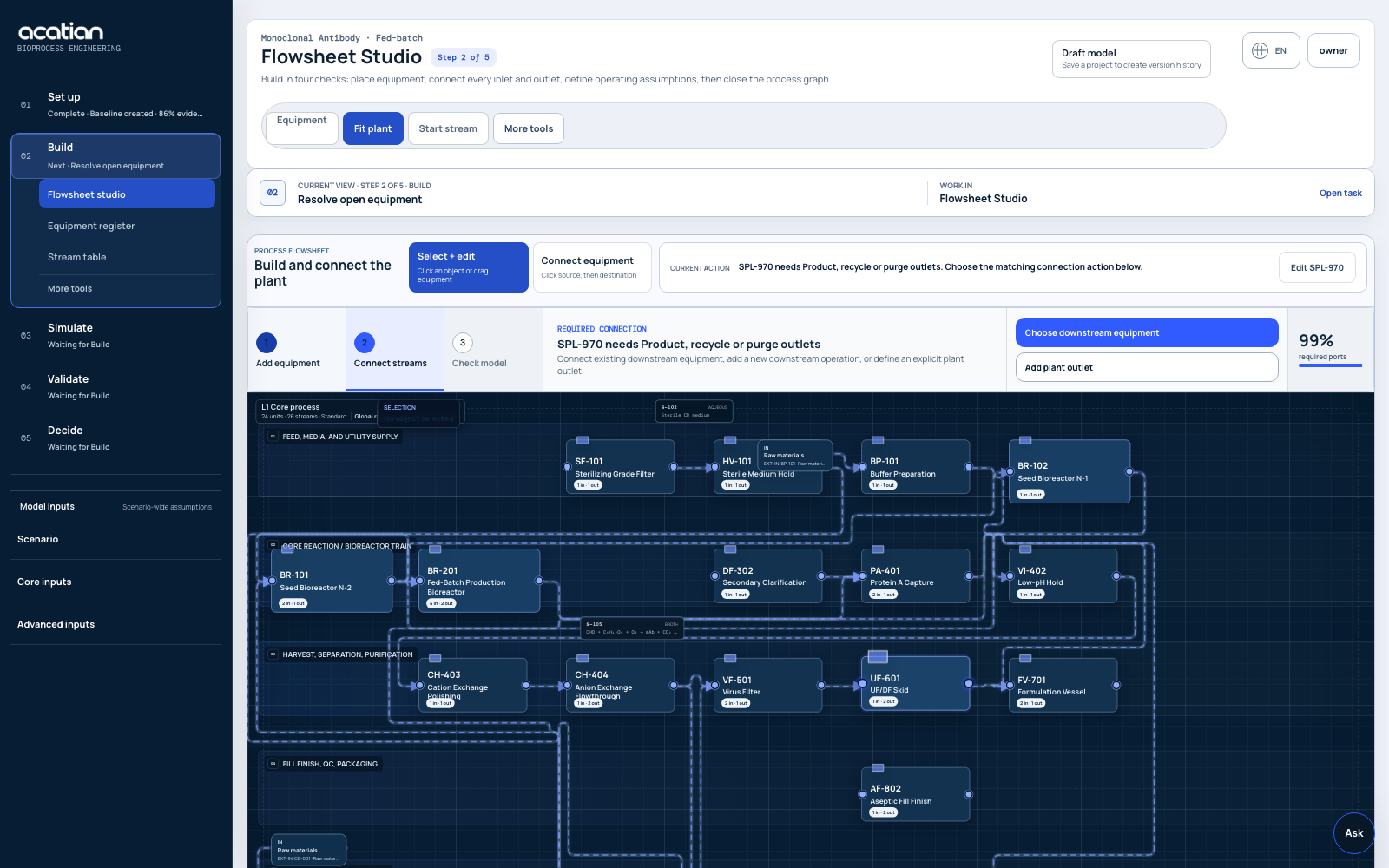
1.5 L DoE15 / 20 L75 L500 L1,500 LDSPCMO transfer
Decision model
A bounded question with a complete plant consequence.
1.5 L DoE through confirmation, optional 75 L engineering run, 500 L pilot, 1,500 L demonstration, harvest/DSP, analytics and external CMO slot.
Equations and accounting rules
Expected runs and time from a stage-gate probability treeScale fidelity across kLa, P/V, tip speed, mixing and heat marginComponent balance from harvest through DSP recoveryFinite asset schedule with analytical and external waitsBase, alternative and stress cases
- Direct 20→500 L jump
- Conservative 20→75→500 L
- Additional 1.5 L replicates
- Oxygen limitation, failed pilot or delayed CMO
Engineering brief
Model the complete decision, not an isolated unit operation.
Boston Bioprocess publicly lists a stepwise 1.5–1,500 L fermentation scale ladder with downstream development and external CMO transfer support.
The public equipment scales anchor eligibility only. Calendars, prices, organisms, yields, success probabilities and customer work are synthetic.
01 · Model basis
What the Acatian model needs to resolve
Inputs, mechanisms, limits and outputs remain reviewable on one declared basis.Inputs
Organism, mode and process trajectory
Vessel geometry and scale criteria
Replicates, gate thresholds and repeat probability
DSP route, analytics, calendars and CMO window
Mechanisms
Expected runs and time from a stage-gate probability tree
Scale fidelity across kLa, P/V, tip speed, mixing and heat margin
Component balance from harvest through DSP recovery
Finite asset schedule with analytical and external waits
Constraints
Oxygen, heat, mixing and viscosity
Seed and equipment availability
DSP yield and analytical turnaround
External CMO transfer window
Outputs
Recommended gate sequence and calendar
Expected runs, material, time and cost
Scale risk by criterion
DSP recovery and asset utilisation
02 · Acatian workflow
Build it in six controlled steps
Each step creates a reviewable object, not a hidden spreadsheet assumption.- 01
Define product, scale target and success criteria.
- 02
Map vessel geometry and scale evidence.
- 03
Build gate probability and replicate logic.
- 04
Schedule seed, fermenters, DSP and analytics.
- 05
Stress failures and external-slot delays.
- 06
Choose the lowest-risk evidence path.
03 · Decisions
Questions the model should answer
Is the 75 L gate worth its time?
How many replicates reduce expected failure?
Which scale criterion controls the jump?
When should DSP development move earlier?
04 · Evidence boundary
Validate before the result carries weight
Validation
Require unit-consistent scale criteria, probability-tree closure, no schedule overlap, genealogy and comparison to authorised scale and DSP results.
Limitations
This is not a Boston Bioprocess schedule, price list or customer result and does not claim Acatian integration with the company.
Public evidence
What the company context supports—and what it does not.
Sources establish the public process architecture. They do not reveal private operating parameters, site performance or an Acatian relationship.Frequently asked questions
Practical modelling questions
Is this the named organisation's real plant model?
No. It is an independent hypothetical Acatian study based only on the cited public process architecture. It claims no affiliation, endorsement, deployment, confidential data or actual plant performance.
Where do the numerical inputs come from?
Every input must be marked as a public fact, literature estimate, transparent engineering assumption or authorised customer input. The public article does not invent private operating values.
Can the model be calibrated to a real facility?
Yes, when the operator supplies authorised process, equipment, schedule and utility evidence and agrees the intended use, acceptance criteria and validation plan.