Advance one route, scale, site or manufacturing strategy only after product quality, process robustness, equipment fit, campaign capacity, utilities, economics, environmental constraints and technology-transfer evidence remain consistent.
Independent company use-case study · pharmaceutical CDMO
Five ways Lonza could use Acatian
Connect a customer molecule from development evidence to scalable manufacturing, capacity, resources and transfer governance without claiming access to any Lonza project or site data.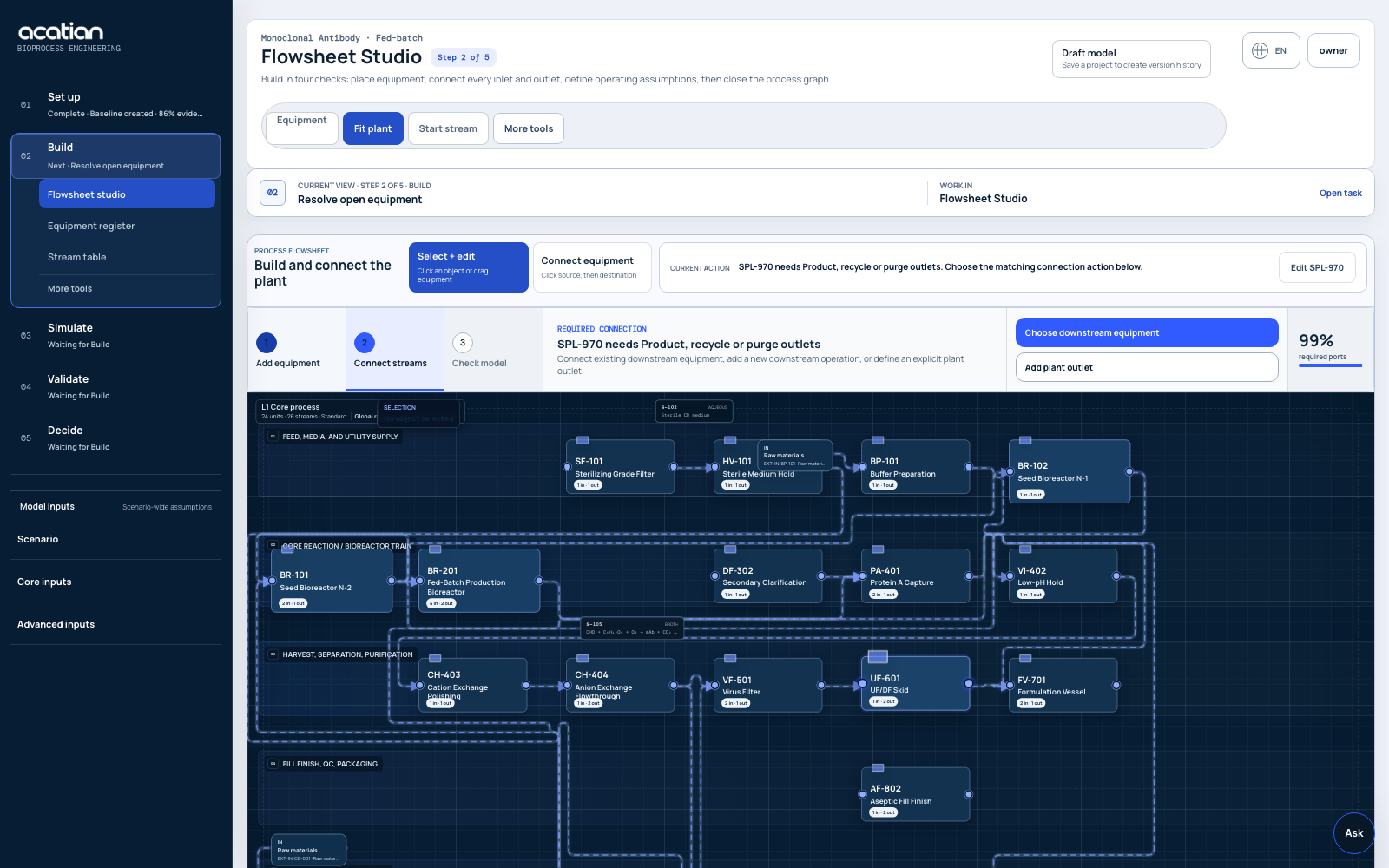
MoleculeRouteDevelopScaleTransferManufactureRelease
Decision model
A bounded question with a complete plant consequence.
Authorised raw materials, cell bank or starting API through drug-substance and relevant drug-product operations, cleaning, utilities, quality holds, waste, transfer and released customer product.
Equations and accounting rules
Released product = starts × route yield × step recoveries × conformance × releaseScale duty follows kinetics, mixing, heat transfer, mass transfer and critical-quality limitsFinite capacity prohibits overlap across qualified equipment, room, labor, utility and quality resourcesScenario value = released product value − material − conversion − facility − risk and loss costsBase, alternative and stress cases
- Alternative synthetic, biological or formulation route
- Clinical, launch and commercial demand scales
- Base, yield loss, deviation, outage and transfer-delay cases
- Site allocation, energy, water, solvent and waste-reduction options
Five practical use cases
Where Acatian could support Lonza
Each use case is a proposed evaluation scope, not a claim about current software use.Compare development routes on a manufacturing basis
Carry route-scouting, HTE or process-development candidates into material demand, impurities, equipment duties, isolation, yield, cost and scale consequences before a route is locked.
Build predictive scale-up and transfer envelopes
Connect mechanistic and empirical evidence to mixing, mass transfer, heat, reaction, bioreactor, separation, drying or lyophilisation limits with explicit acceptance criteria for the receiving scale.
Test customer-program capacity offline
Schedule qualified equipment, rooms, cleaning, containment, labor, assays and release holds across illustrative campaigns to evaluate delivery alternatives without representing Lonza's actual portfolio or commitments.
Evaluate facility fit and site allocation
Compare customer-owned requirements with an authorised site and asset matrix, then identify equipment, utility, containment, qualification and transfer gaps before capacity is reserved.
Join economics with sustainable facility scenarios
Propagate each process option into energy, water, solvent, material, waste, capital and operating-cost inventories so sustainable-design choices remain tied to product quality and released output.
Engineering brief
Model the complete decision, not an isolated unit operation.
Lonza publicly describes integrated pharmaceutical development and manufacturing from early development to commercial supply, including AI-enabled route scouting, high-throughput experimentation, design of experiments, predictive models, PAT, scale-up and technology transfer. Its environmental programme covers energy, water, materials, waste and sustainable design for new assets and buildings.
Acatian could provide an independent customer-process decision layer connecting authorised chemistry or biology, equipment, schedules, utilities, cost, environmental inventory and evidence. It would not replace Lonza's development platforms, MES, LIMS, quality systems, process-control tools, regulatory services or customer-governance procedures.
01 · Model basis
What the Acatian model needs to resolve
Inputs, mechanisms, limits and outputs remain reviewable on one declared basis.Inputs
Molecule, product, quality, demand and development-stage basis
Reaction, kinetic, cell-culture, purification and formulation evidence
Equipment eligibility, scale rules, hold times and site calendars
Materials, utilities, waste, cost and environmental factors
Mechanisms
Released product = starts × route yield × step recoveries × conformance × release
Scale duty follows kinetics, mixing, heat transfer, mass transfer and critical-quality limits
Finite capacity prohibits overlap across qualified equipment, room, labor, utility and quality resources
Scenario value = released product value − material − conversion − facility − risk and loss costs
Constraints
Critical quality, impurity, containment and product-stability limits
Reaction, bioreactor, separation, drying and formulation envelopes
Qualified site, equipment, cleaning, hold and release dependencies
Energy, water, solvent, waste, room and environmental capacity
Outputs
Route and process-design comparison
Scale-up, facility-fit and technology-transfer package
Finite campaign schedule and released-capacity range
Cost, resource, environmental and evidence-gap register
02 · Acatian workflow
Build it in six controlled steps
Each step creates a reviewable object, not a hidden spreadsheet assumption.- 01
Select one customer-authorised molecule and decision.
- 02
Declare route, product, quality and containment boundaries.
- 03
Import development, scale-up and equipment evidence.
- 04
Build finite-capacity manufacturing and quality schedules.
- 05
Stress route, scale, site, resource and demand alternatives.
- 06
Review transfer and validation gaps before the next commitment.
03 · Decisions
Questions the model should answer
Which route remains robust and economical at the target scale?
Which scale-dependent duty threatens quality or throughput?
Does the authorised facility configuration fit the customer process?
Which resource or quality gate controls the delivery range?
What evidence must transfer before manufacturing can proceed?
04 · Evidence boundary
Validate before the result carries weight
Validation
Reconcile balances, kinetics, equipment occupancy, PAT signals, resource meters, quality results and release timing against authorised development and manufacturing records. Validate every molecule, route, site, scale and context of use independently.
Limitations
No Lonza customer, molecule, process, site, schedule, yield, cost, quality result, capacity commitment or digital system is represented. Process validation, technology transfer, GxP, safety, regulatory and commercial decisions remain under approved Lonza and customer systems.
Public evidence
What the company context supports—and what it does not.
Sources establish the public process architecture. They do not reveal private operating parameters, site performance or an Acatian relationship.- Lonza — Data-driven drug developmentOfficial context for AI route scouting, high-throughput experimentation, DoE, model-based optimisation, digital twins, scale-up and technology transfer.
- Lonza — Predictive models and PAT for biologics manufacturingOfficial context for predictive modelling, PAT, bioreactor scale-up, lyophilisation, technology transfer and lifecycle process robustness.
- Lonza — EnvironmentOfficial context for energy, water, material and waste management plus sustainable design standards for facilities and assets.
Frequently asked questions
Practical modelling questions
Is Lonza an Acatian customer?
Not to Acatian's knowledge. This independent article describes five hypothetical uses based only on cited public information. It claims no affiliation, endorsement, deployment, confidential data or actual plant performance.
Does the article reproduce a real company model?
No. Unreported recipes, equipment, schedules, costs and performance values must remain explicit assumptions until the company supplies authorised evidence for a bounded project.
How would a real evaluation start?
Select one company-owned process decision, agree the system boundary and acceptance criteria, import only authorised evidence, and compare Acatian results with an approved reference before expanding the scope.