Accept, defer or decline a candidate campaign—and identify whether another reactor, downstream asset, WFI expansion or changeover reduction creates the greatest capacity value.
Independent model study · mammalian CDMO
Accept the next biologics campaign only when the whole facility fits
Test whether production reactors, downstream suites, buffer holds, WFI, changeovers, analytics or labour bind before a commercial slot is promised.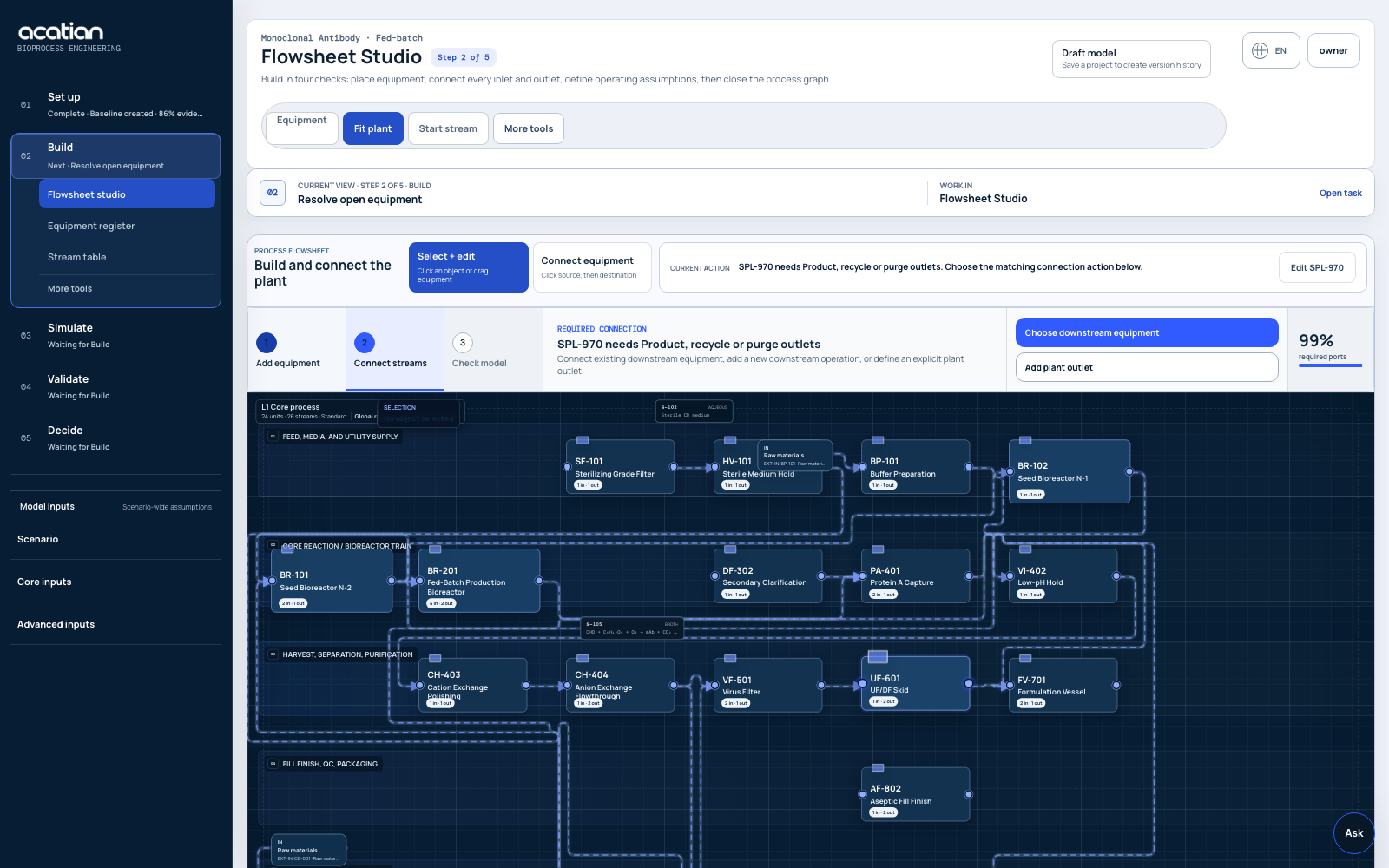
SeedProductionHarvestCapturePolishUF/DFBulk fill
Decision model
A bounded question with a complete plant consequence.
Inoculum through bulk drug substance, including media/buffer preparation, clean rooms, columns, tanks, WFI, CIP/SIP, cold storage, QC sampling and release holds.
Equations and accounting rules
Batch output = working volume × titer × DSP yieldColumn load ≤ DBC × resin volume × safety utilisationOne task per exclusive resource plus sequence-dependent setup cₚ,q,uOTIF = accepted lots delivered on time / accepted lotsBase, alternative and stress cases
- Long campaigns versus frequent changeovers
- New high-volume molecule in the demand mix
- Production line outage or chromatography rework
- Additional buffer tank, WFI or capture skid
Engineering brief
Model the complete decision, not an isolated unit operation.
Lonza publicly describes multi-product mammalian capacity at several scales, including 12,000 L and 25,000 L reactors. The study uses those public scale classes only to frame a reusable CDMO planning problem.
All molecule recipes, titers, customers, campaign orders, changeover matrices and utilisation values are synthetic. The model asks whether a candidate campaign is feasible, not whether any named facility has a problem.
01 · Model basis
What the Acatian model needs to resolve
Inputs, mechanisms, limits and outputs remain reviewable on one declared basis.Inputs
Product recipes, culture durations, titers and yields
Equipment eligibility, campaign size and due dates
Buffer recipes, WFI draws and hold limits
Changeover, QC, labour and maintenance calendars
Mechanisms
Batch output = working volume × titer × DSP yield
Column load ≤ DBC × resin volume × safety utilisation
One task per exclusive resource plus sequence-dependent setup cₚ,q,u
OTIF = accepted lots delivered on time / accepted lots
Constraints
Suite segregation and cleaning validation
Buffer/WFI time-series inventory
Column cycles, pool volumes and maximum holds
QC release, labour and maintenance availability
Outputs
Feasible Gantt schedule and start date
Accepted kg, OTIF and late lots
Suite, WFI and buffer utilisation
Contribution per constrained suite-hour
02 · Acatian workflow
Build it in six controlled steps
Each step creates a reviewable object, not a hidden spreadsheet assumption.- 01
Define the candidate contract and due-date window.
- 02
Create product-specific recipes and resource eligibility.
- 03
Close material, buffer and column-cycle balances.
- 04
Apply cleaning, hold, QC and labour calendars.
- 05
Solve alternative campaign sequences and outages.
- 06
Return feasibility, bottleneck and data-gap evidence.
03 · Decisions
Questions the model should answer
Can the proposed campaign fit without breaking existing delivery?
Which shared resource controls the slot?
Is CAPEX or sequencing the better intervention?
What downside case should commercial terms recognise?
04 · Evidence boundary
Validate before the result carries weight
Validation
Verify material genealogy, equipment no-overlap, cleaning precedence, WFI inventory, hold compliance and schedule reproduction against authorised historical campaigns.
Limitations
No Lonza customer, recipe, utilisation, commercial slot or actual facility schedule is represented. The model is a planning pattern, not an operational commitment.
Public evidence
What the company context supports—and what it does not.
Sources establish the public process architecture. They do not reveal private operating parameters, site performance or an Acatian relationship.Frequently asked questions
Practical modelling questions
Is this the named organisation's real plant model?
No. It is an independent hypothetical Acatian study based only on the cited public process architecture. It claims no affiliation, endorsement, deployment, confidential data or actual plant performance.
Where do the numerical inputs come from?
Every input must be marked as a public fact, literature estimate, transparent engineering assumption or authorised customer input. The public article does not invent private operating values.
Can the model be calibrated to a real facility?
Yes, when the operator supplies authorised process, equipment, schedule and utility evidence and agrees the intended use, acceptance criteria and validation plan.