Prioritise higher fermentation titer, greater downstream recovery, membrane pre-concentration, heat recovery or lower-carbon steam.
Independent model study · fermentation sweetener
Find whether titer, recovery or lower-carbon concentration matters most
Connect yeast-fermentation performance to purification recovery, water removal, cost and cradle-to-gate carbon on one accepted-product basis.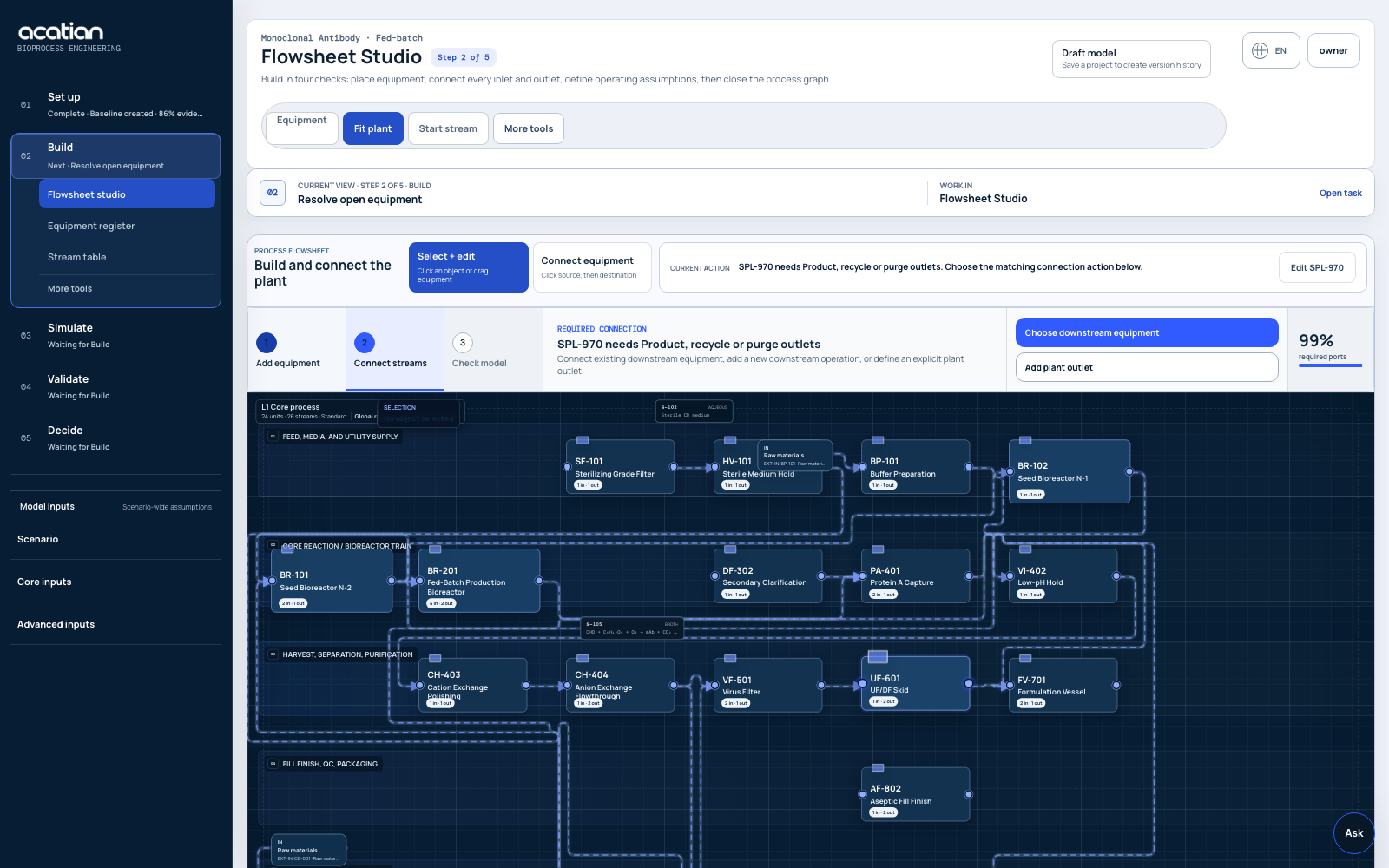
SugarYeast fermentationInactivationClarificationConcentrationPurificationFinish
Decision model
A bounded question with a complete plant consequence.
Sugar preparation through fermentation, inactivation, clarification, concentration, purification/crystallisation abstraction, drying, biomass and wastewater.
Equations and accounting rules
Product = substrate × YP/S × fermentation conversionOTR = kLa(C* − CL) ≥ OUROverall recovery = product of step recoveriesCarbon intensity = sum(activity × factor) / accepted kgBase, alternative and stress cases
- +25% titer
- +5 recovery percentage points
- Membrane pre-concentration and heat recovery
- Low-carbon steam and energy-price stress
Engineering brief
Model the complete decision, not an isolated unit operation.
dsm-firmenich and Cargill publicly describe EverSweet as fermentation-derived, while regulatory material supports a generic cell-inactivation, removal and purification architecture for Reb M.
This model calculates its own transparent hypothetical inventory. It does not reproduce a proprietary strain, recipe or first-party LCA and does not treat company-reported comparisons as independent Acatian results.
01 · Model basis
What the Acatian model needs to resolve
Inputs, mechanisms, limits and outputs remain reviewable on one declared basis.Inputs
Sugar assay, yield, titer and OUR
Cell solids and clarification flux
Purification recovery, purity and water removal
Utility cost and traceable emission factors
Mechanisms
Product = substrate × YP/S × fermentation conversion
OTR = kLa(C* − CL) ≥ OUR
Overall recovery = product of step recoveries
Carbon intensity = sum(activity × factor) / accepted kg
Constraints
Oxygen/cooling and broth solids
Clarification and concentration capacity
Purity, crystallisation and drying
Equivalent LCA boundary and factor quality
Outputs
Accepted kg and overall recovery
Sugar, water and energy intensity
Residual COD and equipment hours
Cost/carbon contribution and break-even target
02 · Acatian workflow
Build it in six controlled steps
Each step creates a reviewable object, not a hidden spreadsheet assumption.- 01
Declare product and inventory boundaries.
- 02
Build fermentation mass and oxygen balances.
- 03
Add cell removal and concentration.
- 04
Parameterise purification and finishing.
- 05
Attach cost and emission-factor provenance.
- 06
Rank interventions under uncertainty.
03 · Decisions
Questions the model should answer
Does titer or recovery create more accepted product?
Which unit dominates water removal?
When does low-carbon steam beat yield work?
Which unknown needs a pilot measurement?
04 · Evidence boundary
Validate before the result carries weight
Validation
Verify component closure, titer and OUR trajectories, recovery, purity, energy and accepted-product denominator against authorised runs.
Limitations
No Avansya production strain, yield, equipment or commercial footprint is represented. Comparisons require equivalent system boundaries and sourced factors.
Public evidence
What the company context supports—and what it does not.
Sources establish the public process architecture. They do not reveal private operating parameters, site performance or an Acatian relationship.Frequently asked questions
Practical modelling questions
Is this the named organisation's real plant model?
No. It is an independent hypothetical Acatian study based only on the cited public process architecture. It claims no affiliation, endorsement, deployment, confidential data or actual plant performance.
Where do the numerical inputs come from?
Every input must be marked as a public fact, literature estimate, transparent engineering assumption or authorised customer input. The public article does not invent private operating values.
Can the model be calibrated to a real facility?
Yes, when the operator supplies authorised process, equipment, schedule and utility evidence and agrees the intended use, acceptance criteria and validation plan.