Choose a feed blend and severity policy that remains feasible under impurity, hydrogen, pretreatment, product-property and fractionation constraints.
Independent model study · renewable aviation fuel
Trade feedstock flexibility against hydrogen and pretreatment capacity
Test how used oils and fat residues change impurity removal, hydrogen demand, cold-flow severity, SAF yield and unit throughput.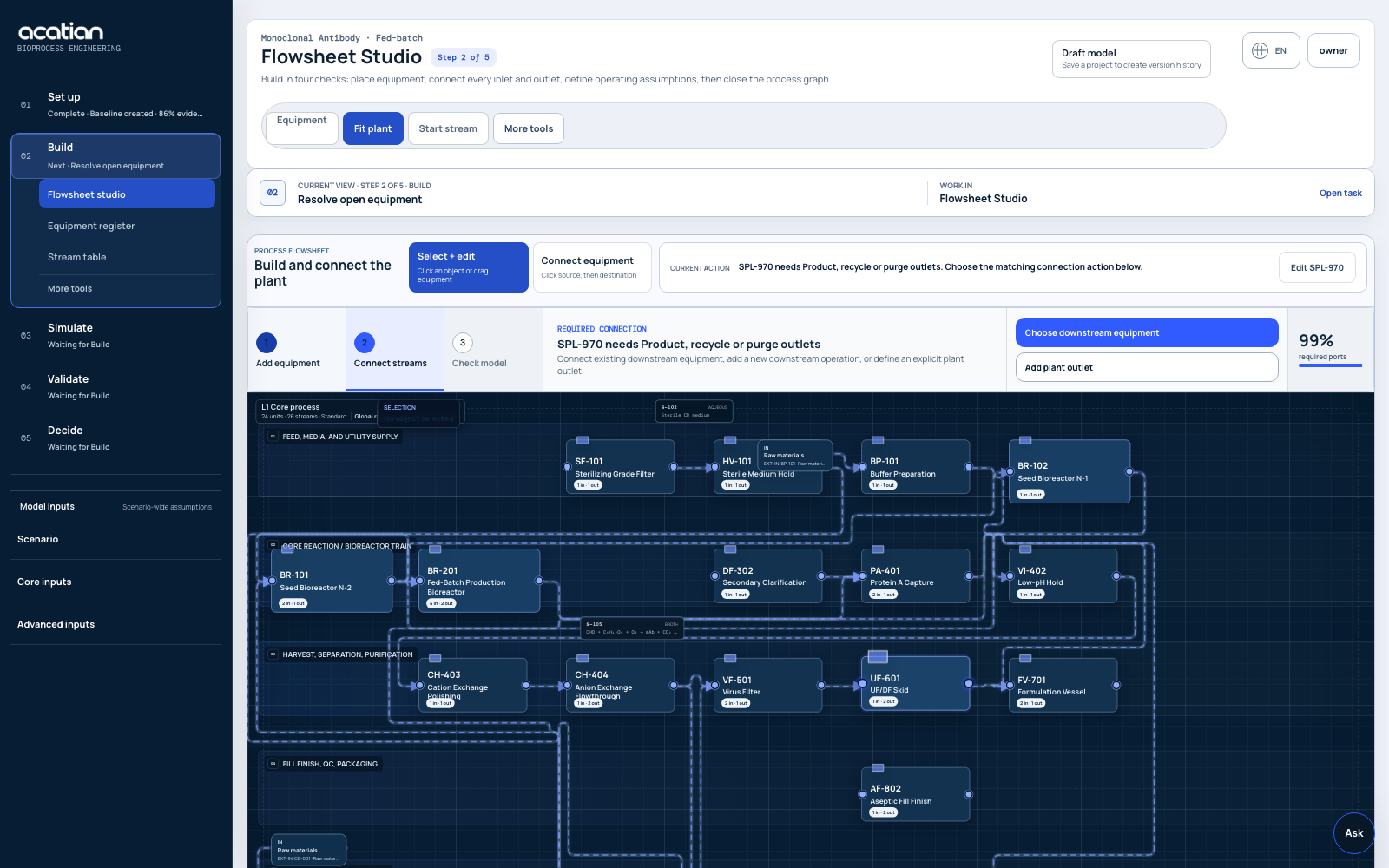
BlendPretreatHydrodeoxygenateSeparateIsomeriseFractionateSAF
Decision model
A bounded question with a complete plant consequence.
Feed receipt and blending through pretreatment, hydrodeoxygenation, gas/liquid separation, isomerisation/hydrocracking abstraction and product fractionation.
Equations and accounting rules
Elemental C/H/O and total mass balanceStoichiometric minimum H₂ plus excess/side-reaction demandFeed-property/severity yield correlationProduct-cut allocation and lifecycle activity ledgerBase, alternative and stress cases
- Used-cooking-oil-rich blend
- Animal-fat-rich and high-impurity blend
- Constrained green hydrogen
- SAF-maximising versus diesel-maximising severity
Engineering brief
Model the complete decision, not an isolated unit operation.
Neste publicly describes NEXBTL as a feed-flexible route using pretreatment, hydrogen-based deoxygenation, isomerisation and product separation.
Catalyst, operating severity, actual feed blend, yield and hydrogen intensity are proprietary. This model uses transparent public or literature ranges and clearly separates nameplate capacity from modelled production.
01 · Model basis
What the Acatian model needs to resolve
Inputs, mechanisms, limits and outputs remain reviewable on one declared basis.Inputs
Feed FFA, water, P, metals, N/S and chain distribution
Pretreatment losses and capacity
Hydrogen purity, consumption and availability
Conversion, selectivity, product cuts and utility factors
Mechanisms
Elemental C/H/O and total mass balance
Stoichiometric minimum H₂ plus excess/side-reaction demand
Feed-property/severity yield correlation
Product-cut allocation and lifecycle activity ledger
Constraints
Feed contaminants and pretreatment
Hydrogen and reactor LHSV
Cold-flow/product specifications
Fractionation, storage and traceability
Outputs
SAF, diesel and co-product tonnes
Hydrogen kg/t and carbon efficiency
Pretreatment loss and unit utilisation
Margin and carbon-intensity contributions
02 · Acatian workflow
Build it in six controlled steps
Each step creates a reviewable object, not a hidden spreadsheet assumption.- 01
Define feed assays and traceability boundary.
- 02
Close elemental and pretreatment balances.
- 03
Calculate hydrogen and conversion envelope.
- 04
Allocate products through fractionation.
- 05
Add equipment, utilities and inventory.
- 06
Compare margin and carbon under uncertainty.
03 · Decisions
Questions the model should answer
Which feed has the highest marginal value?
Is hydrogen or pretreatment limiting?
How much SAF yield is robust?
Which impurity drives downside risk?
04 · Evidence boundary
Validate before the result carries weight
Validation
Reconcile feed assays, elemental closure, hydrogen, product cuts and utilities against authorised operating or licensor evidence before decision use.
Limitations
This is not a Neste or licensor reactor design and makes no fuel-certification claim. Lifecycle results require jurisdiction-specific rules and traceable factors.
Public evidence
What the company context supports—and what it does not.
Sources establish the public process architecture. They do not reveal private operating parameters, site performance or an Acatian relationship.Frequently asked questions
Practical modelling questions
Is this the named organisation's real plant model?
No. It is an independent hypothetical Acatian study based only on the cited public process architecture. It claims no affiliation, endorsement, deployment, confidential data or actual plant performance.
Where do the numerical inputs come from?
Every input must be marked as a public fact, literature estimate, transparent engineering assumption or authorised customer input. The public article does not invent private operating values.
Can the model be calibrated to a real facility?
Yes, when the operator supplies authorised process, equipment, schedule and utility evidence and agrees the intended use, acceptance criteria and validation plan.