Feedstock composition, moisture, ash and delivered cost
Biofuel plant · process model
How to model a biofuel plant in Acatian
Connect feedstock variability, reaction or fermentation, recovery, energy integration and plant economics in one reviewable model.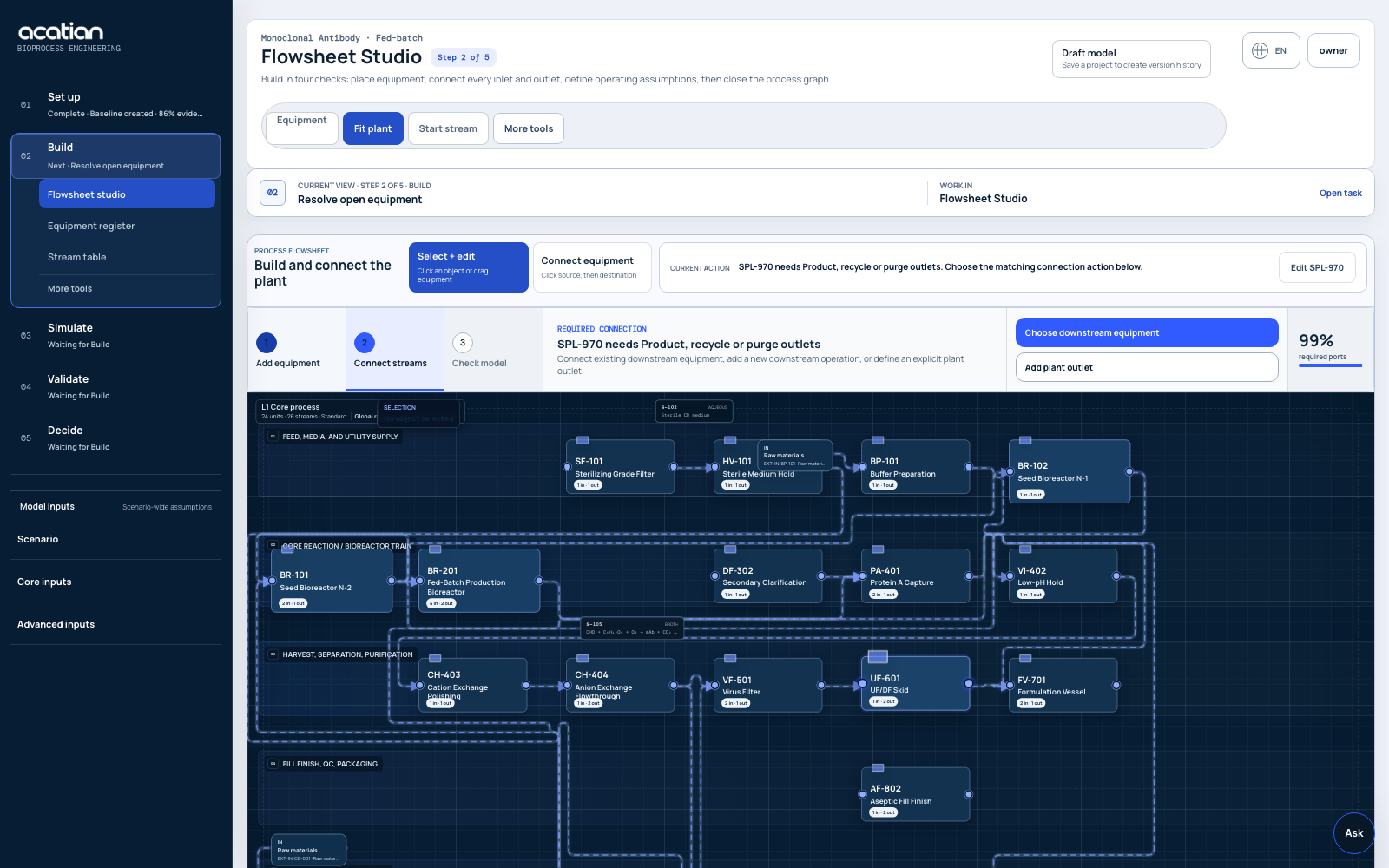
FeedstockPretreatmentConversionRecoveryUpgradingUtilitiesProduct
Engineering brief
Model the complete decision, not an isolated unit operation.
A credible biofuel plant model starts with the actual feedstock and ends with saleable product, coproducts, emissions and wastewater. Acatian keeps component balances, unit operations, batch or continuous timing, utilities, cost and environmental inventory on the same declared basis.
The useful question is not only whether conversion is technically possible. The model must show which combination of feedstock composition, yield, residence time, separation duty, heat recovery and annual availability controls product cost and plant capacity.
01 · Model basis
What the Acatian model needs to resolve
Inputs, mechanisms, limits and outputs remain reviewable on one declared basis.Inputs
Stoichiometry, kinetics, yield and conversion ranges
Separation recoveries, solvent or water use and recycle
Steam, electricity, cooling, compression and wastewater loads
Mechanisms
Component mass and elemental balances
Reaction, fermentation or catalytic conversion models
Phase separation, recovery and recycle convergence
Equipment occupancy, utility peaks and annual production
Constraints
Inhibitors and feedstock variability
Reactor residence time or fermentation productivity
Distillation, drying or upgrading energy
Storage, campaign and maintenance availability
Outputs
Fuel yield and annual saleable output
CAPEX, OPEX, minimum selling-price scenarios
Utility and wastewater bottlenecks
Carbon and energy inventory with sensitivity ranks
02 · Acatian workflow
Build it in six controlled steps
Each step creates a reviewable object, not a hidden spreadsheet assumption.- 01
Declare fuel, feedstock, scale and product specification.
- 02
Build a component ledger and process flowsheet.
- 03
Add conversion kinetics or measured yield envelopes.
- 04
Size recovery, upgrading and recycle equipment.
- 05
Schedule the plant and reconcile utility peaks.
- 06
Compare TEA/LCA scenarios and document validation gaps.
03 · Decisions
Questions the model should answer
Which feedstock window remains operable?
Where does another yield point have economic value?
Which separation or heat-integration change removes the bottleneck?
What plant availability is required for the investment case?
04 · Evidence boundary
Validate before the result carries weight
Validation
Reconcile the model against independent pilot or plant data for feed composition, conversion, product recovery, utility consumption and elapsed time. A screening TEA is not a bankable engineering design.
Limitations
Acatian supports process modelling and engineering review; it does not replace hazardous-area design, relief studies, emissions permitting, detailed mechanical design or professional approval.
Frequently asked questions
Practical modelling questions
Can Acatian model different biofuel routes?
Yes. The flowsheet can represent biochemical, thermochemical and catalytic routes, provided the relevant reactions, phase behaviour, equipment constraints and evidence are supplied.
Can the model include coproduct credits?
Yes. Coproduct mass, quality, market assumptions and allocation method can be explicit so the economic and environmental effect remains reviewable.
Does the model include TEA and LCA?
Yes. Materials, utilities, equipment, labor, waste and emissions can feed scenario-based TEA and LCA on the reconciled process basis.