Choose zero, one, two or three partial withdrawals and their timing to maximise accepted annual lysine-equivalent output.
Independent model study · dynamic amino-acid fermentation
Test whether repeated broth withdrawal improves annual lysine output
Optimise draw fraction and timing only after dilution, oxygen, heat, evaporator, granulator and cleaning consequences are included.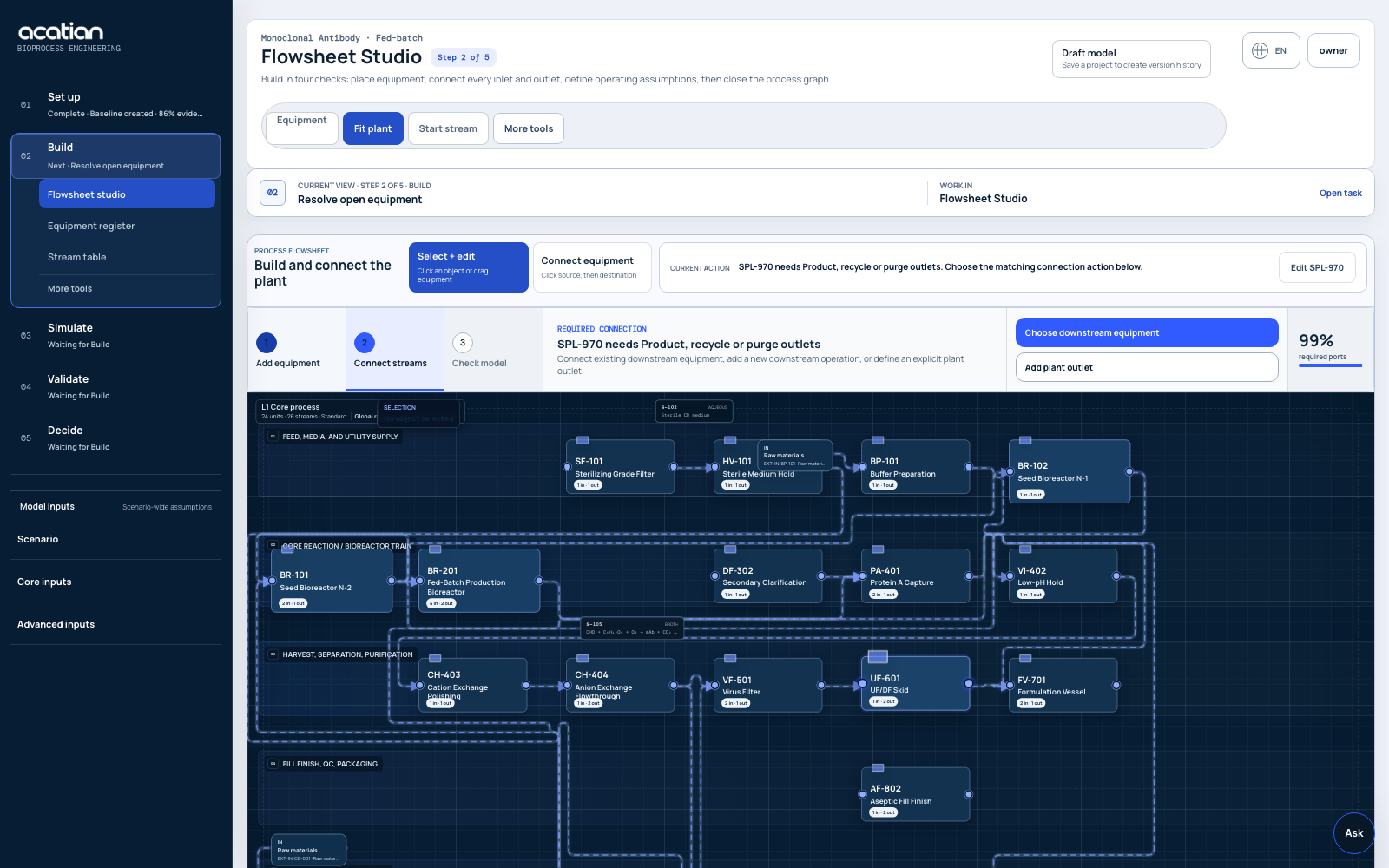
DextroseSeedFermentDraw / refillEvaporateGranulatePack
Decision model
A bounded question with a complete plant consequence.
Dextrose/media and seed through dynamic fermentation with discrete draw/refill events, inactivation, evaporation, granulation, packaging, condensate and CIP.
Equations and accounting rules
Mᵢ⁺ = Mᵢ⁻(1 − f draw) + Mᵢ,refill at each eventDynamic biomass, substrate, lysine and volume balancesOUR ≤ OTR and generated heat ≤ removed heatEvaporator water and granulator solids/moisture balancesBase, alternative and stress cases
- Batch versus one, two and three draws
- Alternative draw fractions and timing
- Air-only versus oxygen enrichment
- Evaporator/granulator bottleneck and condensate reuse
Engineering brief
Model the complete decision, not an isolated unit operation.
Evonik publicly describes a historical Biolys process shift to partial broth withdrawal and refill during Corynebacterium cultivation, followed by evaporation and granulation.
The reported historical productivity improvement is context, not a guaranteed model result. Vessel scale, strain kinetics, draw policy and utility duties remain hypothetical.
01 · Model basis
What the Acatian model needs to resolve
Inputs, mechanisms, limits and outputs remain reviewable on one declared basis.Inputs
Working volume, draw fraction and refill recipe
Growth, yield, productivity, OUR and kLa
Evaporator economy and granulator rate
Product composition, cleaning and campaign calendar
Mechanisms
Mᵢ⁺ = Mᵢ⁻(1 − f draw) + Mᵢ,refill at each event
Dynamic biomass, substrate, lysine and volume balances
OUR ≤ OTR and generated heat ≤ removed heat
Evaporator water and granulator solids/moisture balances
Constraints
Oxygen, cooling and working volume
Dilution and metabolic-state recovery
Evaporator and granulator occupancy
Condensate, packaging and CIP
Outputs
Lysine-equivalent mass/campaign
Sugar conversion and retained biomass
Oxygen/cooling peaks and water removed
Annual tonnes, energy and optimal draw policy
02 · Acatian workflow
Build it in six controlled steps
Each step creates a reviewable object, not a hidden spreadsheet assumption.- 01
Set batch and product basis.
- 02
Fit dynamic fermentation states.
- 03
Insert discrete withdrawal/refill events.
- 04
Test oxygen, cooling and volume limits.
- 05
Schedule evaporation, granulation and CIP.
- 06
Compare annual accepted output and energy.
03 · Decisions
Questions the model should answer
How many draws are actually capacity-positive?
Does dilution recover productivity?
When does downstream erase the gain?
Which event data is required for calibration?
04 · Evidence boundary
Validate before the result carries weight
Validation
Require event-by-event mass closure, timestep independence, measured gas and broth states, downstream water/solids reconciliation and campaign reproduction.
Limitations
No Evonik strain, vessel, operating policy or actual productivity is represented. The model does not replace control, biosafety or feed-product qualification.
Public evidence
What the company context supports—and what it does not.
Sources establish the public process architecture. They do not reveal private operating parameters, site performance or an Acatian relationship.Frequently asked questions
Practical modelling questions
Is this the named organisation's real plant model?
No. It is an independent hypothetical Acatian study based only on the cited public process architecture. It claims no affiliation, endorsement, deployment, confidential data or actual plant performance.
Where do the numerical inputs come from?
Every input must be marked as a public fact, literature estimate, transparent engineering assumption or authorised customer input. The public article does not invent private operating values.
Can the model be calibrated to a real facility?
Yes, when the operator supplies authorised process, equipment, schedule and utility evidence and agrees the intended use, acceptance criteria and validation plan.