Classify SKUs for family campaigns, make-to-order, make-to-stock or retirement while meeting service and quality constraints.
Independent model study · specialty ingredients
Decide which SKUs deserve scarce reactor and changeover time
Campaign product families together—or retire them—only after service, cleaning, inventory age, off-spec risk and margin remain visible.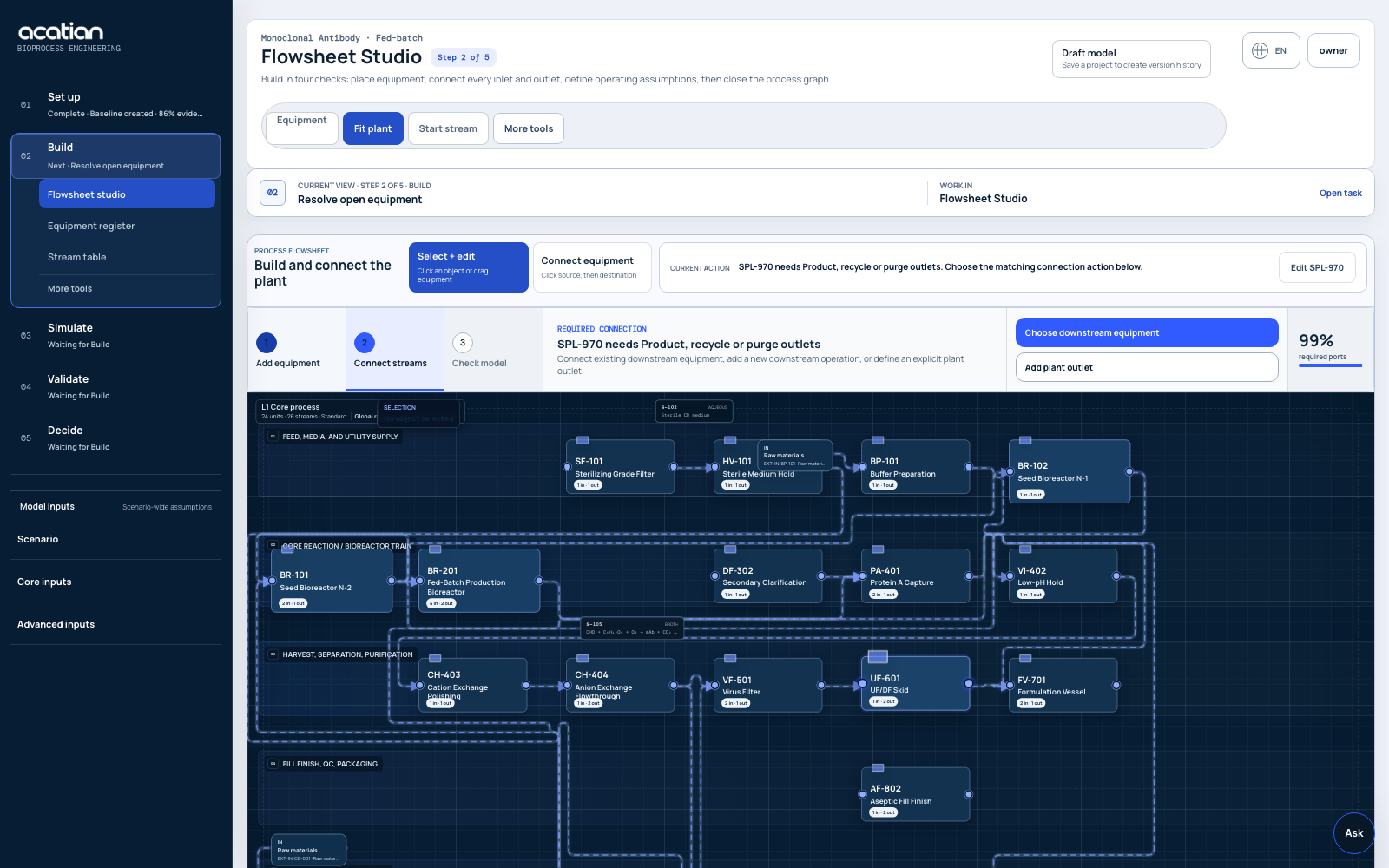
Raw materialReactRefinePurifyHoldQCPack
Decision model
A bounded question with a complete plant consequence.
Raw-material receipt through route-specific reaction abstraction, refinement, purification, hold, QC, packaging, warehouse, cleaning and rework.
Equations and accounting rules
Finite-capacity task schedule with no resource overlapSequence setup cₚ,q includes time, flush and first-off lossInventory ages against demand and shelf lifeObjective combines lateness, changeover, margin and working capitalBase, alternative and stress cases
- Full portfolio versus bottom-decile removal
- Family campaigns
- Make-to-order versus make-to-stock
- Reactor outage, shorter wash and demand upside
Engineering brief
Model the complete decision, not an isolated unit operation.
Croda publicly describes a large specialty-ingredient portfolio, shared manufacturing sites, downstream refinement/purification and a SKU-reduction programme.
That public business architecture supports a generic portfolio study, not an assertion that named Croda products share a line. All recipes, demand, margins and cleaning rules are synthetic.
01 · Model basis
What the Acatian model needs to resolve
Inputs, mechanisms, limits and outputs remain reviewable on one declared basis.Inputs
SKU routes, recipes, yields and eligibility
Demand, forecast error, price and margin
Sequence-dependent cleaning and compatibility
Shelf life, QC, packaging and warehouse limits
Mechanisms
Finite-capacity task schedule with no resource overlap
Sequence setup cₚ,q includes time, flush and first-off loss
Inventory ages against demand and shelf life
Objective combines lateness, changeover, margin and working capital
Constraints
Equipment compatibility and utility peaks
Cleaning validation and segregation
Shelf life, demand and warehouse
QC release, rework and packaging formats
Outputs
OTIF, batches and asset utilisation
Changeover time, water and material loss
Inventory age and working capital
Margin contribution and keep/retire evidence
02 · Acatian workflow
Build it in six controlled steps
Each step creates a reviewable object, not a hidden spreadsheet assumption.- 01
Map SKUs to routes and assets.
- 02
Close recipes, yields and demand.
- 03
Build the cleaning/compatibility matrix.
- 04
Add shelf life, QC and warehouse.
- 05
Optimise campaign alternatives.
- 06
Review service, margin and working-capital trade-offs.
03 · Decisions
Questions the model should answer
Which SKU consumes disproportionate changeover?
Which family should campaign together?
Where does inventory age become risk?
Would a small dedicated asset create value?
04 · Evidence boundary
Validate before the result carries weight
Validation
Back-test schedules, cleaning, demand, inventory and service against authorised history; preserve product genealogy and every rework decision.
Limitations
This is not a Croda portfolio recommendation. Hazard analysis, recipes, customer demand and cleaning validation remain company-owned evidence.
Public evidence
What the company context supports—and what it does not.
Sources establish the public process architecture. They do not reveal private operating parameters, site performance or an Acatian relationship.Frequently asked questions
Practical modelling questions
Is this the named organisation's real plant model?
No. It is an independent hypothetical Acatian study based only on the cited public process architecture. It claims no affiliation, endorsement, deployment, confidential data or actual plant performance.
Where do the numerical inputs come from?
Every input must be marked as a public fact, literature estimate, transparent engineering assumption or authorised customer input. The public article does not invent private operating values.
Can the model be calibrated to a real facility?
Yes, when the operator supplies authorised process, equipment, schedule and utility evidence and agrees the intended use, acceptance criteria and validation plan.