Select a route and protein target based on packaged yield, acid-whey disposition, viscosity-limited filling, CIP and energy—not an isolated yield claim.
Independent model study · high-protein cultured dairy
Keep the milk solids—or separate and manage acid whey?
Compare two routes at the same packaged protein and solids target while line capacity, rheology, cleaning and side-stream burden remain visible.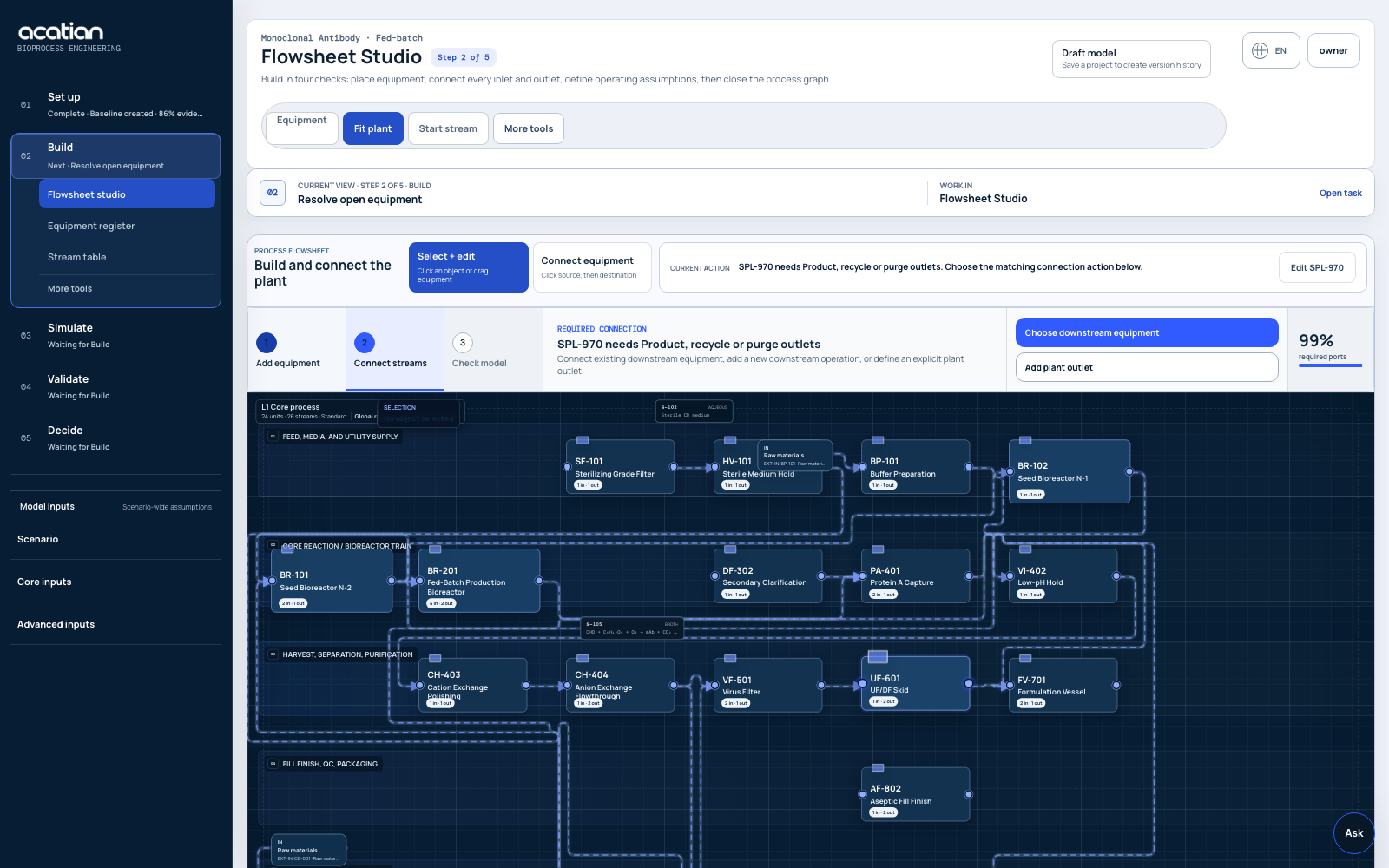
StandardiseHeatFermentSeparate / retainHomogeniseFillCold store
Decision model
A bounded question with a complete plant consequence.
Milk standardisation through heat treatment, fermentation, separation or retained-solids formulation, post-treatment, filling, cold storage, CIP and acid-whey destination.
Equations and accounting rules
Packaged yield = accepted product mass / standardised milk massProtein, fat, lactose, mineral and water balancesThermal duty = mass flow × Cp × temperature changeViscosity links pressure drop and filler throughputBase, alternative and stress cases
- Traditional strained versus retained solids
- 8% versus 12% protein
- Viscosity-limited filling and shorter CIP
- Acid whey sold, concentrated or treated
Engineering brief
Model the complete decision, not an isolated unit operation.
Arla Foods Ingredients publicly contrasts a traditional strained process that creates acid whey with a retained-solids high-yield route. The product literature supports the route comparison, not private plant KPIs.
Viscosity, recipes, cleaning frequency, heat-transfer coefficients and line losses are transparent model inputs. The study does not imply access to an Arla formulation or manufacturing line.
01 · Model basis
What the Acatian model needs to resolve
Inputs, mechanisms, limits and outputs remain reviewable on one declared basis.Inputs
Milk composition and ingredient recipe
Fermentation and separation retention
Protein/solids target and rheology
Heat treatment, filler, CIP and cold storage
Mechanisms
Packaged yield = accepted product mass / standardised milk mass
Protein, fat, lactose, mineral and water balances
Thermal duty = mass flow × Cp × temperature change
Viscosity links pressure drop and filler throughput
Constraints
Protein/solids specification
Viscosity and heat-transfer behaviour
Filler rate and cold-storage capacity
CIP sets, water and acid-whey outlet
Outputs
Packaged tonnes and milk-to-product yield
Protein recovery and acid-whey tonnes
Line utilisation and cold inventory
CIP, energy, wastewater and marginal value
02 · Acatian workflow
Build it in six controlled steps
Each step creates a reviewable object, not a hidden spreadsheet assumption.- 01
Set identical saleable-product specifications.
- 02
Close milk constituent balances.
- 03
Build the separation and retained-solids branches.
- 04
Add rheology, heat treatment and filling.
- 05
Schedule CIP, QC and cold storage.
- 06
Compare whole-line yield and burden.
03 · Decisions
Questions the model should answer
Which route creates the best accepted yield?
When does viscosity erase a yield advantage?
What is the real cost of acid whey?
Which cleaning or filling evidence is missing?
04 · Evidence boundary
Validate before the result carries weight
Validation
Reconcile constituents, packaged mass, acid-whey composition, rheology, meter data, CIP records and line speed over representative production periods.
Limitations
Product-literature claims remain attributed. The model does not reproduce an Arla recipe, actual site performance or product-quality qualification.
Public evidence
What the company context supports—and what it does not.
Sources establish the public process architecture. They do not reveal private operating parameters, site performance or an Acatian relationship.Frequently asked questions
Practical modelling questions
Is this the named organisation's real plant model?
No. It is an independent hypothetical Acatian study based only on the cited public process architecture. It claims no affiliation, endorsement, deployment, confidential data or actual plant performance.
Where do the numerical inputs come from?
Every input must be marked as a public fact, literature estimate, transparent engineering assumption or authorised customer input. The public article does not invent private operating values.
Can the model be calibrated to a real facility?
Yes, when the operator supplies authorised process, equipment, schedule and utility evidence and agrees the intended use, acceptance criteria and validation plan.