Ingredient composition, culture dose and initial conditions
Food tech · fermentation model
How to model a food fermentation process
Connect microbial and biochemical change to texture, acidity, temperature, hygienic operations, capacity and consistent product release.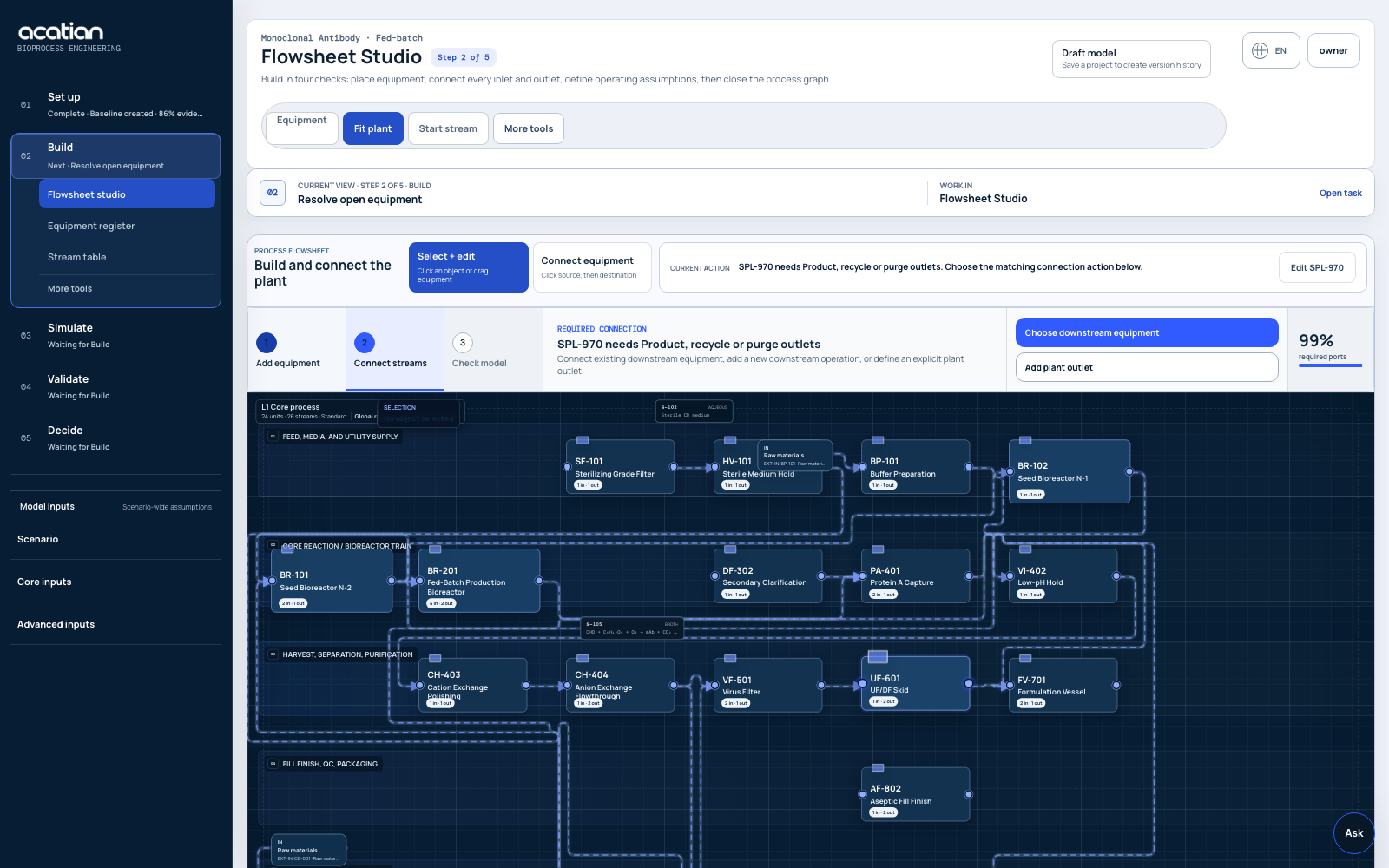
IngredientsPreparationInoculationFermentationCoolingSeparation / blendPack
Engineering brief
Model the complete decision, not an isolated unit operation.
Food fermentation combines biological trajectories with sensory, texture and safety endpoints. Acatian can model time-dependent substrate conversion, acidification, temperature and biomass while retaining the manufacturing schedule around preparation, inoculation, hold, cooling and cleaning.
The model should be product-specific. Yogurt, cultured beverages, fermented vegetables, cocoa, coffee and alternative-protein fermentations do not share one kinetic law or validation boundary.
01 · Model basis
What the Acatian model needs to resolve
Inputs, mechanisms, limits and outputs remain reviewable on one declared basis.Inputs
Acidification, growth and temperature evidence
Mixing, heat transfer, viscosity and cooling
Hygiene, allergen, hold, cleaning and packaging schedule
Mechanisms
Substrate, acid and biomass balances
Temperature-dependent kinetic states
Heating, cooling and mixing duty
Batch events and hygienic equipment occupancy
Constraints
Target pH, acidity, texture or flavor window
Cooling rate and post-acidification
Contamination and hold-time controls
Shared tanks, fillers and CIP availability
Outputs
Endpoint time and batch variability
Heating and cooling capacity
Ingredient yield and product loss
Campaign capacity, water, energy and COGS
02 · Acatian workflow
Build it in six controlled steps
Each step creates a reviewable object, not a hidden spreadsheet assumption.- 01
Name the product attributes and release window.
- 02
Map ingredients and biological transformations.
- 03
Fit kinetics within measured temperature ranges.
- 04
Connect viscosity to mixing and heat transfer.
- 05
Schedule hygienic transfers, cleaning and packing.
- 06
Validate endpoints and stress operating scenarios.
03 · Decisions
Questions the model should answer
Which endpoint signal should stop fermentation?
Can cooling prevent post-acidification?
Where does viscosity constrain scale?
How do recipe and culture changes affect capacity?
04 · Evidence boundary
Validate before the result carries weight
Validation
Validate pH or acid trajectory, temperature, viable count where relevant, texture proxy, yield and cycle time across independent lots and worst-case conditions.
Limitations
A model cannot establish food safety, HACCP controls, shelf life, sensory acceptance or regulatory compliance without qualified evidence and responsible review.
Frequently asked questions
Practical modelling questions
Can food-quality endpoints be included?
Yes, if a defensible measured relationship links them to model states; otherwise they should remain explicit validation criteria.
Can CIP and allergen changeovers be scheduled?
Yes. Cleaning recipes, holds and shared equipment can be represented as finite-capacity events.
Can the model compare culture suppliers?
Yes, using authorized performance data and a consistent recipe, endpoint and operating boundary.