Advance one product, process or packaging change only when nutrition and quality requirements, scale-up evidence, factory capacity, water and energy demand, environmental trade-offs and validation gaps remain consistent on the same released-product basis.
Independent company use-case study · food and nutrition
Five ways Danone could use Acatian
Connect nutrition and product-design choices to pilot evidence, factory physics, finite capacity and resource performance without claiming access to any Danone recipe, system or site.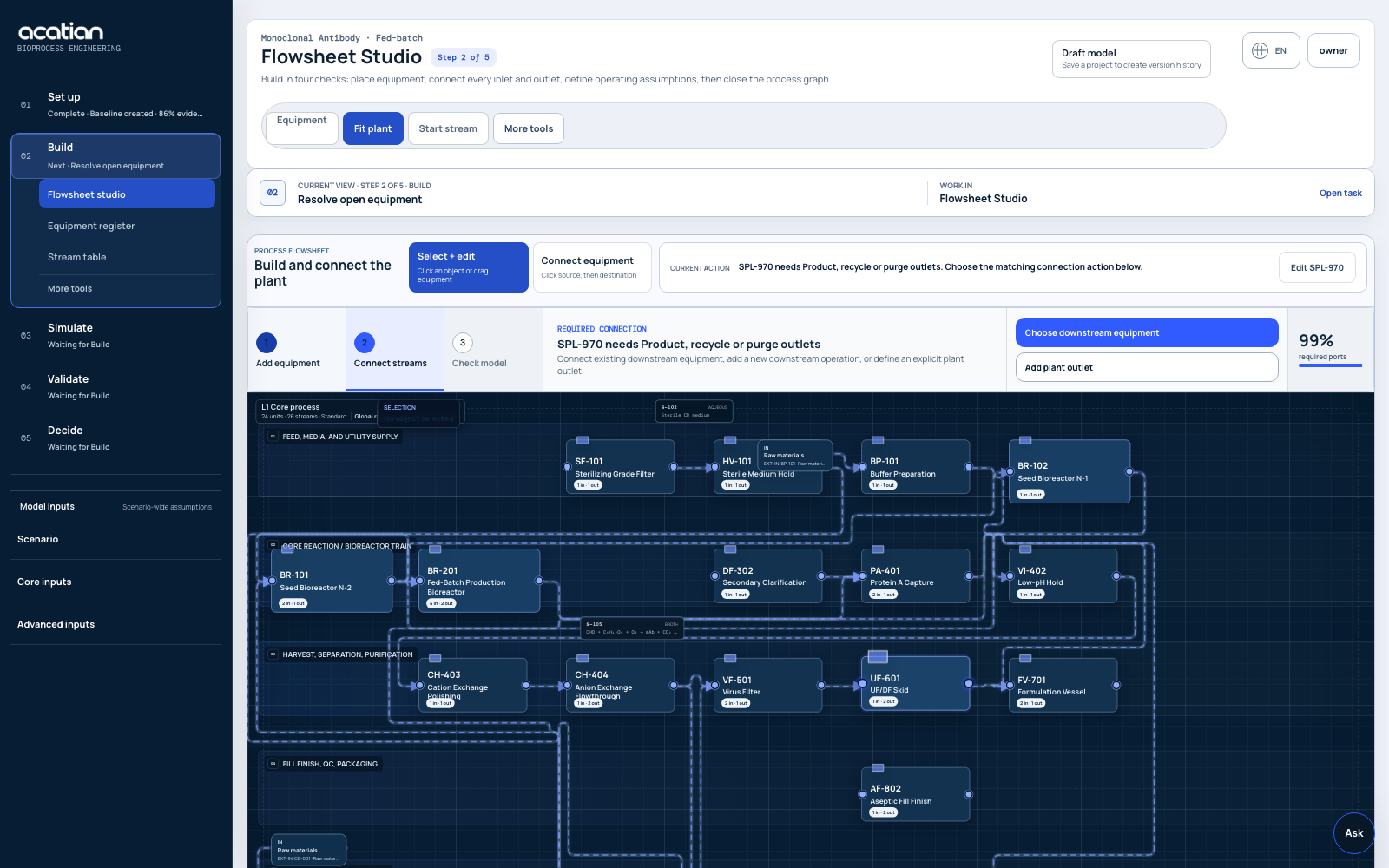
IngredientsPrototypePilotFactoryPackReleaseImprove
Decision model
A bounded question with a complete plant consequence.
Authorised ingredient, culture and packaging receipt through preparation, fermentation or transformation, separation, thermal treatment, filling, packing, cleaning, utilities, quality holds, waste and released product.
Equations and accounting rules
Component in = released product + by-product + waste + emissions + accumulationScale duty follows mass, rheology, heat transfer, residence time and target specificationFinite resources prohibit overlap across vessel, line, filler, packer, cleaner and shared utilityScenario intensity = resource or impact inventory / released conforming productBase, alternative and stress cases
- Dairy, plant-based or specialised-nutrition prototype at multiple scales
- Alternative fermentation, thermal or separation operating window
- Product mix, allergen sequence, cleaning and line-change policy
- Water reuse, heat recovery, packaging redesign and demand-upside case
Five practical use cases
Where Acatian could support Danone
Each use case is a proposed evaluation scope, not a claim about current software use.Connect product design to manufacturing consequences
Carry an authorised recipe or packaging alternative from nutrition and functionality constraints into yield, process time, equipment duty, released output, cost and environmental consequences.
Translate pilot evidence into a factory operating envelope
Scale fermentation, mixing, heat treatment, concentration, drying or filling with explicit geometry, transfer and uncertainty limits instead of treating a successful prototype as a production guarantee.
Schedule product families and hygienic changeovers
Test campaign order, allergen transitions, cleaning, quality holds, labor and shared filling or packing assets to determine whether a proposed portfolio fits a declared calendar.
Close site water and energy balances
Resolve production, CIP, steam, cooling, refrigeration, wastewater treatment, reuse and heat-recovery scenarios by time bucket so average consumption cannot hide a peak-capacity constraint.
Compare packaging and product lifecycle scenarios
Evaluate material reduction, recycled content, filling losses, logistics, shelf life and end-of-life assumptions together with process cost and environmental inventory on one functional basis.
Engineering brief
Model the complete decision, not an isolated unit operation.
Danone publicly describes research centres with laboratories, fermentation and biotics prototyping, pilot-scale production, flexible pilot plants, product design and packaging expertise. It also publishes programmes for operational energy efficiency, site water stewardship and circular packaging. Those disclosures support a bounded process-systems study without exposing a proprietary product or factory model.
Acatian could connect authorised formulation, process and packaging assumptions to component balances, scale-up, equipment, line schedules, utilities, cost, environmental inventory and evidence. It would not replace Danone's nutrition science, sensory research, food-safety, quality, automation, lifecycle-assessment or enterprise systems.
01 · Model basis
What the Acatian model needs to resolve
Inputs, mechanisms, limits and outputs remain reviewable on one declared basis.Inputs
Recipe, nutrition, functionality, sensory and quality limits
Pilot yields, kinetics, rheology, heat and mass-transfer evidence
Eligible equipment, cleaning rules, line calendars and release times
Water, energy, packaging, waste, cost and environmental factors
Mechanisms
Component in = released product + by-product + waste + emissions + accumulation
Scale duty follows mass, rheology, heat transfer, residence time and target specification
Finite resources prohibit overlap across vessel, line, filler, packer, cleaner and shared utility
Scenario intensity = resource or impact inventory / released conforming product
Constraints
Nutrition, food safety, sensory and shelf-life requirements
Mixing, transfer, heating, cooling, separation and filling envelopes
Allergen, hygiene, cleaning, packaging and release dependencies
Water, wastewater, steam, refrigeration, power and site capacity
Outputs
Product-to-process and scale-up comparison
Feasible campaign schedule and released output
Site water, energy, waste and packaging inventory
Cost, environmental and evidence-gap decision package
02 · Acatian workflow
Build it in six controlled steps
Each step creates a reviewable object, not a hidden spreadsheet assumption.- 01
Select one authorised product, site and decision boundary.
- 02
Declare product, packaging, quality and released-output requirements.
- 03
Reconcile pilot balances and scale-dependent process duties.
- 04
Add equipment calendars, hygiene rules, utilities and quality holds.
- 05
Compare base, alternative, stress and resource-reduction scenarios.
- 06
Validate against approved evidence and record every unresolved gap.
03 · Decisions
Questions the model should answer
Does the product remain manufacturable at the proposed scale?
Which equipment, line or utility becomes limiting after the change?
Which campaign order protects hygiene while increasing released output?
Does a water, energy or packaging option survive product and cost constraints?
What new evidence is required before industrial implementation?
04 · Evidence boundary
Validate before the result carries weight
Validation
Reconcile components, elapsed steps, equipment occupancy, water and energy meters, packaging usage, waste and released output against authorised pilot and factory records. Validate each product, site and scale context separately.
Limitations
No Danone recipe, product claim, consumer result, site, capacity, cost, footprint or internal digital architecture is represented. Nutrition, food safety, sensory, quality, environmental and investment decisions remain under Danone's approved processes.
Public evidence
What the company context supports—and what it does not.
Sources establish the public process architecture. They do not reveal private operating parameters, site performance or an Acatian relationship.- Danone — Daniel Carasso Research & Innovation CenterOfficial context for fermentation expertise, product design, packaging and pilot-scale production within Danone research and innovation.
- Danone — Protecting water resourcesOfficial context for production-site water stewardship, 4R plans, wastewater treatment and reuse scenarios.
- Danone — Driving climate actionOfficial context for operational energy efficiency, packaging, logistics, co-manufacturing and low-carbon product decisions.
Frequently asked questions
Practical modelling questions
Is Danone an Acatian customer?
Not to Acatian's knowledge. This independent article describes five hypothetical uses based only on cited public information. It claims no affiliation, endorsement, deployment, confidential data or actual plant performance.
Does the article reproduce a real company model?
No. Unreported recipes, equipment, schedules, costs and performance values must remain explicit assumptions until the company supplies authorised evidence for a bounded project.
How would a real evaluation start?
Select one company-owned process decision, agree the system boundary and acceptance criteria, import only authorised evidence, and compare Acatian results with an approved reference before expanding the scope.