Choose one product or factory change only after product constraints, process feasibility, line capacity, utilities, cost, environmental impact and validation evidence remain consistent on the same scenario basis.
Independent company use-case study · food and beverage
Five ways Nestlé could use Acatian
Connect formulation decisions to production physics, factory capacity, resource demand and traceable engineering evidence without claiming access to any Nestlé system or plant data.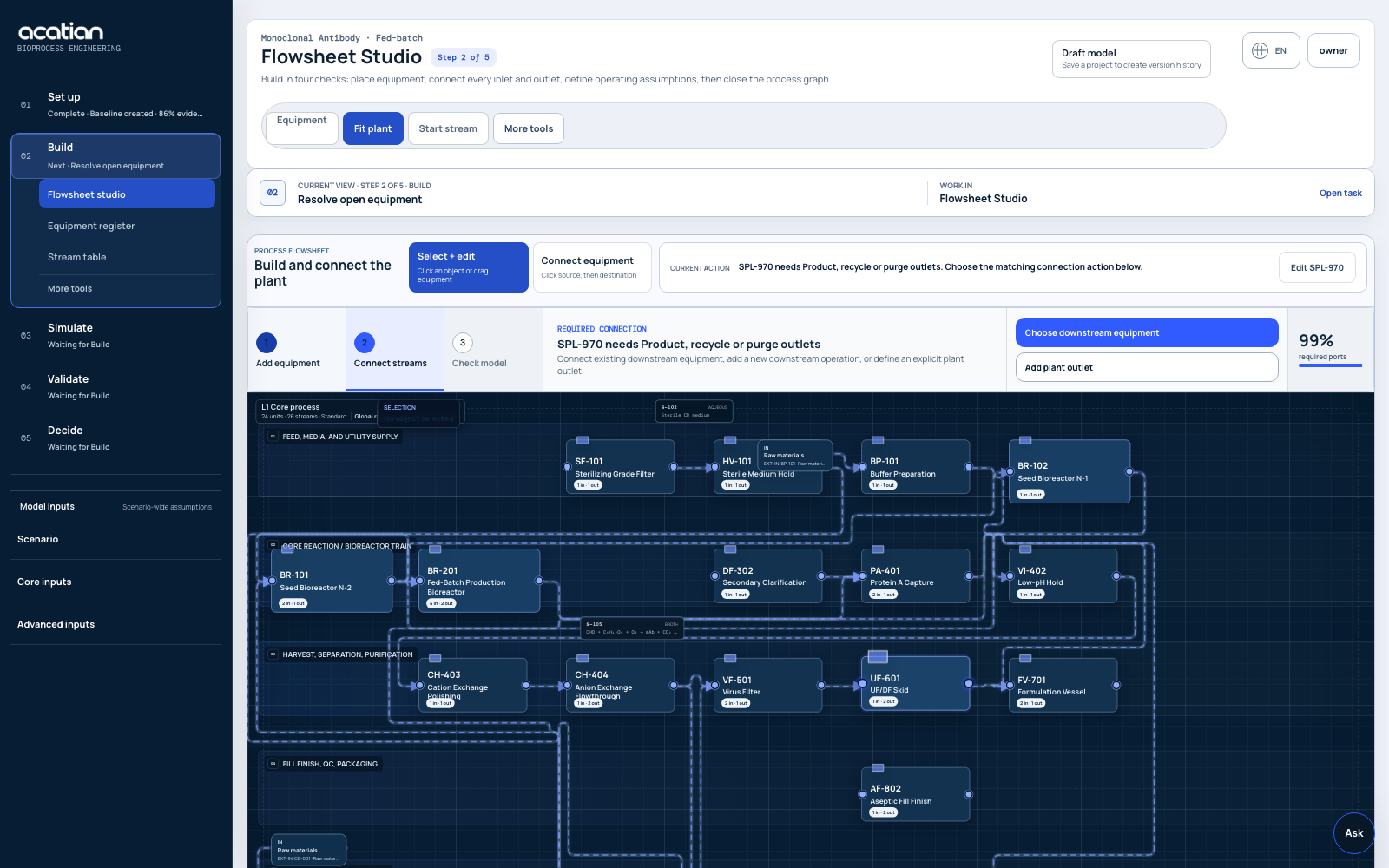
IngredientsRecipeProcessFactoryQualityResourcesDecision
Decision model
A bounded question with a complete plant consequence.
Authorised ingredient and packaging inputs through transformation, separation, concentration or drying, filling and packing, including cleaning, utilities, waste, quality holds and released output.
Equations and accounting rules
Component in = released product + by-product + waste + emissions + accumulationAccepted output = scheduled output × conformance fraction × release fractionFinite capacity requires no overlap on an exclusive line, vessel, room or shared utilityScenario value = released margin − material − conversion − changeover − resource and waste costsBase, alternative and stress cases
- Ingredient or packaging change with unchanged quality limits
- Pilot-to-factory scale-up with low/base/high process performance
- Campaign sequence, cleaning policy and line-change alternative
- Energy-recovery, water-reuse and waste-valorisation investment case
Five practical use cases
Where Acatian could support Nestlé
Each use case is a proposed evaluation scope, not a claim about current software use.Engineer recipe trade-offs on a production basis
Carry an ingredient or packaging change beyond formulation scores into mass yield, process time, equipment duty, released output, cost and environmental consequences.
Scale processes before changing the physical line
Translate laboratory or pilot evidence into operating ranges for mixing, heat transfer, concentration, drying, extrusion or fermentation while preserving uncertainty and acceptance limits.
Test factory capacity and changeovers
Schedule products, cleaning, allergen transitions, holds, labor and shared equipment to see whether a portfolio change fits the real production calendar.
Connect utilities, TEA and environmental scenarios
Propagate each process scenario into steam, cooling, electricity, water, wastewater, material cost, waste and environmental inventories on the same released-product basis.
Keep changes and evidence traceable
Link sources, assumptions, model versions, acceptance criteria and affected results so a virtual prototype or process change remains reviewable alongside existing traceability systems.
Engineering brief
Model the complete decision, not an isolated unit operation.
Nestlé publicly describes algorithmic recipe optimisation across ingredients, nutrition, cost and sustainability, virtual simulation of manufacturing settings, digital twins of production lines and digital birth certificates for process traceability. Those disclosures support a credible process-systems use-case analysis without revealing an internal model.
Acatian would sit at the engineering-decision layer: it could connect declared recipes and operating assumptions to material balances, equipment, batch or continuous timing, utilities, cost, environmental inventory and evidence. It would not replace Nestlé's product-science, food-safety, MES, consumer-research or enterprise systems.
01 · Model basis
What the Acatian model needs to resolve
Inputs, mechanisms, limits and outputs remain reviewable on one declared basis.Inputs
Recipe composition, functional targets and quality limits
Unit-operation yields, cycle times and operating envelopes
Equipment eligibility, cleaning, labor and factory calendars
Energy, water, waste, price and environmental factors
Mechanisms
Component in = released product + by-product + waste + emissions + accumulation
Accepted output = scheduled output × conformance fraction × release fraction
Finite capacity requires no overlap on an exclusive line, vessel, room or shared utility
Scenario value = released margin − material − conversion − changeover − resource and waste costs
Constraints
Food safety, nutrition, sensory and product specifications
Heat, mass transfer, residence time and equipment limits
Allergen, cleaning, changeover and quality-release rules
Water, steam, refrigeration, power and waste capacity
Outputs
Recipe-to-process scenario comparison
Feasible line schedule and accepted output
Material, water, energy and waste inventory
Cost, environmental and evidence-gap register
02 · Acatian workflow
Build it in six controlled steps
Each step creates a reviewable object, not a hidden spreadsheet assumption.- 01
Select one authorised product and factory decision.
- 02
Declare the recipe, process, quality and packaging boundary.
- 03
Connect material balances to equipment and time.
- 04
Add cleaning, release, utilities, cost and environmental factors.
- 05
Run base, alternative and stress scenarios.
- 06
Reconcile results with approved evidence and record open gaps.
03 · Decisions
Questions the model should answer
Does the new recipe remain manufacturable at the target scale?
Which line or utility becomes limiting after the change?
Does a faster cycle improve released output or move the bottleneck?
Which resource-saving option survives cost and quality constraints?
What evidence is still required before implementation?
04 · Evidence boundary
Validate before the result carries weight
Validation
Reconcile every component, elapsed step, equipment occupancy, utility peak and released-output denominator against authorised development and factory evidence. Validate changed-product and changed-scale cases independently rather than assuming one calibration transfers.
Limitations
No Nestlé recipe, site, cost, line performance, consumer result or internal digital architecture is represented. Food safety, regulatory, sensory, automation and investment decisions remain under Nestlé's qualified processes.
Public evidence
What the company context supports—and what it does not.
Sources establish the public process architecture. They do not reveal private operating parameters, site performance or an Acatian relationship.- Nestlé — Digital innovationOfficial context for recipe optimisation, virtual manufacturing simulation, production-line digital twins and digital birth certificates.
- Nestlé — R&D for sustainabilityOfficial context for process efficiency, lower-impact product and packaging innovation, energy recovery and resource decisions.
Frequently asked questions
Practical modelling questions
Is Nestlé an Acatian customer?
Not to Acatian's knowledge. This independent article describes five hypothetical uses based only on cited public information. It claims no affiliation, endorsement, deployment, confidential data or actual plant performance.
Does the article reproduce a real company model?
No. Unreported recipes, equipment, schedules, costs and performance values must remain explicit assumptions until the company supplies authorised evidence for a bounded project.
How would a real evaluation start?
Select one company-owned process decision, agree the system boundary and acceptance criteria, import only authorised evidence, and compare Acatian results with an approved reference before expanding the scope.