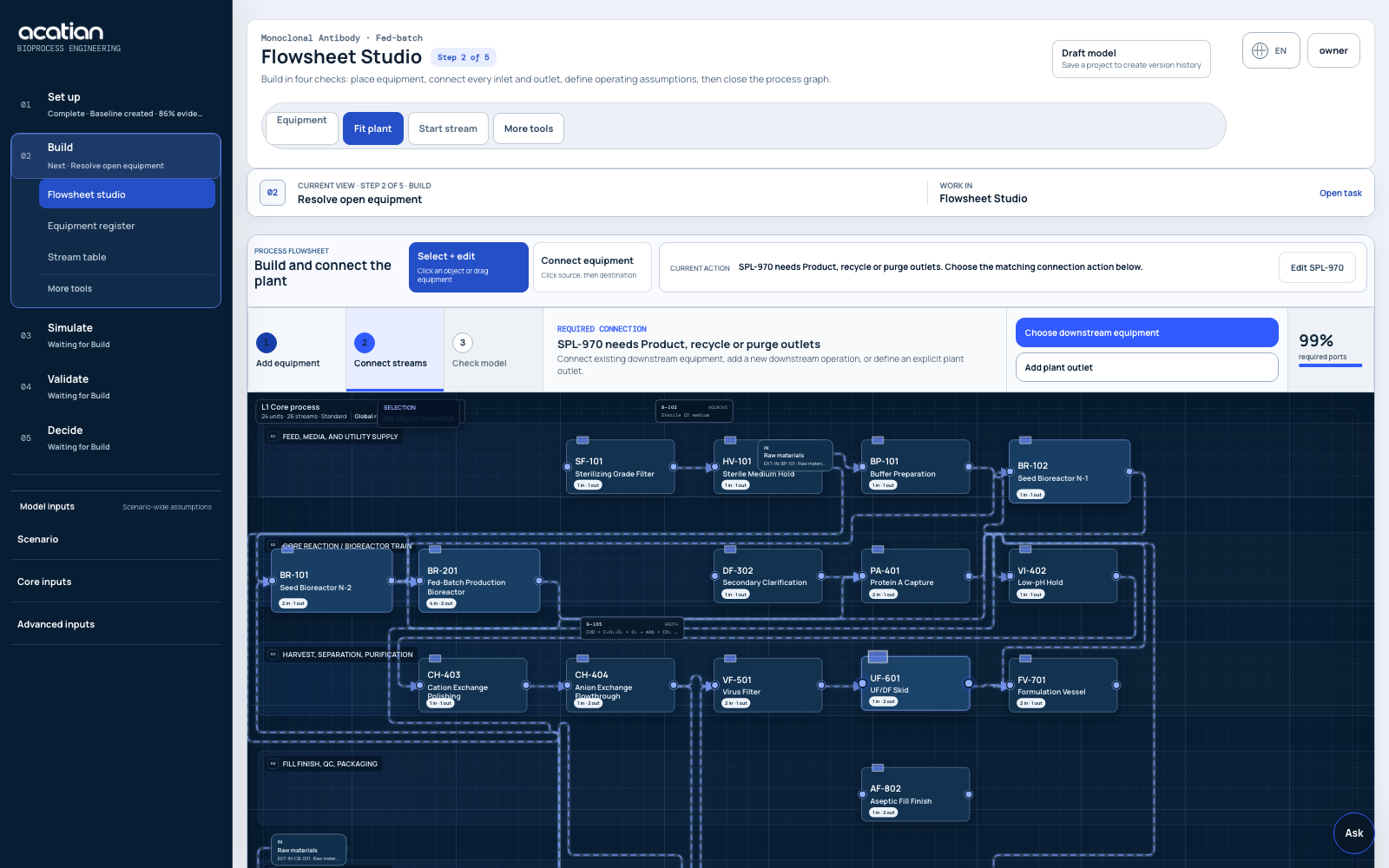
Teaching mechanistic bioprocess modelling through a transparent process balance.
Students understand a factory model when they can move from conservation equations to streams, unit operations, uncertainty, equipment limits and an engineering decision.
A flowsheet makes equations inspectable: every inlet, outlet, reaction, loss and assumption has a physical location.01
Learning design
Make the model explain the process, not just produce an answer.
Conservation
Students define a component basis and apply input + generation − output − consumption = accumulation. They distinguish total mass closure from component closure and explain how reaction stoichiometry changes composition without creating total mass.
Mechanism
Each equation must point to a physical mechanism: growth, conversion, separation, hold-up, evaporation or loss. Parameters carry units, sources, uncertainty and a validity domain instead of appearing as unexplained constants.
Decision
The final question is operational: which assumption controls product recovery, waste, equipment duty or schedule? Students compare scenarios and state what new evidence would change the conclusion.
90-minute exercise
Reconcile fermentation, clarification and sterile filtration.
The supplied dataset is synthetic and deliberately small enough to audit by hand before students reproduce it in software.
0–20 min · define
Identify water, substrate, biomass and product components. Mark given, calculated and assumed values. Confirm that the fermentation receives 1,050 kg in total and declare whether the exercise is steady-state or dynamic.
20–55 min · calculate
Reconcile the fermentation to 1,035 kg harvest plus 15 kg vent and evaporation. Carry the harvest into clarification, verify 945 kg clarified pool plus 90 kg wet solids, then close the 930 kg filtered pool and 15 kg filter hold-up and waste.
55–90 min · challenge
Calculate product recovery and biomass removal at each step. Vary evaporation and filter hold-up, identify which outputs move and propose the measurement that would reduce decision uncertainty most efficiently.
CriterionEvidence in the submissionCommon failure
BasisNamed components, system boundary, time basis and unitsMixing batch totals with rates or annual values
ClosureTotal and per-component residuals for every operationReporting only plant-wide closure that hides a local error
MechanismEach conversion or loss mapped to a physical explanationUsing a fitted factor without a validity domain
UncertaintyScenario range, source and proposed discriminating measurementTreating an assumption as measured evidence
DecisionOne conclusion tied to an explicit acceptance criterionPresenting a calculation without an engineering question
04
Frequently asked questions
Teach the model as a claim with evidence and limits.
Does mechanistic modelling exclude data-driven methods?
No. Mechanistic balances encode conservation and known process structure; data can estimate parameters, quantify residuals and test validity. The important teaching point is to identify what comes from physics, data and assumption.
Can an instructor evaluate Acatian before discussing a campus licence?
Yes. A 14-day teaching evaluation can be requested for a defined course, lab or student-project use case. Scope, data rights and access are agreed before the account is provisioned.
Downloadable classroom datasetThe CSV contains the three operations, four components, evidence class and a student task for each stream.Download the teaching exercise
Curriculum contextABET engineering criteria emphasize experimentation, data interpretation, engineering design, communication and learning. This exercise can support those outcomes; it does not by itself establish accreditation compliance.Review the ABET criteria