Carbon source composition and trace nutrients
Citric acid · industrial fermentation
How to model citric acid fermentation in Acatian
Relate morphology, oxygen demand and substrate conversion to broth handling, purification and crystallization capacity.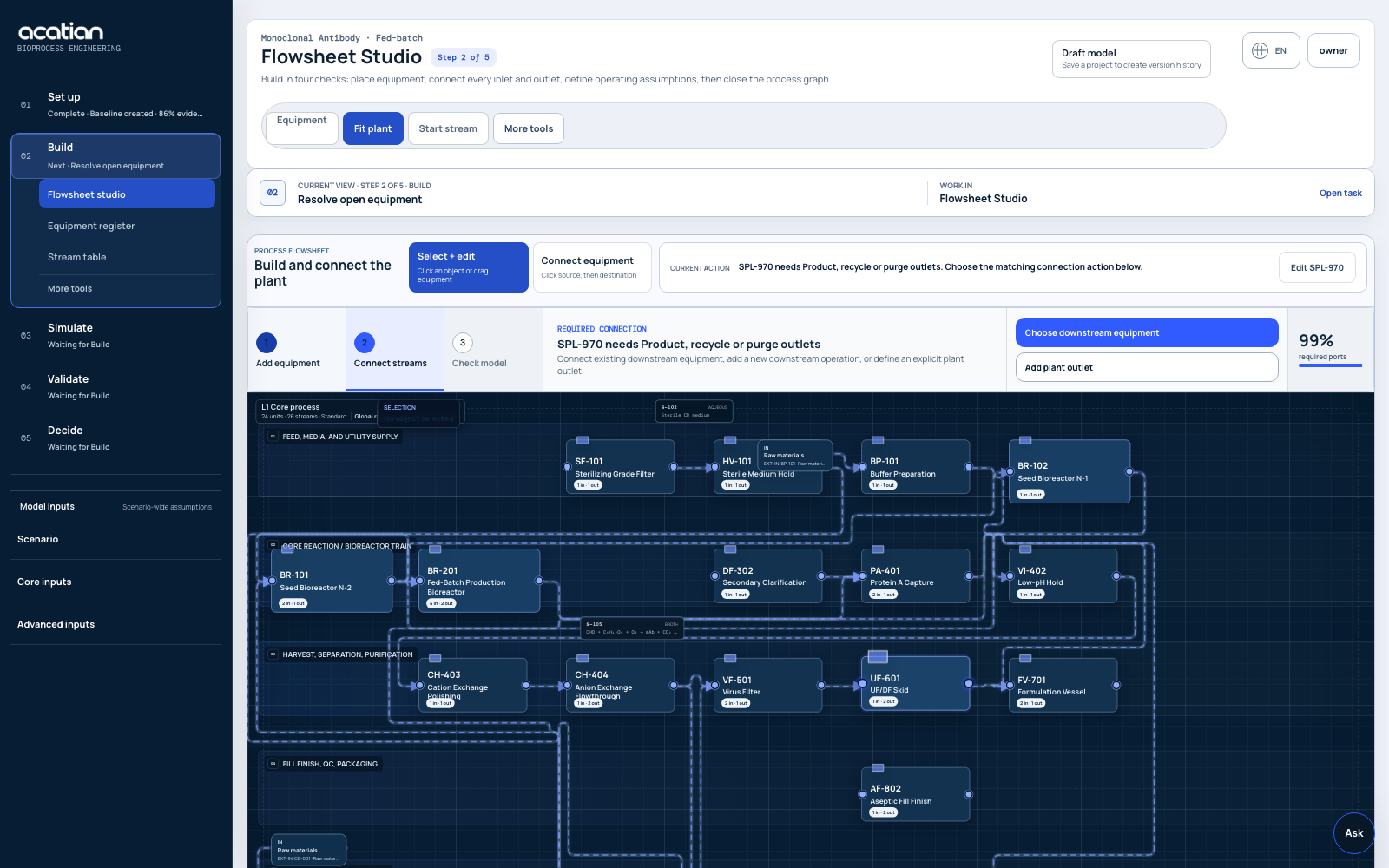
Feed prepInoculumFermentationBiomass removalPurificationCrystallizationDrying
Engineering brief
Model the complete decision, not an isolated unit operation.
Industrial citric acid production links fungal fermentation to a recovery sequence with significant solid-liquid, water and energy duty. Acatian keeps yield, titer, batch time and recovery assumptions attached to the same flowsheet.
Morphology, trace nutrients, oxygen transfer and impurity formation affect both production and broth filterability. A decision model should surface those interactions instead of applying one overall yield.
01 · Model basis
What the Acatian model needs to resolve
Inputs, mechanisms, limits and outputs remain reviewable on one declared basis.Inputs
Growth, acid production, morphology and batch time
Aeration, agitation, heat and foam evidence
Filtration, purification, crystallization and drying data
Mechanisms
Substrate, biomass and product balances
Dynamic oxygen and heat constraints
Biomass and impurity separation
Solubility, mother liquor and crystal yield accounting
Constraints
Morphology and broth rheology
Oxygen transfer and cooling
Filtration rate and impurity load
Crystallizer and dryer capacity
Outputs
Citric acid yield, titer and productivity
Peak oxygen, heat and air demand
Recovery yield, recycle and waste
Annual output and cost sensitivity
02 · Acatian workflow
Build it in six controlled steps
Each step creates a reviewable object, not a hidden spreadsheet assumption.- 01
Define raw-material and product assays.
- 02
Calibrate production and morphology proxies.
- 03
Evaluate transfer and cooling over time.
- 04
Build filtration and purification steps.
- 05
Close crystallization and drying balances.
- 06
Schedule trains and test sensitivities.
03 · Decisions
Questions the model should answer
Which fermentation variable controls filterability?
Where does oxygen or heat constrain scale?
How much mother liquor should recycle?
Which yield improvement increases saleable crystals?
04 · Evidence boundary
Validate before the result carries weight
Validation
Use independent batches to verify titer, morphology proxy, gas demand, heat removal, filtration performance, crystal recovery and purity.
Limitations
Crystallization screening requires product-specific phase and impurity evidence before detailed design.
Frequently asked questions
Practical modelling questions
Can morphology effects be represented?
Yes, as measured or calibrated relationships to viscosity, oxygen demand and separation performance, with the evidence range stated.
Can crystallization be linked to fermentation impurities?
Yes. Impurity and mother-liquor assumptions can remain in the component ledger.
Can alternative carbon sources be compared?
Yes, with composition, pretreatment, conversion, price and variability kept explicit.