Activity assay, titer, productivity and stability
Industrial enzymes · production model
How to model industrial enzyme production in Acatian
Translate activity, titer and recovery into formulated product, equipment demand, utility load and COGS.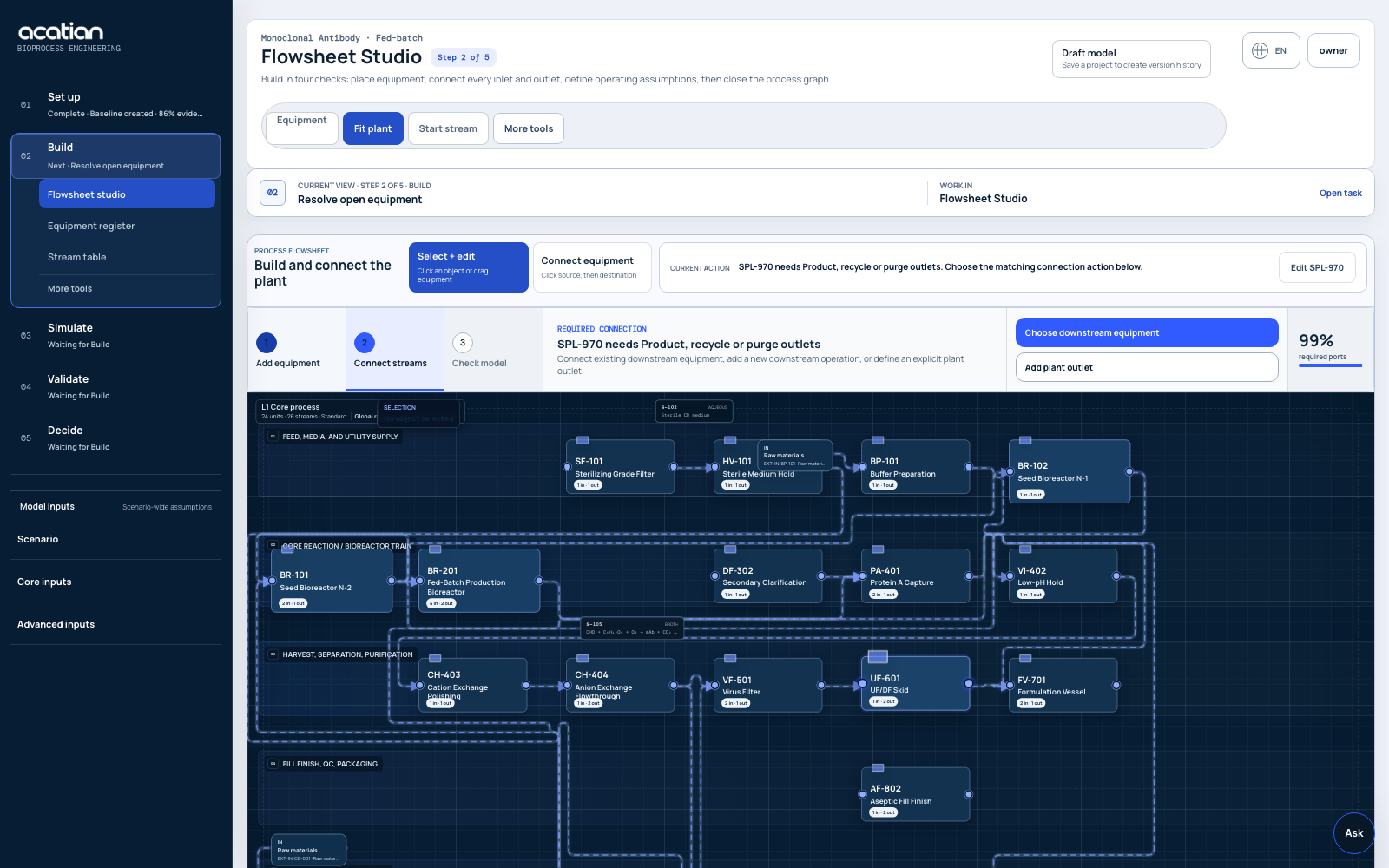
MediaSeedFermentationClarificationConcentrationFormulationPack
Engineering brief
Model the complete decision, not an isolated unit operation.
Enzyme manufacturing is governed by activity and formulation specification, not mass alone. Acatian can retain enzyme activity, impurities, solids, water and formulation components through the flowsheet while also closing the physical mass balance.
The model makes upstream and downstream trade-offs visible: a titer improvement may reduce fermentation capacity but alter viscosity, clarification or concentration duty.
01 · Model basis
What the Acatian model needs to resolve
Inputs, mechanisms, limits and outputs remain reviewable on one declared basis.Inputs
Media and fermentation recipe
Cell and solids properties, clarification performance
UF concentration, stabilizer, drying and formulation specification
Mechanisms
Fermentation state and activity balances
Solids removal and yield accounting
Membrane concentration and diafiltration
Activity loss, blending and packaging basis
Constraints
Broth rheology and oxygen transfer
Clarifier or filter solids loading
Membrane flux and product passage
Thermal and storage stability
Outputs
Activity units per batch and per year
Step yield and activity loss
Equipment, water and energy demand
COGS per activity unit and sensitivity
02 · Acatian workflow
Build it in six controlled steps
Each step creates a reviewable object, not a hidden spreadsheet assumption.- 01
Define the saleable activity specification.
- 02
Build component and activity ledgers.
- 03
Calibrate fermentation and stability.
- 04
Model solids removal and concentration.
- 05
Add formulation, drying and packaging.
- 06
Schedule campaigns and compare cost scenarios.
03 · Decisions
Questions the model should answer
Is titer or activity recovery more valuable?
Liquid concentrate or dried formulation?
Which step causes the largest activity loss?
How does broth variability affect plant capacity?
04 · Evidence boundary
Validate before the result carries weight
Validation
Check activity as well as mass across independent fermentation, recovery and stability studies. Confirm flux, fouling and drying assumptions at representative scale.
Limitations
The model does not replace product-specific safety, regulatory, allergen, containment or quality validation.
Frequently asked questions
Practical modelling questions
Can activity units be tracked separately from mass?
Yes. A model can track both a physical component balance and product activity with step-specific decay or loss.
Can secreted and intracellular enzymes be compared?
Yes. Cell disruption, solids load and recovery architecture remain explicit.
Can liquid and powder products be compared?
Yes. Formulation, evaporation or drying, stability, packaging and energy can share one annual basis.