Decision and deliverable required
Software evaluation · Roebling / Röbling
Is Acatian a Roebling alternative? Compare the delivery models
A source-linked comparison for teams choosing between an expert-led engineering engagement and a browser-based workspace they operate directly.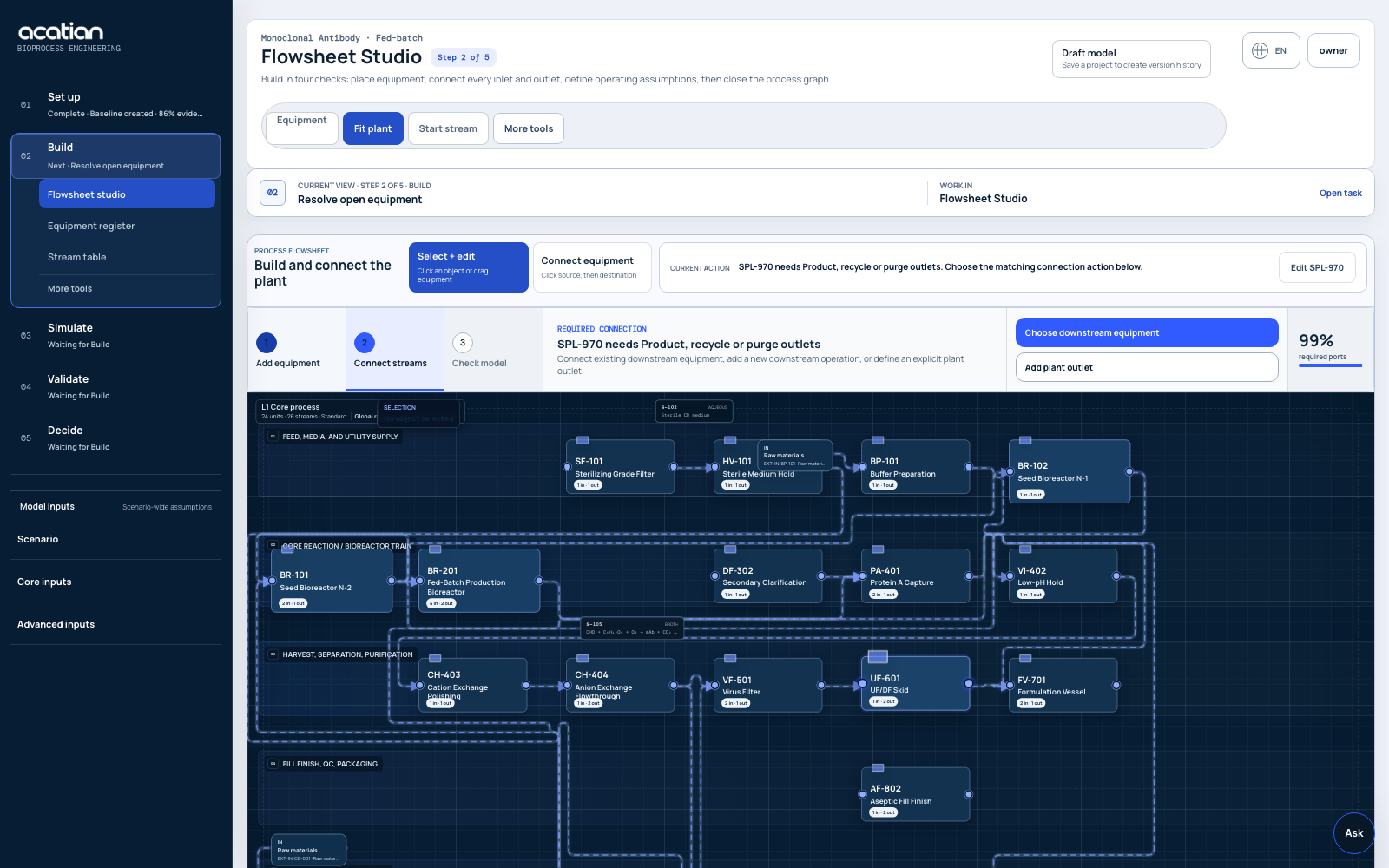
Process basisScale-upFacilityTEAEvidenceCollaborationDecision
Engineering brief
Model the complete decision, not an isolated unit operation.
Roebling publicly describes an expert-led, AI-native engineering approach spanning process scale-up, techno-economics and capital-project definition. Acatian is a browser-based engineering workspace in which customer teams build, version and review their own connected process model.
The two offers can overlap in early bioprocess and facility decisions, but they are not identical substitutes. Procurement should compare the required deliverable, responsibility, access to the live model, validation evidence and need for engineering services.
01 · Model basis
What the Acatian model needs to resolve
Inputs, mechanisms, limits and outputs remain reviewable on one declared basis.Inputs
Available process data and internal modelling capability
Need for expert engineering services
Collaboration, governance and deployment requirements
Mechanisms
Acatian: customer-operated browser workspace
Roebling: publicly described expert-led engineering offer
Both: process, facility and economic reasoning
Different contracting, responsibility and delivery boundaries
Constraints
Internal skills and review ownership
Data sensitivity and integration
Required engineering certification or deliverables
Model access, change control and handover
Outputs
A documented evaluation matrix
One authorized benchmark process
Acceptance criteria for balances and economics
A clear software-versus-services decision
02 · Acatian workflow
Build it in six controlled steps
Each step creates a reviewable object, not a hidden spreadsheet assumption.- 01
Define the decision and required deliverable.
- 02
Ask each provider to state scope and exclusions.
- 03
Use one authorized reference process.
- 04
Compare balances, scale-up, schedule and economics.
- 05
Review evidence, governance and model access.
- 06
Choose the delivery model that fits responsibility.
03 · Decisions
Questions the model should answer
Do we need software, engineering services or both?
Who will maintain the live model?
Which deliverables require qualified engineering review?
How will results be validated and handed over?
04 · Evidence boundary
Validate before the result carries weight
Validation
Run a controlled benchmark with agreed inputs and tolerances. Verify current commercial scope, security, services and contract terms directly with each provider before procurement.
Limitations
Acatian publishes this comparison and has a commercial interest in the evaluation. Acatian is not affiliated with Roebling. Roebling and Röbling may be used as search variants, but Roebling is the company spelling.
Frequently asked questions
Practical modelling questions
Is Acatian the same as Roebling?
No. Acatian is a customer-operated browser workspace; Roebling publicly presents an expert-led engineering offer. Their scope can overlap, but delivery and responsibility differ.
Why is Röbling mentioned?
Some users type Röbling when searching for Roebling. This page uses Roebling as the correct company spelling.
How should the tools be compared?
Use an authorized process, pre-agreed acceptance criteria and direct vendor confirmation rather than marketing claims alone.