Oil composition, FFA, moisture and delivered cost
Biodiesel · chemical process model
How to model a biodiesel plant in Acatian
Connect feed quality and reaction chemistry to separation, methanol recovery, product specification, utilities and plant economics.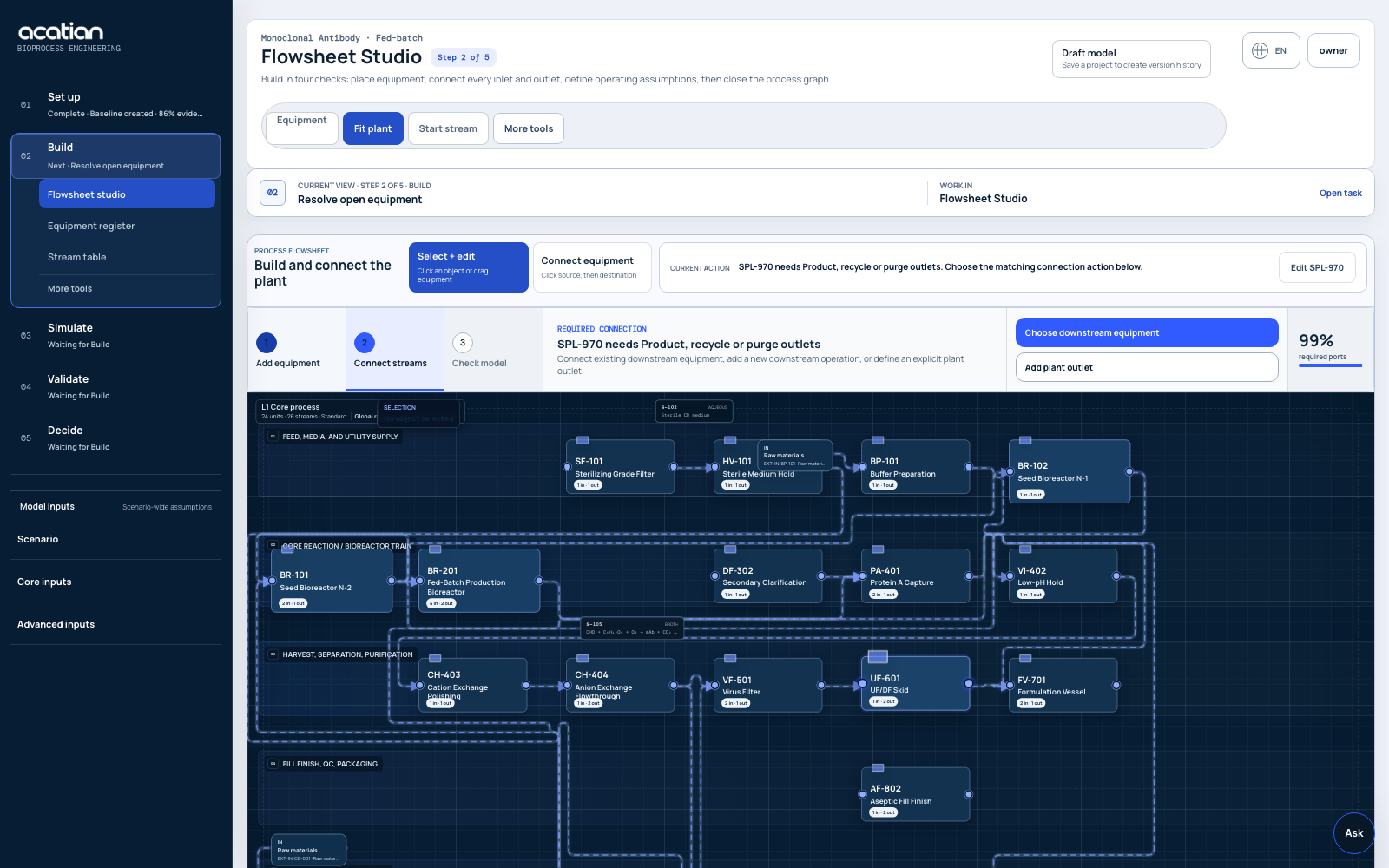
Oil receiptPretreatmentReactionPhase splitPurificationMethanol recoveryProducts
Engineering brief
Model the complete decision, not an isolated unit operation.
Biodiesel performance depends strongly on oil quality. Acatian can distinguish triglycerides, free fatty acids, water, catalyst, alcohol, esters, glycerol and impurities so pretreatment and downstream separation remain visible.
The model can compare homogeneous or alternative catalytic routes without collapsing product, glycerol, methanol recovery, wash water and waste into a single conversion factor.
01 · Model basis
What the Acatian model needs to resolve
Inputs, mechanisms, limits and outputs remain reviewable on one declared basis.Inputs
Alcohol ratio, catalyst, conversion and residence time
Settling, centrifugation, washing or dry-purification data
Methanol recovery, glycerol quality and fuel specification
Mechanisms
Reaction stoichiometry and conversion
Liquid-liquid phase and component allocation
Alcohol recycle and purge convergence
Heating, separation and utility balances
Constraints
FFA and water limits
Soap/emulsion formation and separation
Methanol recovery and safety
Fuel and glycerol product specifications
Outputs
Biodiesel yield, purity and feed demand
Alcohol, catalyst, wash and energy use
Glycerol and waste streams
Throughput, cost and feedstock sensitivity
02 · Acatian workflow
Build it in six controlled steps
Each step creates a reviewable object, not a hidden spreadsheet assumption.- 01
Define feed assay and product specifications.
- 02
Add pretreatment for FFA and water.
- 03
Close reaction stoichiometry by component.
- 04
Model phase split and purification.
- 05
Converge methanol recovery and recycle.
- 06
Evaluate capacity, TEA and uncertainty.
03 · Decisions
Questions the model should answer
Which feed quality needs pretreatment?
Which purification route fits the water boundary?
How valuable is methanol recovery?
What feed-price range preserves margin?
04 · Evidence boundary
Validate before the result carries weight
Validation
Reconcile conversion, ester specification, phase yields, residual methanol, catalyst loss, energy and elapsed time against representative feed lots.
Limitations
The process model does not replace flammability, pressure, hazardous-area, materials, emissions or fuel-certification engineering.
Frequently asked questions
Practical modelling questions
Can waste oils be modelled?
Yes. FFA, water and impurities should be measured and routed through explicit pretreatment and uncertainty cases.
Can methanol recycle be closed?
Yes. Recovery, purity, purge and makeup can be iterated to a declared convergence tolerance.
Can coproduct glycerol be valued?
Yes, but its composition, purification need, sale assumption and uncertainty should be explicit.