Carbohydrate fractions, moisture, solids and inhibitors
Bioethanol · integrated plant model
How to model a bioethanol plant in Acatian
Trace carbon from variable feedstock through hydrolysis and fermentation to dehydrated ethanol, coproducts and stillage treatment.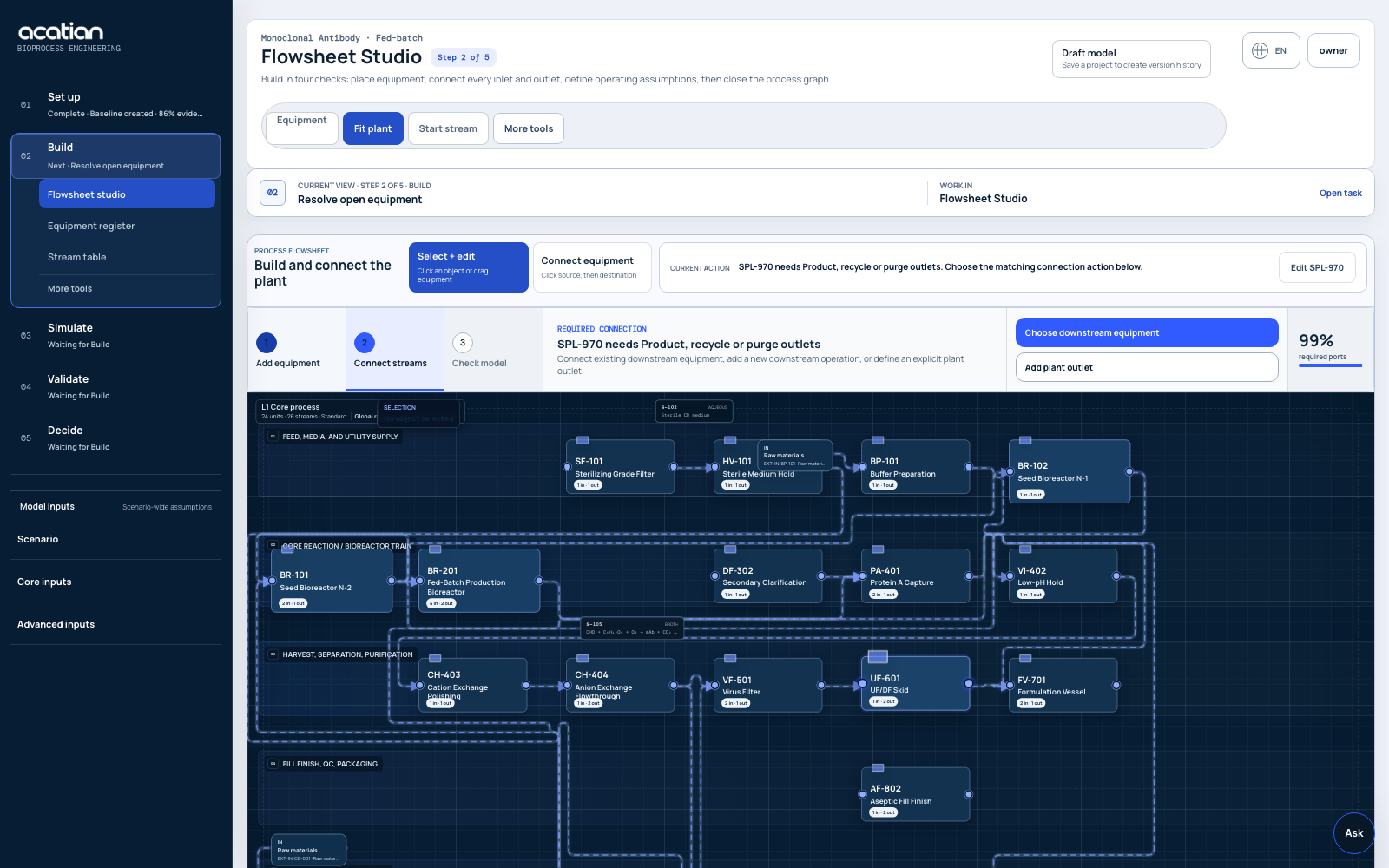
MillingPretreatmentHydrolysisFermentationDistillationDehydrationStillage
Engineering brief
Model the complete decision, not an isolated unit operation.
Bioethanol economics couple biological conversion to a heat-intensive recovery train. Acatian lets the fermentation trajectory determine ethanol concentration, fermenter occupancy and the downstream mass and energy load instead of treating each step as a disconnected estimate.
For starch, sugar or lignocellulosic routes, the design basis must distinguish fermentable sugars, insoluble solids, inhibitors, water, nutrients and coproduct streams. This exposes whether yield, titer, cycle time or steam demand controls the case.
01 · Model basis
What the Acatian model needs to resolve
Inputs, mechanisms, limits and outputs remain reviewable on one declared basis.Inputs
Hydrolysis conversion and enzyme demand
Sugar uptake, ethanol yield, productivity and inhibition
Distillation targets, molecular-sieve duty and stillage route
Mechanisms
Hydrolysis and fermentation component balances
Dynamic sugar, biomass and ethanol states
Vapor-liquid recovery duties and water removal
Coproduct, recycle and wastewater reconciliation
Constraints
Pretreatment severity and inhibitor formation
Ethanol inhibition and contamination allowance
Fermenter turns and seed capacity
Steam, cooling and dehydration capacity
Outputs
Ethanol titer, yield and volumetric productivity
Fermenter count and annual production
Steam, cooling, water and stillage loads
Cost and footprint sensitivity to yield and titer
02 · Acatian workflow
Build it in six controlled steps
Each step creates a reviewable object, not a hidden spreadsheet assumption.- 01
Define feedstock assay and product specification.
- 02
Map pretreatment and hydrolysis conversions by component.
- 03
Calibrate fermentation states and batch events.
- 04
Close distillation, dehydration and stillage balances.
- 05
Add cleaning, turnaround and utility schedules.
- 06
Compare feedstock, titer and heat-integration scenarios.
03 · Decisions
Questions the model should answer
Is higher titer worth a yield trade-off?
How many fermenters support the distillation train?
Where should water and heat be recovered?
Which feedstock assay drives downside risk?
04 · Evidence boundary
Validate before the result carries weight
Validation
Use measured hydrolysate, fermentation and column data from independent runs. Check carbon closure, ethanol recovery, steam duty and plant time before using the model for investment decisions.
Limitations
Screening calculations do not establish food, fuel, pressure-system, environmental or explosion-safety compliance.
Frequently asked questions
Practical modelling questions
Can Acatian represent simultaneous saccharification and fermentation?
Yes. SSF can be expressed as coupled hydrolysis and fermentation states with temperature, enzyme and inhibition assumptions.
Can starch and lignocellulosic routes be compared?
Yes, when both use a consistent product, time, cost and system boundary.
Can distillation energy be linked to fermentation titer?
Yes. The recovered broth composition drives separation and utility assumptions in the same model.